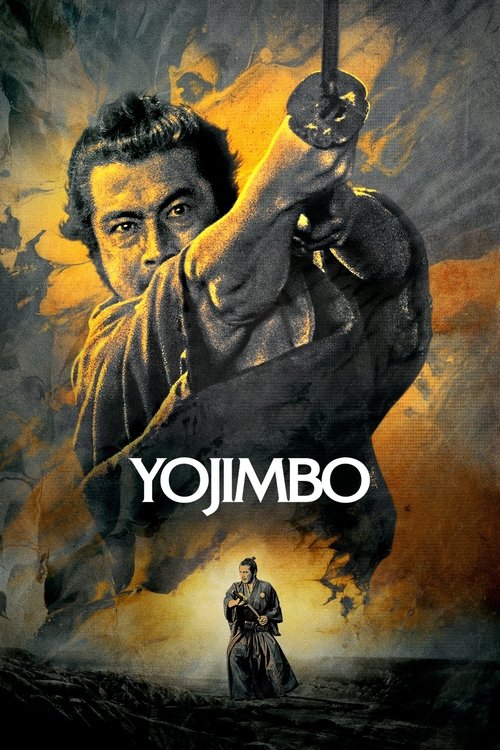
Yojimbo
1961 · Directed by Akira Kurosawa
Woke Score
CriticCritic Score
Audience
Ultra Based
Critics rated this 93 points above its woke score. Among Ultra Based films, this critic score ranks #85 of 1469.
Representation Casting
Score: 0/100
The film features an all-male ensemble cast in significant roles with female characters relegated to minor, traditionally subordinate positions.
LGBTQ+ Themes
Score: 0/100
No LGBTQ+ themes, representation, or relationships present in the narrative.
Feminist Agenda
Score: 0/100
No feminist agenda or progressive commentary on gender. Female characters serve traditional roles without critique.
Racial Consciousness
Score: 0/100
The film is set in feudal Japan with an entirely Japanese cast, with no engagement with modern racial consciousness or identity politics.
Climate Crusade
Score: 0/100
No environmental messaging or climate-related themes present in the film.
Eat the Rich
Score: 0/100
While the narrative involves merchant competition, there is no anti-capitalist ideology or critique of wealth accumulation.
Body Positivity
Score: 0/100
No body positivity messaging or commentary on bodies and appearance present.
Neurodivergence
Score: 0/100
No representation of neurodivergent characters or conditions.
Revisionist History
Score: 0/100
The film does not rewrite history through a contemporary progressive lens.
Lecture Energy
Score: 0/100
The narrative unfolds through action and character behavior rather than preachy exposition or moral lectures.


Synopsis
A nameless ronin, or samurai with no master, enters a small village in feudal Japan where two rival businessmen are struggling for control of the local gambling trade. Taking the name Sanjuro Kuwabatake, the ronin convinces both silk merchant Tazaemon and sake merchant Tokuemon to hire him as a personal bodyguard, then artfully sets in motion a full-scale gang war between the two ambitious and unscrupulous men.
Consciousness Assessment
Yojimbo stands as a masterwork of visual storytelling and narrative economy, a film that accomplishes more through gesture and composition than most contemporary works achieve with exposition. Kurosawa's direction transforms a straightforward premise, a masterless samurai inserting himself into a merchant conflict, into a sophisticated meditation on corruption and human nature. Toshiro Mifune's performance carries the film with barely a word spoken, his physicality and expressions doing the narrative labor that lesser films require pages of dialogue to accomplish. The film's pleasures are entirely aesthetic and structural: the precise choreography of violence, the careful manipulation of mise-en-scene, the quiet comedy of watching a man play two sides against each other with methodical patience.
What deserves emphasis is the film's complete indifference to any contemporary social consciousness. The narrative exists in a feudal Japanese setting rendered with historical specificity but no modern sensibility whatsoever. The female characters appear peripherally, their roles dictated by historical period and genre convention rather than by any statement about gender. The samurai code and the merchant economy are observed without ideological commentary. The film's cynicism about human greed and violence emerges from its plot mechanics rather than from any attempt to lecture the audience about capitalism or corruption.
This is not a deficiency but rather a stylistic clarity that allows the film to achieve its effects. Yojimbo succeeds precisely because it refuses to burden its narrative with messages or contemporary moral frameworks. The film trusts viewers to observe the behavior of its characters and draw their own conclusions about what such behavior reveals. This approach, now six decades old, remains a rebuke to cinema that subordinates story to sermon.
Analysis generated by our Consciousness Algorithm
Critic Reviews
“[Kurosawa] was deliberately combining the samurai story with the Western, so that the wind-swept main street could be in any frontier town, the samurai (Toshiro Mifune) could be a gunslinger, and the local characters could have been lifted from John Ford's gallery of supporting actors.”
“Less visceral than the battle scene in Seven Samurai, this is more of a free-for-all, with brute force leaving no room for skill.”
“Yojimbo does not cause viewers to ponder deep issues in the way Rashomon does, nor does it possess the epic grandness of The Seven Samurai, yet it must still be considered in the top tier of Kurosawa's films. Stylish, compelling, and involving, it became as much a blueprint for future productions as it is an homage to past ones.”
“As in most Westerns, the dramatic penetration is not deep, and the plot complications are many and hard to follow in Japanese. Kurosawa is here showing more virtuosity than strength. Yojimbo is a long way (in the wrong direction) from his brilliant Rashomon.”
Consciousness Markers
The film features an all-male ensemble cast in significant roles with female characters relegated to minor, traditionally subordinate positions.
No LGBTQ+ themes, representation, or relationships present in the narrative.
No feminist agenda or progressive commentary on gender. Female characters serve traditional roles without critique.
The film is set in feudal Japan with an entirely Japanese cast, with no engagement with modern racial consciousness or identity politics.
No environmental messaging or climate-related themes present in the film.
While the narrative involves merchant competition, there is no anti-capitalist ideology or critique of wealth accumulation.
No body positivity messaging or commentary on bodies and appearance present.
No representation of neurodivergent characters or conditions.
The film does not rewrite history through a contemporary progressive lens.
The narrative unfolds through action and character behavior rather than preachy exposition or moral lectures.