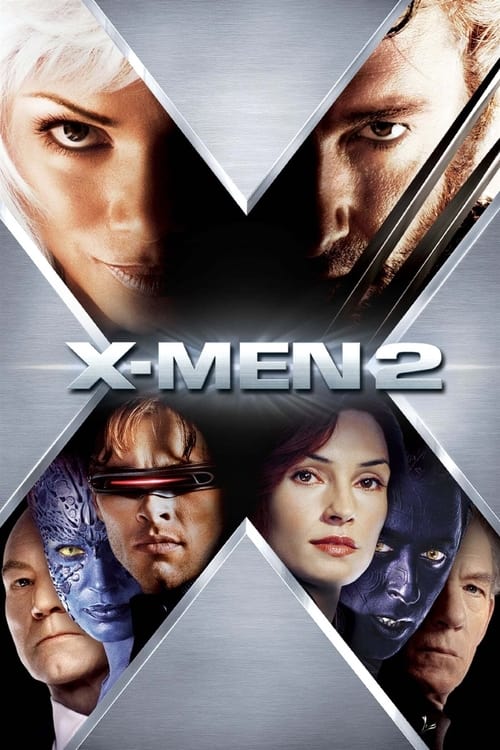
X2
2003 · Directed by Bryan Singer
Woke Score
CriticCritic Score
Based
Critics rated this 52 points above its woke score. Among Based films, this critic score ranks #126 of 345.
Representation Casting
Score: 45/100
The ensemble features Halle Berry as Storm, Rebecca Romijn as Mystique, and Alan Cumming as Nightcrawler, providing visible diversity. However, this appears to reflect 2000s casting norms rather than a deliberate statement about representation.
LGBTQ+ Themes
Score: 15/100
Alan Cumming's Nightcrawler may read as coded queer to contemporary audiences, but the film makes no explicit engagement with LGBTQ themes. Any subtext remains unexamined by the narrative.
Feminist Agenda
Score: 20/100
Jean Grey and Storm are active participants in the ensemble, but the film does not center feminist ideology or examine gender dynamics. They function as team members rather than as subjects of feminist analysis.
Racial Consciousness
Score: 35/100
The mutant persecution plot carries echoes of civil rights allegory, and casting includes Black and Latinx actors. However, the film does not explicitly engage with racial themes or acknowledge race as a distinct category within its metaphor.
Climate Crusade
Score: 0/100
No climate-related themes or environmental consciousness appear in the film. The narrative is entirely divorced from ecological concerns.
Eat the Rich
Score: 10/100
While the plot involves a military-industrial conspiracy, the film does not mount any sustained critique of capitalism or wealth accumulation. The villain's motivation is ideological rather than economic.
Body Positivity
Score: 5/100
The film features conventionally attractive actors in standard superhero physiques. No engagement with body diversity, disability representation, or body acceptance rhetoric appears.
Neurodivergence
Score: 0/100
No characters are presented as neurodivergent, and no themes related to neurodiversity appear in the narrative. Professor Xavier's telepathy is portrayed as a superpower, not a neurodivergent trait.
Revisionist History
Score: 0/100
The film contains no historical revisionism or reexamination of historical events. It is set in a fictional universe with no claims to historical accuracy.
Lecture Energy
Score: 15/100
While characters discuss persecution and acceptance, the film does not adopt a preachy tone or attempt to educate the audience about social issues. Philosophical dialogue remains in service to plot and character.


Synopsis
Professor Charles Xavier and his team of genetically gifted superheroes face a rising tide of anti-mutant sentiment led by Col. William Stryker. Storm, Wolverine and Jean Grey must join their usual nemeses, Magneto and Mystique, to unhinge Stryker's scheme to exterminate all mutants.
Consciousness Assessment
X2 arrives from an era before contemporary progressive sensibilities calcified into their current form, and it shows. The film operates on a fundamentally different register from modern genre cinema, interested in persecution and difference primarily as metaphor for general human conflict rather than as a vehicle for explicit cultural commentary. The mutant allegory, while thematically resonant, remains too diffuse to qualify as targeted social consciousness, and the narrative's focus is action-adventure spectacle rather than examination of systemic power structures. What emerges is a competent blockbuster that happens to feature a diverse ensemble cast, but the film neither labors to celebrate this diversity nor interrogates it with particular intention. The representation feels incidental to the story, a natural consequence of superhero team dynamics rather than a conscious statement about whose voices belong in cinema. Bryan Singer's direction prioritizes kinetic momentum over cultural interrogation, and the film makes no particular effort to lecture its audience about social matters. This is not to say the film is retrograde; it is simply to note that it operates in a different conceptual universe from the one we now inhabit. For the purposes of measuring contemporary cultural markers, X2 registers as a period piece, interesting precisely because it demonstrates how recently the entire apparatus of modern progressive filmmaking came into being.
Analysis generated by our Consciousness Algorithm
Critic Reviews
“It's well-done sci-fi action-adventure that honors its pulp origins but doesn't depend on them.”
“A diverting mix of insight and spectacle, human and superhuman.”
“X2 sparkles with a lightness of spirit that was missing from 'X-Men.'”
“The movie is overplotted, a soulless maze of special effects and relentless action.”
Consciousness Markers
The ensemble features Halle Berry as Storm, Rebecca Romijn as Mystique, and Alan Cumming as Nightcrawler, providing visible diversity. However, this appears to reflect 2000s casting norms rather than a deliberate statement about representation.
Alan Cumming's Nightcrawler may read as coded queer to contemporary audiences, but the film makes no explicit engagement with LGBTQ themes. Any subtext remains unexamined by the narrative.
Jean Grey and Storm are active participants in the ensemble, but the film does not center feminist ideology or examine gender dynamics. They function as team members rather than as subjects of feminist analysis.
The mutant persecution plot carries echoes of civil rights allegory, and casting includes Black and Latinx actors. However, the film does not explicitly engage with racial themes or acknowledge race as a distinct category within its metaphor.
No climate-related themes or environmental consciousness appear in the film. The narrative is entirely divorced from ecological concerns.
While the plot involves a military-industrial conspiracy, the film does not mount any sustained critique of capitalism or wealth accumulation. The villain's motivation is ideological rather than economic.
The film features conventionally attractive actors in standard superhero physiques. No engagement with body diversity, disability representation, or body acceptance rhetoric appears.
No characters are presented as neurodivergent, and no themes related to neurodiversity appear in the narrative. Professor Xavier's telepathy is portrayed as a superpower, not a neurodivergent trait.
The film contains no historical revisionism or reexamination of historical events. It is set in a fictional universe with no claims to historical accuracy.
While characters discuss persecution and acceptance, the film does not adopt a preachy tone or attempt to educate the audience about social issues. Philosophical dialogue remains in service to plot and character.