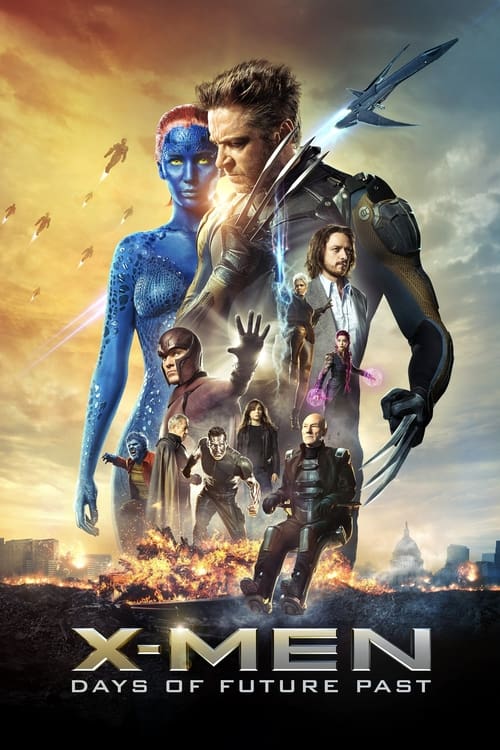
X-Men: Days of Future Past
2014 · Directed by Bryan Singer
Woke Score
CriticCritic Score
Audience
Based
Critics rated this 37 points above its woke score. Among Based films, this critic score ranks #115 of 345.
Representation Casting
Score: 55/100
The ensemble features several actors of color in meaningful roles, including Halle Berry and Omar Sy, though their screen time remains limited. The casting reflects contemporary Hollywood diversity standards without appearing to center on representation as a narrative concern.
LGBTQ+ Themes
Score: 35/100
Elliot Page appears in the cast, though their character's identity as a mutant does not explicitly invoke LGBTQ+ themes. The broader X-Men metaphor about marginalization exists but remains subdued and rarely surfaces as direct commentary.
Feminist Agenda
Score: 48/100
Jennifer Lawrence's Mystique receives a character arc centered on self-acceptance and agency, though the film frames this primarily through action sequences rather than genuine feminist interrogation. Female characters exist but occupy secondary narrative positions.
Racial Consciousness
Score: 30/100
The film includes actors of color but does not engage in explicit racial commentary. The mutant metaphor theoretically extends to racial marginalization, yet the script avoids making this connection overt or thematic.
Climate Crusade
Score: 5/100
Climate concerns are entirely absent from the narrative. The film's environmental setting is purely incidental to the time-travel plot mechanics.
Eat the Rich
Score: 25/100
The antagonist's motivations involve geopolitical conflict rather than systemic capitalist critique. While the film features military and corporate entities, it does not mount any sustained argument against capitalist structures.
Body Positivity
Score: 20/100
The film presents conventionally attractive action heroes in superhero bodies. No meaningful engagement with body diversity or body positivity discourse appears in the narrative.
Neurodivergence
Score: 10/100
Neurodivergent representation or themes are entirely absent. The film does not address disability, mental health, or neurodiversity in any meaningful way.
Revisionist History
Score: 45/100
The 1973 sequences set during the Vietnam War era provide some opportunity for historical reframing, though the film prioritizes action spectacle over genuine historical interrogation. The time-travel narrative allows for alternate history but treats it as plot device rather than commentary.
Lecture Energy
Score: 35/100
The film maintains an action-adventure tone and largely avoids preachy exposition about its themes. Occasional references to mutant persecution exist but remain background context rather than sermon.


Synopsis
The ultimate X-Men ensemble fights a war for the survival of the species across two time periods as they join forces with their younger selves in an epic battle that must change the past – to save our future.
Consciousness Assessment
X-Men: Days of Future Past operates in the comfortable middle distance of contemporary blockbuster filmmaking, where progressive sensibilities have become standard issue without requiring genuine commitment. The film inherits the X-Men franchise's foundational metaphor about marginalization, yet treats this inheritance with the care one might show a piece of rental furniture. The presence of Elliot Page in the ensemble cast carries retrospective cultural weight, though the film itself remains indifferent to such significance.
The Mystique subplot, anchored by Jennifer Lawrence's character arc toward self-acceptance, gestures toward feminist and identity-conscious themes without substantially developing them. We observe a character learning to embrace her true form, a narrative that could engage seriously with questions of authenticity and societal acceptance. Instead, the film channels this into action sequences where her transformation becomes a superpower to deploy rather than an identity to interrogate. The temporal structure offers genuine opportunities for revisionist historical commentary, particularly in its 1973 sequences during the Vietnam War era, yet the screenplay remains fixated on time-travel mechanics rather than historical reassessment.
The ensemble cast includes actors of color in roles that carry narrative weight, reflecting the baseline casting practices of contemporary Hollywood rather than any particular commitment to progressive representation. The film scores moderately because it contains the ambient cultural awareness of 2014 without ever truly leaning into it. It is a film that benefits from the cultural work done by others, comfortable in the knowledge that superhero narratives about persecuted minorities need not examine their own metaphors too closely. All the ingredients of progressive cinema are arranged in a fundamentally conservative package.
Analysis generated by our Consciousness Algorithm
Critic Reviews
“Once every couple of years, a movie comes along to remind us how satisfyingly complex the genre can be. Christopher Nolan’s reimagining of the “Batman” saga did that masterfully. On a slightly less ambitious scale, so does X-Men: Days of Future Past. ”
“If the characters’ quandaries at times feel overly circumscribed, they’re also advanced with a bracing emotional directness, devoid of either cynicism or sentimentalism, that touches genuine chords of feeling over the course of the film’s fleet 130-minute running time.”
“While it's more dramatically diffuse than the reboot and lacks a definitive villain, the new film is shot through with a stirring reverence for the Marvel Comics characters and their universe.”
“The film squanders both of its casts, reeling from one fumbled set-piece to the next. It seems to have been constructed in a stupor, and you watch in a daze of future past.”
Consciousness Markers
The ensemble features several actors of color in meaningful roles, including Halle Berry and Omar Sy, though their screen time remains limited. The casting reflects contemporary Hollywood diversity standards without appearing to center on representation as a narrative concern.
Elliot Page appears in the cast, though their character's identity as a mutant does not explicitly invoke LGBTQ+ themes. The broader X-Men metaphor about marginalization exists but remains subdued and rarely surfaces as direct commentary.
Jennifer Lawrence's Mystique receives a character arc centered on self-acceptance and agency, though the film frames this primarily through action sequences rather than genuine feminist interrogation. Female characters exist but occupy secondary narrative positions.
The film includes actors of color but does not engage in explicit racial commentary. The mutant metaphor theoretically extends to racial marginalization, yet the script avoids making this connection overt or thematic.
Climate concerns are entirely absent from the narrative. The film's environmental setting is purely incidental to the time-travel plot mechanics.
The antagonist's motivations involve geopolitical conflict rather than systemic capitalist critique. While the film features military and corporate entities, it does not mount any sustained argument against capitalist structures.
The film presents conventionally attractive action heroes in superhero bodies. No meaningful engagement with body diversity or body positivity discourse appears in the narrative.
Neurodivergent representation or themes are entirely absent. The film does not address disability, mental health, or neurodiversity in any meaningful way.
The 1973 sequences set during the Vietnam War era provide some opportunity for historical reframing, though the film prioritizes action spectacle over genuine historical interrogation. The time-travel narrative allows for alternate history but treats it as plot device rather than commentary.
The film maintains an action-adventure tone and largely avoids preachy exposition about its themes. Occasional references to mutant persecution exist but remain background context rather than sermon.