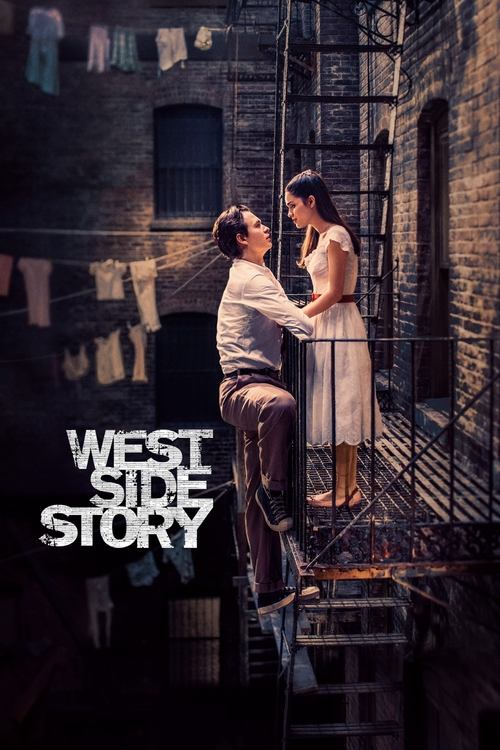
West Side Story
2021 · Directed by Steven Spielberg
Woke Score
CriticCritic Score
Audience
Woke-Adjacent
Critics rated this 34 points above its woke score. Among Woke-Adjacent films, this critic score ranks #19 of 151.
Representation Casting
Score: 85/100
The ensemble features diverse casting including Rachel Zegler (Colombian-Polish), Ariana DeBose (openly queer), David Alvarez, and other Latinx actors in leading roles. This directly reflects contemporary casting practices prioritizing representation.
LGBTQ+ Themes
Score: 25/100
Ariana DeBose's presence as an openly queer actress is notable, but the character of Anita contains no explicit LGBTQ+ elements or subtext. Her queerness exists off-screen rather than in the narrative.
Feminist Agenda
Score: 40/100
Maria remains largely a passive character defined by her romantic relationship. While the film does not actively undermine female agency, it also does not advance feminist themes beyond what the original material contained.
Racial Consciousness
Score: 55/100
The film centers Latinx and Puerto Rican characters and includes Spanish language dialogue without subtitles, demonstrating cultural specificity. However, it does not interrogate systemic racism or colonialism with any depth.
Climate Crusade
Score: 0/100
No evidence of climate-related themes or messaging in this adaptation of a 1960s musical about urban gang conflict.
Eat the Rich
Score: 15/100
The film contains no critique of capitalism or economic systems. The poverty and economic desperation that might fuel gang membership are presented as atmospheric rather than systemic.
Body Positivity
Score: 0/100
No evidence of body positivity themes. The film features conventionally attractive young leads in a traditional romantic narrative with no commentary on bodies or appearance.
Neurodivergence
Score: 0/100
No representation of neurodivergent characters or themes in this adaptation.
Revisionist History
Score: 30/100
The film updates the original with more accurate representation of Puerto Rican and Latinx New York, but does not fundamentally revise historical understanding of gang violence or police violence in the 1950s-60s.
Lecture Energy
Score: 35/100
The film occasionally explains Puerto Rican cultural elements and includes untranslated Spanish dialogue that assumes audience familiarity, but avoids heavy-handed preachiness about social issues.


Synopsis
Two youngsters from rival New York City gangs fall in love, but tensions between their respective friends build toward tragedy.
Consciousness Assessment
Spielberg's 2021 adaptation of West Side Story operates as a kind of cultural artifact of contemporary progressive casting sensibilities. The film casts Rachel Zegler, a Colombian-Polish American, as Maria, and assembles an ensemble that reflects the actual ethnic composition of New York City in ways the 1961 original could not or would not. Ariana DeBose, an openly queer Black actress, plays Anita with considerable presence. The film's attention to the Puerto Rican and Latinx experience, including dialogue in Spanish without subtitles, represents a deliberate choice to center the marginalized communities that form the story's foundation.
Yet this representation functions primarily as backdrop to a narrative that remains fundamentally unchanged from its source material. The film does not interrogate why these communities are in conflict, nor does it explore systemic factors beyond gang rivalry and personal tragedy. The racism and police brutality that contextualize the original musical are present but not examined with any particular depth or contemporary urgency. Rita Moreno, now in her nineties, appears in a newly created role as Valentina, a shop owner and observer, which reads as a gesture toward intergenerational Latinx representation rather than substantive narrative development.
The film's progressive casting choices, while visible and deliberate, ultimately serve a film that remains a tragedy about young love rather than a social critique. Spielberg has made a handsome, respectful remake that acknowledges its characters' identities more directly than previous versions, but this acknowledgment does not translate into the kind of systematic social consciousness that would elevate the work beyond spectacle. The progressive sensibilities are there, applied with a light touch, like a glaze over the essential architecture of the original.
Analysis generated by our Consciousness Algorithm
Critic Reviews
“West Side Story remains a landmark of musical history. But if the drama had been as edgy as the choreography, if the lead performances had matched Moreno's fierce concentration, if the gangs had been more dangerous and less like bad-boy Archies and Jugheads, if the ending had delivered on the pathos and tragedy of the original, there's no telling what might have resulted.”
“West Side Story is a beautifully-mounted, impressive, emotion-ridden and violent musical which, in its stark approach to a raging social problem and realism of unfoldment, may set a pattern for future musical presentations. Screen takes on a new dimension in this powerful and sometimes fascinating translation of the Broadway musical to the greater scope of motion pictures.”
“What they have done with West Side Story in knocking it down and moving it from stage to screen is to reconstruct its fine material into nothing short of a cinema masterpiece...In every respect, the recreation of the Arthur Laurents-Leonard Bernstein musical in the dynamic forms of motion pictures is superbly and appropriately achieved.”
“The irony of this hyped-up, slam-bang production is that those involved apparently don't really believe that beauty and romance can be expressed in modern rhythms, because whenever their Romeo and Juliet enter the scene, the dialogue becomes painfully old-fashioned and mawkish, the dancing turns to simpering, sickly romantic ballet, and sugary old stars hover in the sky. When true love enters the film, Bernstein abandons Gershwin and begins to echo Richard Rodgers, Rudolf Friml, and Victor Herbert.”
Consciousness Markers
The ensemble features diverse casting including Rachel Zegler (Colombian-Polish), Ariana DeBose (openly queer), David Alvarez, and other Latinx actors in leading roles. This directly reflects contemporary casting practices prioritizing representation.
Ariana DeBose's presence as an openly queer actress is notable, but the character of Anita contains no explicit LGBTQ+ elements or subtext. Her queerness exists off-screen rather than in the narrative.
Maria remains largely a passive character defined by her romantic relationship. While the film does not actively undermine female agency, it also does not advance feminist themes beyond what the original material contained.
The film centers Latinx and Puerto Rican characters and includes Spanish language dialogue without subtitles, demonstrating cultural specificity. However, it does not interrogate systemic racism or colonialism with any depth.
No evidence of climate-related themes or messaging in this adaptation of a 1960s musical about urban gang conflict.
The film contains no critique of capitalism or economic systems. The poverty and economic desperation that might fuel gang membership are presented as atmospheric rather than systemic.
No evidence of body positivity themes. The film features conventionally attractive young leads in a traditional romantic narrative with no commentary on bodies or appearance.
No representation of neurodivergent characters or themes in this adaptation.
The film updates the original with more accurate representation of Puerto Rican and Latinx New York, but does not fundamentally revise historical understanding of gang violence or police violence in the 1950s-60s.
The film occasionally explains Puerto Rican cultural elements and includes untranslated Spanish dialogue that assumes audience familiarity, but avoids heavy-handed preachiness about social issues.