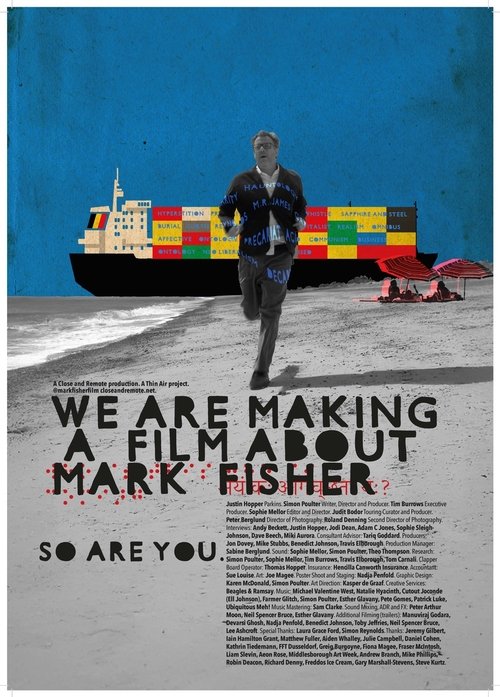
We Are Making a Film About Mark Fisher
2025 · Directed by Sophie Mellor, Simon Poulter
Peak Woke
Consciousness Score: 87%
Representation Casting
Score: 65/100
The film features diverse collaborators (70 total) and centers on a British cultural theorist whose work is concerned with systemic critique. However, the lead actor is white and male, and the film does not foreground identity-based representation as a primary concern.
LGBTQ+ Themes
Score: 30/100
Fisher's own work engaged with queer theory and non-normative temporalities, but the film itself does not foreground LGBTQ+ themes or representation as central to its argument.
Feminist Agenda
Score: 50/100
The film is co-directed by a woman and engages with Fisher's work on affect and emotional life, which intersects with feminist theory. However, it does not prioritize feminist critique as a primary analytical frame.
Racial Consciousness
Score: 35/100
The film does not appear to foreground race as a central analytical category, though Fisher's work on cultural capitalism has implicit connections to structural inequality. The focus remains on class-based critique.
Climate Crusade
Score: 15/100
Climate change is not a primary concern of the film. Fisher's hauntology engages with futures and temporality, but not specifically with environmental catastrophe.
Eat the Rich
Score: 95/100
This is perhaps the film's most explicit ideological commitment. The entire project centers on Mark Fisher's concept of capitalist realism and his critique of late capitalism. The film is fundamentally anti-capitalist in its theoretical orientation.
Body Positivity
Score: 10/100
Body positivity and physical representation are not significant concerns of the film, which operates primarily in the register of theory and affect rather than embodied politics.
Neurodivergence
Score: 50/100
Fisher's own writings extensively engage with depression and mental health, and the film centers these themes as part of its engagement with his life and work. However, the framing is more existential and theoretical than specifically neurodiversity-focused.
Revisionist History
Score: 70/100
The film engages in a form of hauntological history-telling, arguing that the promised futures of the 20th century never materialized and tracing how capitalist realism has colonized our relationship to temporality. This is a deliberate reframing of historical narrative.
Lecture Energy
Score: 88/100
This is a film about a cultural theorist's ideas, structured as a kind of intellectual inquiry. It maintains considerable lecture-like qualities despite its experimental form, with sustained engagement with complex theoretical concepts and their implications.
Synopsis
A cinematic experiment exploring the continuing relevance of the late theorist's ideas on capitalism, culture, and the future. Blending documentary, performance, and hauntological fiction, the film follows Parkins — a time-slipped character — through ghostly landscapes and digital spaces, tracing Fisher's thought from the 1990s to our algorithmic present.
Consciousness Assessment
This is a film that does not merely discuss progressive theory. It inhabits it. Sophie Mellor and Simon Poulter's documentary about Mark Fisher functions as both intellectual biography and formal enactment of the theorist's own concepts, which is precisely the kind of self-aware meta-textuality that contemporary cultural consciousness celebrates. The film's central subject, Fisher's concept of "capitalist realism," argues that we live in an ideological system so totalizing that alternatives have become literally unimaginable. By extension, the film's very existence becomes an argument against that thesis: here is an artifact that imagines alternatives, that refuses the algorithmic present's logic of inevitable homogenization.
The formal choices reveal considerable investment in the apparatus of modern progressive filmmaking. The incorporation of 70 collaborators, the emphasis on collective creative labor, the deliberate blending of documentary and fictional modes to destabilize truth-claims, the focus on spectral presences and digital spaces as sites of cultural meaning. These are not incidental aesthetic decisions. They are methodological commitments to the kind of distributed, networked, non-hierarchical creative production that contemporary cultural consciousness valorizes. The film's engagement with Fisher's ideas on depression, collective consciousness, and the affective dimensions of capitalist culture also aligns it squarely with modern progressive sensibilities around mental health, emotional authenticity, and the politicization of the personal.
Yet the film's theoretical density and deliberate opacity also function as a kind of barrier. This is not cinema for the masses. It is cinema for those already versed in cultural theory, already primed to receive its references and formal innovations. That exclusivity, that assumption of intellectual sophistication among the audience, sits in some tension with the egalitarian impulses that animate progressive cultural politics. The result is a film that scores extremely high on theoretical alignment with contemporary progressive consciousness while remaining somewhat ambiguous about its actual capacity to transform understanding or inspire material change. That ambiguity is perhaps the most honest thing about it.
Analysis generated by our Consciousness Algorithm
Critic Reviews
“Close and Remote have brought their subject nearer, less remote, and the film is a fascinating tribute which is expanding, getting made over, with each viewing.”
Consciousness Markers
The film features diverse collaborators (70 total) and centers on a British cultural theorist whose work is concerned with systemic critique. However, the lead actor is white and male, and the film does not foreground identity-based representation as a primary concern.
Fisher's own work engaged with queer theory and non-normative temporalities, but the film itself does not foreground LGBTQ+ themes or representation as central to its argument.
The film is co-directed by a woman and engages with Fisher's work on affect and emotional life, which intersects with feminist theory. However, it does not prioritize feminist critique as a primary analytical frame.
The film does not appear to foreground race as a central analytical category, though Fisher's work on cultural capitalism has implicit connections to structural inequality. The focus remains on class-based critique.
Climate change is not a primary concern of the film. Fisher's hauntology engages with futures and temporality, but not specifically with environmental catastrophe.
This is perhaps the film's most explicit ideological commitment. The entire project centers on Mark Fisher's concept of capitalist realism and his critique of late capitalism. The film is fundamentally anti-capitalist in its theoretical orientation.
Body positivity and physical representation are not significant concerns of the film, which operates primarily in the register of theory and affect rather than embodied politics.
Fisher's own writings extensively engage with depression and mental health, and the film centers these themes as part of its engagement with his life and work. However, the framing is more existential and theoretical than specifically neurodiversity-focused.
The film engages in a form of hauntological history-telling, arguing that the promised futures of the 20th century never materialized and tracing how capitalist realism has colonized our relationship to temporality. This is a deliberate reframing of historical narrative.
This is a film about a cultural theorist's ideas, structured as a kind of intellectual inquiry. It maintains considerable lecture-like qualities despite its experimental form, with sustained engagement with complex theoretical concepts and their implications.