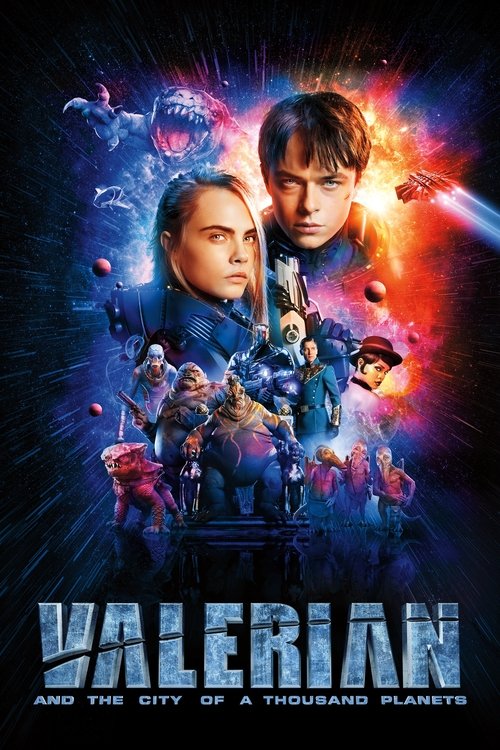
Valerian and the City of a Thousand Planets
2017 · Directed by Luc Besson
Woke Score
CriticCritic Score
Audience
Based
Critics rated this 13 points above its woke score. Among Based films, this critic score ranks #291 of 345.
Representation Casting
Score: 65/100
The cast includes actors of various ethnic backgrounds and the film features an ensemble of diverse alien species, though this diversity registers as backdrop rather than central to character development or narrative agency.
LGBTQ+ Themes
Score: 0/100
No LGBTQ+ themes, representation, or storylines are present in the film.
Feminist Agenda
Score: 35/100
Laureline is positioned as a strong female action hero with combat skills and agency, yet the film was retitled to remove her name from prominence, and narrative weight consistently favors the male lead in action sequences and plot importance.
Racial Consciousness
Score: 40/100
The film's central premise involves peaceful coexistence among diverse alien species and civilizations, implicitly coded as a metaphor for racial and cultural harmony, though this theme remains largely unexamined and serves primarily as worldbuilding rather than commentary.
Climate Crusade
Score: 0/100
No climate-related themes or environmental consciousness are present in the film.
Eat the Rich
Score: 0/100
The film contains no critique of capitalism or wealth structures; it focuses on military/governmental operatives protecting the status quo rather than challenging systemic power.
Body Positivity
Score: 45/100
Alien characters display varied body types and forms without commentary, and Rihanna's character Bubble exists as a shapeshifter, though female human characters are conventionally attractive and shot with objectifying camera work.
Neurodivergence
Score: 0/100
No neurodivergent representation or themes related to neurodiversity are present in the film.
Revisionist History
Score: 0/100
The film is set in a distant future and contains no historical revisionism or reframing of past events.
Lecture Energy
Score: 20/100
While the film occasionally includes dialogue asserting gender equality, these moments feel inserted rather than integral, and the film avoids sustained examination of social themes in favor of spectacle.


Synopsis
In the 28th century, Valerian and Laureline are special operatives charged with keeping order throughout the human territories. On assignment from the Minister of Defense, the two undertake a mission to Alpha, an ever-expanding metropolis where species from across the universe have converged over centuries to share knowledge, intelligence, and cultures. At the center of Alpha is a mysterious dark force which threatens the peaceful existence of the City of a Thousand Planets, and Valerian and Laureline must race to identify the menace and safeguard not just Alpha, but the future of the universe.
Consciousness Assessment
Luc Besson's sprawling space opera arrives bearing all the visual markers of contemporary progressive sensibilities: a cosmos where countless alien species coexist in harmony, a female co-protagonist with combat capabilities, and a narrative framed around peaceful multiculturalism. The film's Alpha station represents an idealized vision of interspecies cooperation, where difference is celebrated as cultural richness rather than conflict. Yet this veneer of inclusivity obscures a film fundamentally uncertain about its own relationship to gender and representation. Laureline appears as a competent action hero, yet her name was excised from the title, a detail that speaks volumes about whose story the film actually wanted to tell.
The representation extends beyond gender into more complicated terrain. The cast includes actors of various ethnic backgrounds, and the alien designs embrace visual diversity without fetishizing it, though such inclusion in a 2017 blockbuster registers as obligatory rather than organic. Rihanna appears as Bubble, a shapeshifting entertainer whose role oscillates between agency and objectification. The film labors to insert progressive dialogue about gender equality into scenes that undermine those very ideas through visual grammar and narrative emphasis. Besson has built a career on strong female characters, yet here the machinery creaks audibly, caught between impulses to modernize and an inability to fully commit.
The film's greatest weakness lies in its contradictions rather than its failures. It theoretically embraces a vision where species and genders work in equal partnership, yet stages nearly every significant action sequence around its male lead, relegating Laureline to supporting beats in her own story. The progressive infrastructure is present, but the film lacks conviction in its own stated values, resulting in a work that satisfies neither those seeking genuine representation nor those indifferent to such concerns. Besson's ambition outpaces his execution, producing something closer to aesthetic diversity than meaningful cultural commentary.
Analysis generated by our Consciousness Algorithm
Critic Reviews
“It's a film filled with humor, charm, excitement and so many memorable images that many viewers will find themselves struggling to keep from blinking so as not to miss any of the eye-popping delights crammed into each overstuffed frame. ”
“Valerian is at times so mind-meltingly beautiful and strange that I’m still not sure I didn’t just dream it all.”
“Valerian is a film to wallow in, not follow, and if you’re tuned to its extra-terrestrial wavelength, you wouldn’t cut a second.”
“At no point along the way does the film provide a reason to invest your interest in any of this.”
Consciousness Markers
The cast includes actors of various ethnic backgrounds and the film features an ensemble of diverse alien species, though this diversity registers as backdrop rather than central to character development or narrative agency.
No LGBTQ+ themes, representation, or storylines are present in the film.
Laureline is positioned as a strong female action hero with combat skills and agency, yet the film was retitled to remove her name from prominence, and narrative weight consistently favors the male lead in action sequences and plot importance.
The film's central premise involves peaceful coexistence among diverse alien species and civilizations, implicitly coded as a metaphor for racial and cultural harmony, though this theme remains largely unexamined and serves primarily as worldbuilding rather than commentary.
No climate-related themes or environmental consciousness are present in the film.
The film contains no critique of capitalism or wealth structures; it focuses on military/governmental operatives protecting the status quo rather than challenging systemic power.
Alien characters display varied body types and forms without commentary, and Rihanna's character Bubble exists as a shapeshifter, though female human characters are conventionally attractive and shot with objectifying camera work.
No neurodivergent representation or themes related to neurodiversity are present in the film.
The film is set in a distant future and contains no historical revisionism or reframing of past events.
While the film occasionally includes dialogue asserting gender equality, these moments feel inserted rather than integral, and the film avoids sustained examination of social themes in favor of spectacle.