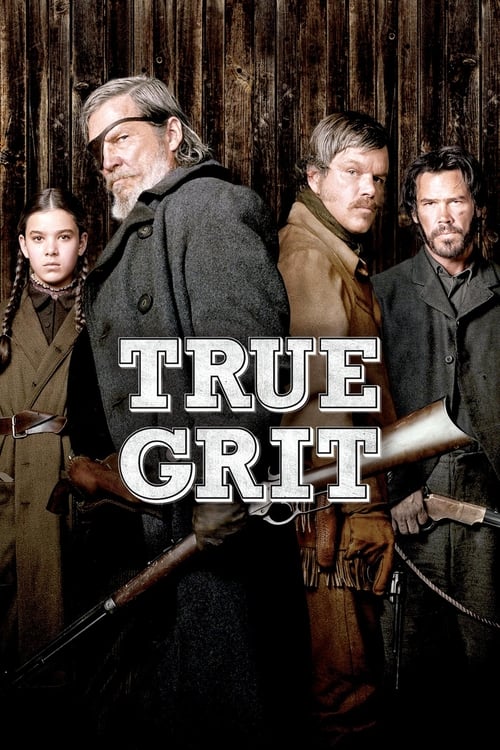
True Grit
2010 · Directed by Joel Coen
Woke Score
Critic Score
Audience
Ultra Based
Critics rated this 73 points above its woke score. Among Ultra Based films, this critic score ranks #280 of 833.
Representation Casting
Score: 25/100
Female protagonist in a traditionally male-dominated genre, but this reflects 1968 source material rather than contemporary casting consciousness. The cast is predominantly white with no modern diversity sensibility.
LGBTQ+ Themes
Score: 0/100
No LGBTQ+ themes or characters present in the narrative.
Feminist Agenda
Score: 40/100
Mattie Ross is witty, independent, and drives the plot, but the film presents her capability matter-of-factly rather than as a modern feminist statement. Her strength emerges from narrative necessity, not ideological commitment.
Racial Consciousness
Score: 0/100
No contemporary racial consciousness or commentary on systemic racism. Native Americans appear as period-appropriate plot elements without meaningful representation.
Climate Crusade
Score: 0/100
No environmental themes or climate-related messaging present.
Eat the Rich
Score: 0/100
No critique of wealth, capitalism, or economic systems present in the narrative.
Body Positivity
Score: 0/100
No body positivity messaging or deliberate representation of diverse body types.
Neurodivergence
Score: 0/100
No representation of neurodivergent characters or discussion of neurodiversity.
Revisionist History
Score: 0/100
The film is a faithful period adaptation with no reinterpretation of history through a modern progressive lens.
Lecture Energy
Score: 5/100
Minimal didactic moralizing. The narrative is primarily an adventure story with no explicit social messaging or contemporary commentary.


Synopsis
Following the murder of her father by a hired hand, a 14-year-old farm girl sets out to capture the killer. To aid her, she hires the toughest U.S. Marshal she can find, a man with 'true grit', Reuben J. 'Rooster' Cogburn.
Consciousness Assessment
The Coen Brothers' True Grit presents a 14-year-old girl as the central character of a Western revenge narrative, a detail that has prompted some contemporary observers to locate feminist consciousness within the film's DNA. This reading mistakes source material fidelity for cultural intentionality. Charles Portis wrote his 1968 novel about a determined young woman pursuing justice, and the Coens adapted that novel with their characteristic precision and respect for the text. Mattie Ross is competent and witty, but these qualities emerge as plot necessities rather than as commentary on gender relations or as a statement about representation. The film offers no modern progressive sensibility, no interrogation of its historical period, no acknowledgment of structural inequities.
What remains is a classically constructed Western that succeeds on its own terms, which is to say entirely outside the framework of contemporary cultural consciousness. The production is meticulous and the performances are excellent, but the film traffics in no progressive themes. Hailee Steinfeld delivers a breakout performance, yet the film's interest in her character is narrative and dramatic, not ideological. She is a strong person in a strong story, not a political statement about female empowerment or representation.
The film's box office success and critical reception reflect its quality as cinema, not any alignment with modern social consciousness. It remains a thoroughly traditional Western that happens to have been made in 2010 rather than 1970, a distinction the Coen Brothers seem to have treated as immaterial. This is not a condemnation but an observation, the kind one makes when confronted with a film that exists almost entirely outside the cultural anxieties of its moment.
Analysis generated by our Consciousness Algorithm
Critic Reviews
“In some ways, much like Charles Laughton's "Night of the Hunter," which the Coens quote both musically and visually, True Grit is a parable about good and evil. Only here, the lines between the two are so blurred as to be indistinguishable, making this a true picture of how the West was won, or - depending on your view - lost.”
“Terrific: tough, exciting, funny, gorgeous and bewitchingly acted, this is darn close to perfection.”
“On its own conventional terms, the film succeeds – maybe not as a "Coen Brothers" movie, but as a tall tale well told.”
“The Coens direct True Grit with a light touch, but like Portis' stark, funny novel, their adventure tale shaves off none of the rough edges.”
“Smartly emphasizing Portis' quirky dialogue and dark comic tone, the Coens show the flare that made them famous.”
“For the Coens, the plot elements are a given; the telling is all.”
Consciousness Markers
Female protagonist in a traditionally male-dominated genre, but this reflects 1968 source material rather than contemporary casting consciousness. The cast is predominantly white with no modern diversity sensibility.
No LGBTQ+ themes or characters present in the narrative.
Mattie Ross is witty, independent, and drives the plot, but the film presents her capability matter-of-factly rather than as a modern feminist statement. Her strength emerges from narrative necessity, not ideological commitment.
No contemporary racial consciousness or commentary on systemic racism. Native Americans appear as period-appropriate plot elements without meaningful representation.
No environmental themes or climate-related messaging present.
No critique of wealth, capitalism, or economic systems present in the narrative.
No body positivity messaging or deliberate representation of diverse body types.
No representation of neurodivergent characters or discussion of neurodiversity.
The film is a faithful period adaptation with no reinterpretation of history through a modern progressive lens.
Minimal didactic moralizing. The narrative is primarily an adventure story with no explicit social messaging or contemporary commentary.