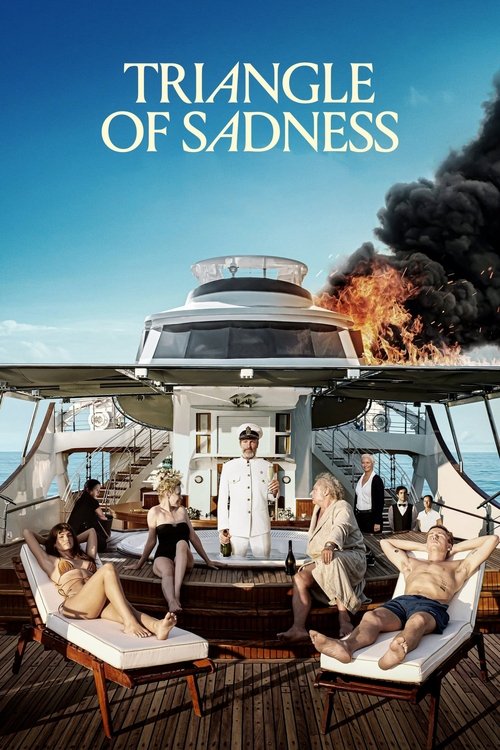
Triangle of Sadness
2022 · Directed by Ruben Östlund
Woke Score
CriticCritic Score
Audience
Woke-Adjacent
Critics rated this 15 points above its woke score. Among Woke-Adjacent films, this critic score ranks #106 of 151.
Representation Casting
Score: 45/100
The film features an international ensemble cast with notable diversity, including Dolly de Leon in a prominent role as a working-class survivor. However, the casting choices appear organic to the narrative rather than serving as a deliberate statement about representation.
LGBTQ+ Themes
Score: 0/100
There is no evidence of LGBTQ+ themes, characters, or representation in the film. The narrative centers on heterosexual relationships and does not engage with queer identity.
Feminist Agenda
Score: 35/100
The film depicts a female character assuming power and control in the post-collapse hierarchy, subverting traditional gender expectations. However, this inversion is treated as comedic reversal rather than as a sustained exploration of feminist themes or systemic gender critique.
Racial Consciousness
Score: 15/100
While the film features actors of color, including Dolly de Leon in a meaningful role, there is minimal explicit engagement with racial consciousness or systemic racism as thematic concerns. Representation exists without commentary.
Climate Crusade
Score: 0/100
The film contains no engagement with climate change, environmental degradation, or ecological consciousness. The desert island setting is purely narrative convenience, not an environmental statement.
Eat the Rich
Score: 68/100
The film's entire structure is built on critiquing wealth, luxury consumption, and capitalist excess. The wealthy are systematically humiliated, their possessions rendered useless, and their dependence on service systems exposed as fundamental weakness.
Body Positivity
Score: 25/100
The film employs extensive bodily humor including vomiting, defecation, and physical degradation. While this could be read as desacralizing beauty standards associated with wealth and celebrity, it primarily functions as shock comedy rather than body-positive advocacy.
Neurodivergence
Score: 0/100
There is no representation of neurodivergent characters or engagement with neurodivergence as a thematic concern in the film.
Revisionist History
Score: 0/100
The film does not engage with historical events or narratives. It is a contemporary satirical work without historical revisionism.
Lecture Energy
Score: 42/100
While the film clearly communicates its anti-capitalist perspective through visual and narrative means, it maintains artistic distance and aesthetic restraint. Östlund avoids explicit preachiness, preferring to show rather than tell, which limits the lecturing quality.


Synopsis
A celebrity model couple are invited on a luxury cruise for the uber-rich, helmed by an unhinged, alcoholic captain. What first appears Instagrammable ends catastrophically, leaving the survivors stranded on a desert island in a struggle of hierarchy.
Consciousness Assessment
Triangle of Sadness presents itself as a blunt instrument of class critique, swinging a sledgehammer at the excesses of wealth with all the subtlety of its famous vomiting scene. Östlund's film is structurally preoccupied with power dynamics and the inversion of hierarchy, particularly the way gender roles scramble once civilization's veneer cracks. The cruise ship setting functions as a microcosm where the ultra-wealthy are systematically humiliated, their superficiality and dependence on service workers exposed through deliberately unglamorous cinematography and prolonged sequences of bodily degradation. The film's commitment to showing the machinery of class oppression is intellectually sincere, even if the execution often prioritizes shock value over nuance.
What complicates a higher score is the film's treatment of these themes as primarily comedic rather than as material for genuine social consciousness. The working-class characters, particularly Dolly de Leon's Abigail, are presented sympathetically and given agency in the post-collapse hierarchy, yet the film reserves its most cutting satire for the wealthy rather than exploring systemic critique in depth. The gender dynamics, while present and occasionally pointed, function more as observational humor than as a sustained engagement with feminist ideas about labor, beauty standards, or power. There is representation in casting, and the film does grapple with anti-capitalist sentiment through its central premise of wealth's inadequacy during crisis. But Östlund maintains artistic distance from his subject matter in ways that prevent the film from becoming preachy, which paradoxically limits its engagement with modern progressive sensibilities.
The film operates as a provocative satire of consumer culture and class structure, executed with formal discipline and a clear eye toward exposing the absurdity of extreme wealth. Yet satire alone does not constitute the specific cultural markers we assess here. Triangle of Sadness is a serious film about serious subjects, but its seriousness manifests through aesthetic provocation rather than through the particular constellation of social consciousness that defines contemporary progressive filmmaking. It critiques the rich without necessarily advancing specific positions on representation, identity, or systemic justice.
Analysis generated by our Consciousness Algorithm
Critic Reviews
“The points of Östlund’s Triangle are far from subtle. Vanity is toxic; fortunes corrupt; everyone loves to see an Instagrammer getting their comeuppance. But across its well-earned two-and-a-half-hour running time, epic schadenfreude keeps edging into genuine sympathy, and we feel just sorry enough for these awful people for the next humiliation to sting just as hard.”
“Östlund has created a full-throated, roaring comedy of hate against the upper-classes. It is cynical, nihilistic and has no issue about punching down.”
“Be warned. Triangle of Sadness rants and smirks at the state of the world over two-and-a-half hours, which is quite some running time for a satirical comedy. But it is never boring. Partly that's because the political commentary is so shrewd, and partly it's because it has a surprising amount of warmth and nuance, too. Östlund ensures that while the situations may be absurd, the people in them are as human as any of us.”
“There are movies that are on-the-nose and then there is Ruben Ostlund’s Triangle of Sadness, a satire™ that is so pharyngeal that it is the cinematic equivalent of a COVID-19 swab.”
Consciousness Markers
The film features an international ensemble cast with notable diversity, including Dolly de Leon in a prominent role as a working-class survivor. However, the casting choices appear organic to the narrative rather than serving as a deliberate statement about representation.
There is no evidence of LGBTQ+ themes, characters, or representation in the film. The narrative centers on heterosexual relationships and does not engage with queer identity.
The film depicts a female character assuming power and control in the post-collapse hierarchy, subverting traditional gender expectations. However, this inversion is treated as comedic reversal rather than as a sustained exploration of feminist themes or systemic gender critique.
While the film features actors of color, including Dolly de Leon in a meaningful role, there is minimal explicit engagement with racial consciousness or systemic racism as thematic concerns. Representation exists without commentary.
The film contains no engagement with climate change, environmental degradation, or ecological consciousness. The desert island setting is purely narrative convenience, not an environmental statement.
The film's entire structure is built on critiquing wealth, luxury consumption, and capitalist excess. The wealthy are systematically humiliated, their possessions rendered useless, and their dependence on service systems exposed as fundamental weakness.
The film employs extensive bodily humor including vomiting, defecation, and physical degradation. While this could be read as desacralizing beauty standards associated with wealth and celebrity, it primarily functions as shock comedy rather than body-positive advocacy.
There is no representation of neurodivergent characters or engagement with neurodivergence as a thematic concern in the film.
The film does not engage with historical events or narratives. It is a contemporary satirical work without historical revisionism.
While the film clearly communicates its anti-capitalist perspective through visual and narrative means, it maintains artistic distance and aesthetic restraint. Östlund avoids explicit preachiness, preferring to show rather than tell, which limits the lecturing quality.