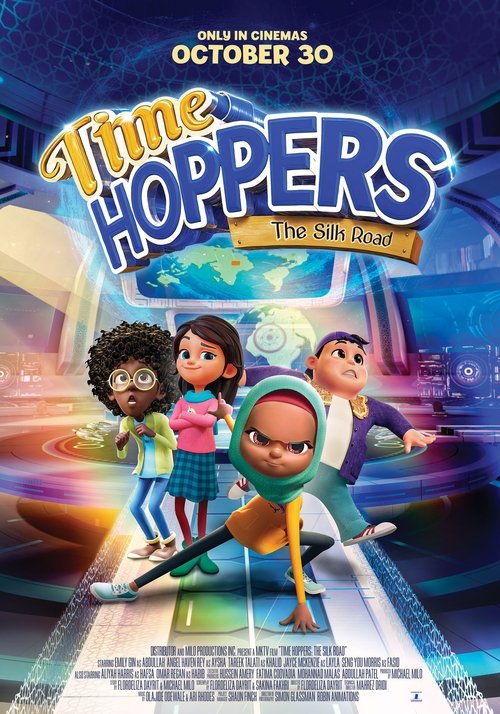
Time Hoppers: The Silk Road
2025 · Directed by Flordeliza Dayrit
Woke
Consciousness Score: 78%
Representation Casting
Score: 92/100
The film centers Muslim and South Asian characters as protagonists and explicitly prioritizes casting from these communities. This represents a deliberate intervention against the historical absence of positive Muslim representation in mainstream animated features.
LGBTQ+ Themes
Score: 0/100
No LGBTQ+ themes or characters are evident in the film's plot, which focuses on time travel adventure and historical scientific figures. The narrative contains no queer representation or thematic exploration.
Feminist Agenda
Score: 35/100
One of the four protagonists is named Layla, suggesting female character inclusion, but available information does not indicate substantial feminist thematic content or examination of gender dynamics. Female presence without explicit feminist agenda.
Racial Consciousness
Score: 82/100
The film engages directly with racial and religious identity by centering Muslim scientists and the Islamic Golden Age as worthy of mainstream cinematic celebration. However, this functions as representation rather than critique of systemic racism.
Climate Crusade
Score: 0/100
The film is a historical adventure narrative set partially in the past with no apparent engagement with climate themes, environmental consciousness, or ecological critique.
Eat the Rich
Score: 5/100
The film is a commercial product distributed through standard theatrical channels. While it may contain themes of protecting knowledge or scientific cooperation, there is no evidence of systemic anti-capitalist critique or examination of economic structures.
Body Positivity
Score: 0/100
No information suggests the film engages with body positivity themes, disability representation, or challenge to beauty standards. The narrative focuses on adventure and historical preservation.
Neurodivergence
Score: 0/100
The film contains no apparent representation of neurodivergent characters or thematic exploration of autism, ADHD, or other neurological differences.
Revisionist History
Score: 65/100
The film celebrates Islamic scientific achievement during the Golden Age, which is historically accurate but presented through a contemporary progressive lens that emphasizes historical Muslim contributions specifically to counter modern marginalization.
Lecture Energy
Score: 58/100
The film's explicit mission to educate audiences about Muslim scientists and Islamic history suggests didactic intent, though as a children's adventure narrative it likely balances this with entertainment. The director's public statements emphasize the educational and representational mission.
Synopsis
2050, Aqli Academy, Vancouver: Four gifted children—Abdullah, Aysha, Khalid and Layla—stumble upon the ability to time travel, they are thrust into an adventure along the historic Silk Road to protect the era's great scientists from the evil time travelling alchemist Fasid. Will the Time Hoppers be able to save the foundations of modern science and safely return home.
Consciousness Assessment
Time Hoppers: The Silk Road arrives as a calculated intervention in the landscape of children's animation, explicitly designed to correct what its creators identify as a representational void. The film centers four Muslim protagonists navigating a time-travel narrative that positions Islamic scientists as the historical custodians of mathematical and optical knowledge. Director Flordeliza Dayrit has stated that the project emerged from lived experience with Islamophobia, framing the work not as entertainment incidentally featuring diverse characters but as a corrective historical document for young audiences. The film's entire architecture rests upon the premise that Muslim visibility in mainstream cinema requires deliberate, engineered intervention.
The film deploys several markers of contemporary progressive sensibility with considerable intentionality. The four lead characters bear Arabic names and Islamic cultural markers, and the narrative explicitly celebrates figures from the Islamic Golden Age, treating historical Muslim achievement as material worthy of blockbuster spectacle. The casting appears to prioritize Muslim and South Asian performers, and the production infrastructure itself operates under explicitly Muslim-led creative control through MuslimKids.TV and Milo Productions. The film's success at the North American box office in its opening weekend suggests that this particular configuration of targeted representation has found commercial viability.
However, the film's progressive credentials operate within circumscribed boundaries. A children's adventure narrative about protecting historical scientists, regardless of their religious background, is not inherently progressive in the modern sense. The film does not appear to foreground contemporary social justice frameworks, climate consciousness, or systemic critique. It functions instead as a representation project that seeks inclusion within mainstream entertainment rather than challenging the structures of that mainstream. This is representation work, executed with clarity of purpose, but it does not extend into the ideological territories that contemporary progressive cinema often occupies.
Analysis generated by our Consciousness Algorithm
Consciousness Markers
The film centers Muslim and South Asian characters as protagonists and explicitly prioritizes casting from these communities. This represents a deliberate intervention against the historical absence of positive Muslim representation in mainstream animated features.
No LGBTQ+ themes or characters are evident in the film's plot, which focuses on time travel adventure and historical scientific figures. The narrative contains no queer representation or thematic exploration.
One of the four protagonists is named Layla, suggesting female character inclusion, but available information does not indicate substantial feminist thematic content or examination of gender dynamics. Female presence without explicit feminist agenda.
The film engages directly with racial and religious identity by centering Muslim scientists and the Islamic Golden Age as worthy of mainstream cinematic celebration. However, this functions as representation rather than critique of systemic racism.
The film is a historical adventure narrative set partially in the past with no apparent engagement with climate themes, environmental consciousness, or ecological critique.
The film is a commercial product distributed through standard theatrical channels. While it may contain themes of protecting knowledge or scientific cooperation, there is no evidence of systemic anti-capitalist critique or examination of economic structures.
No information suggests the film engages with body positivity themes, disability representation, or challenge to beauty standards. The narrative focuses on adventure and historical preservation.
The film contains no apparent representation of neurodivergent characters or thematic exploration of autism, ADHD, or other neurological differences.
The film celebrates Islamic scientific achievement during the Golden Age, which is historically accurate but presented through a contemporary progressive lens that emphasizes historical Muslim contributions specifically to counter modern marginalization.
The film's explicit mission to educate audiences about Muslim scientists and Islamic history suggests didactic intent, though as a children's adventure narrative it likely balances this with entertainment. The director's public statements emphasize the educational and representational mission.