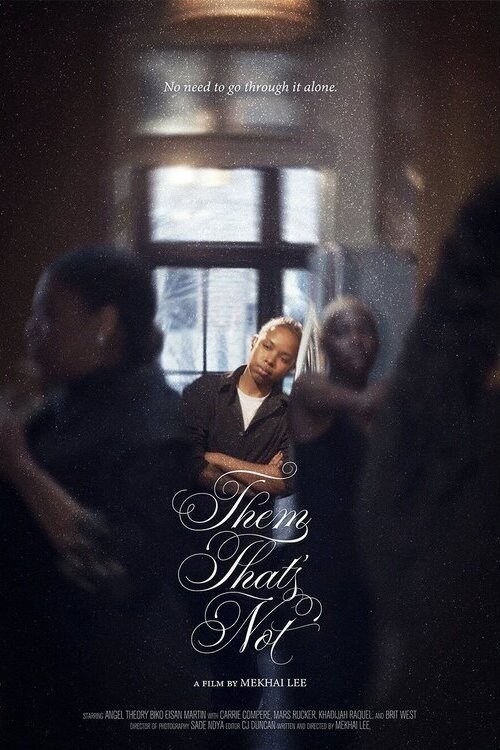
Them That's Not
2026 · Directed by Mekhai Lee
Woke Score
Critic Score
Woke
Critics rated this 18 points above its woke score. Among Woke films, this critic score ranks #33 of 57.
Representation Casting
Score: 85/100
The lead role is cast with Angel Theory, a Deaf actress and poet, centering authentic Deaf representation rather than employing a hearing actor. This is not tokenistic inclusion but genuine casting that determines the film's visual and communicative language.
LGBTQ+ Themes
Score: 70/100
Andrea's queer identity is established and present in the narrative without being the central conflict or requiring explanation. The film treats this aspect of her identity as integrated into her personhood rather than a plot point to be resolved.
Feminist Agenda
Score: 55/100
The film centers a female protagonist navigating family dynamics and masculine authority (her father), but it does not explicitly foreground gender analysis. The feminist dimensions are implicit rather than thematic.
Racial Consciousness
Score: 45/100
The cast includes Black and multiracial family members, reflecting demographic reality. However, race is not explicitly thematized or analyzed within the narrative, remaining largely contextual.
Climate Crusade
Score: 0/100
No climate themes present in this intimate family drama set within a brownstone. Environmental consciousness is not a concern of this work.
Eat the Rich
Score: 35/100
The incarceration of the father suggests awareness of carceral systems, which contains implicit critique of institutional power. However, this is not developed into explicit systemic analysis or anti-capitalist commentary.
Body Positivity
Score: 0/100
No particular emphasis on body positivity, diet culture critique, or disability justice frameworks related to physicality. The film's disability representation does not extend into these territories.
Neurodivergence
Score: 75/100
Deafness is centered as a lived linguistic and cultural experience rather than framed as deficit or disability to be overcome. The film affirms ASL as a valid communicative mode and Deaf culture as legitimate.
Revisionist History
Score: 25/100
The film engages with family history and incarceration history but does not reframe historical events or challenge dominant historical narratives in an explicit way.
Lecture Energy
Score: 30/100
The film maintains emotional restraint and shows rather than tells its themes. While it contains progressive sensibilities, it resists didactic exposition or character speeches that would constitute 'lecture energy.'
Synopsis
Andrea "Drea" Stoney, a queer, Deaf poet, feels isolated at her grandmother's repass, surrounded by a distant family uninterested in ASL. Seeking refuge in quiet corners of the family brownstone, her world is further shaken when her estranged father Samuel—temporarily released from prison after 20 years to mourn his mother—arrives. Bound by grief and blood, father and daughter must confront their strained relationship and find fragile reconciliation before his return behind bars.
Consciousness Assessment
Mekhai Lee's "Them That's Not" operates with the precision of a jeweler, each frame weighted with the specific gravity of lived experience. The film's central narrative architecture rests on two pillars of contemporary cultural consciousness: Deaf representation and queer identity, both embodied by Angel Theory's Andrea "Drea" Stoney with a kind of quiet insistence that refuses to treat these aspects as ornamental. The film does not announce these identities with fanfare, nor does it subordinate them to the larger family drama. They simply exist as the fundamental texture through which we experience the story, which is to say they are treated as central rather than peripheral to the human reality being depicted.
What distinguishes this work from mere representation is its commitment to communicative accessibility as a moral framework. The family's indifference to ASL becomes not merely a character flaw but a structural representation of how marginalized individuals navigate spaces that were not built for them. The film insists on showing us Drea's perspective, her language, her way of being in the world, as the authentic center of the narrative rather than asking us to sympathize from a distance. This is a substantive choice about whose humanity gets centered. The relationship between Drea and her incarcerated father introduces complexity that resists easy categorization, touching on systemic injustice and family obligation without collapsing these elements into a lesson.
Yet the film maintains a certain restraint that prevents it from tipping into what might be called didactic performance. The comedy beats emerge from genuine family dynamics rather than from the comic potential of disability or queerness. This restraint, paradoxically, may be the film's most subversive gesture, suggesting that social consciousness need not announce itself to be effective. A short work of genuine emotional precision, "Them That's Not" demonstrates that progressive sensibilities, when grounded in specificity and craft, need not feel like an imposition on the narrative itself.
Analysis generated by our Consciousness Algorithm
Critic Reviews
“It's a short film that lingers, not because of dramatic spectacle, but because of how human and quietly affecting it chooses to be.”
“Anchored by strong performances that reach a climax in a stunning final scene, Them That's Not is full of empathy and warmth.”
“Them That's Not is an emotionally overwhelming experience that perfectly places the viewer in the point of view of a deeply nuanced central character.”
“Them That's Not ultimately underscores how shared grief can force people to truly see one another, even when long separation has made family relationships feel impossible.”
Consciousness Markers
The lead role is cast with Angel Theory, a Deaf actress and poet, centering authentic Deaf representation rather than employing a hearing actor. This is not tokenistic inclusion but genuine casting that determines the film's visual and communicative language.
Andrea's queer identity is established and present in the narrative without being the central conflict or requiring explanation. The film treats this aspect of her identity as integrated into her personhood rather than a plot point to be resolved.
The film centers a female protagonist navigating family dynamics and masculine authority (her father), but it does not explicitly foreground gender analysis. The feminist dimensions are implicit rather than thematic.
The cast includes Black and multiracial family members, reflecting demographic reality. However, race is not explicitly thematized or analyzed within the narrative, remaining largely contextual.
No climate themes present in this intimate family drama set within a brownstone. Environmental consciousness is not a concern of this work.
The incarceration of the father suggests awareness of carceral systems, which contains implicit critique of institutional power. However, this is not developed into explicit systemic analysis or anti-capitalist commentary.
No particular emphasis on body positivity, diet culture critique, or disability justice frameworks related to physicality. The film's disability representation does not extend into these territories.
Deafness is centered as a lived linguistic and cultural experience rather than framed as deficit or disability to be overcome. The film affirms ASL as a valid communicative mode and Deaf culture as legitimate.
The film engages with family history and incarceration history but does not reframe historical events or challenge dominant historical narratives in an explicit way.
The film maintains emotional restraint and shows rather than tells its themes. While it contains progressive sensibilities, it resists didactic exposition or character speeches that would constitute 'lecture energy.'