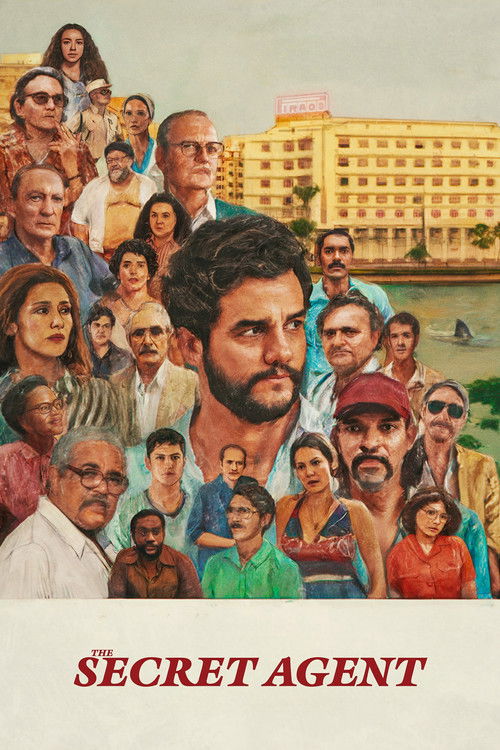
The Secret Agent
2025 · Directed by Kleber Mendonça Filho
Woke Score
CriticCritic Score
Audience
Ultra Based
Critics rated this 33 points above its woke score. Among Ultra Based films, this critic score ranks #1318 of 1469.
Representation Casting
Score: 25/100
The cast includes Brazilian actors of varying ethnicities reflecting the country's demographic makeup, but this appears to be geographic authenticity rather than deliberate representation strategy. No evidence of calculated diversity initiatives.
LGBTQ+ Themes
Score: 0/100
No LGBTQ+ themes evident in the plot summary, cast information, or available materials about the film.
Feminist Agenda
Score: 0/100
The film centers on a male protagonist on the run. No feminist themes are apparent in the synopsis or available information.
Racial Consciousness
Score: 15/100
The setting in Brazil during dictatorship and Recife's specific cultural context suggest some engagement with Brazilian social reality, but no explicit racial justice messaging is evident.
Climate Crusade
Score: 0/100
No climate-related themes present in the film's plot, setting, or available materials.
Eat the Rich
Score: 20/100
The political dictatorship context and the protagonist's status as a fugitive suggest oblique critique of state power, but this is historical circumstance rather than contemporary anti-capitalist messaging.
Body Positivity
Score: 0/100
No body positivity themes or messaging evident in the available information about the film.
Neurodivergence
Score: 0/100
No representation of neurodivergence or disability-related themes present in the plot summary or cast information.
Revisionist History
Score: 10/100
The film is set during Brazil's military dictatorship, a genuinely oppressive historical period, but there is no evidence of contemporary revisionist reframing or alternative historical interpretation.
Lecture Energy
Score: 5/100
Mendonça Filho's directorial style typically favors formal sophistication over explicit messaging, suggesting this thriller resists the preachy tone characteristic of high-lecture-energy filmmaking.


Synopsis
Brazil, 1977. Marcelo, a technology expert in his early 40s, is on the run. Hoping to reunite with his son, he travels to Recife during Carnival but soon realizes that the city is not the safe haven he was expecting.
Consciousness Assessment
Kleber Mendonça Filho has never been a filmmaker interested in comfortable storytelling. The Secret Agent, set during Brazil's 1977 military dictatorship, concerns itself with a man in flight, his identity fragmented by political upheaval and personal desperation. The narrative framework invites certain critical attention: the dictatorship itself was a genuine historical atrocity, Wagner Moura's casting continues his trajectory as an actor drawn to politically charged material, and Recife's Carnival setting provides a visual counterpoint between state surveillance and collective expression. Yet the film's engagement with these elements appears primarily thematic rather than prescriptive. It is a thriller about persecution, not a tract about oppression.
The production context matters here. Mendonça Filho's previous work, particularly Aquarius and Neighboring Sounds, has demonstrated a sophisticated approach to class consciousness and urban decay without abandoning formal rigor or narrative complexity. He is not a filmmaker who lectures. The Secret Agent appears designed as a genre exercise filtered through political circumstance, which is fundamentally different from a film that subordinates plot to ideological messaging. Moura's character is not presented as a symbol of resistance but as a compromised figure seeking refuge in a city that offers none. This moral ambiguity does not align with the kind of preachy social consciousness that defines contemporary progressive filmmaking.
The film's modest engagement with progressive sensibilities stems primarily from historical necessity rather than deliberate cultural positioning. Setting a thriller in 1977 Brazil requires acknowledging the dictatorship, but acknowledgment is not the same as advocacy. The cast is ethnically diverse, but this reflects Brazilian demographics, not a calculated representation strategy. There is no evidence in the available materials of the film pursuing contemporary identity politics, climate messaging, or the rhetorical apparatus that has come to define socially conscious cinema in the 2020s. It is, in essence, a political film that does not appear to be a political film in the current sense.
Analysis generated by our Consciousness Algorithm
Critic Reviews
“A dense, faithful and absorbing adaptation of the Joseph Conrad's 1907 novel. [08 Nov 1996]”
“Writer-director Christopher Hampton's adaptation of Joseph Conrad's widely-read novel is an honorable failure, a screen version that's actually too faithful to its source.”
“The movie is full of macabre surprises. As good as Hoskins is as the little sweat-manufacturer caught in everybody's pliers, far better is Robin Williams in an unbilled appearance as a nihilist dynamiter. [13 Dec 1996]”
“Hampton's directorial inexperience shows, and the film remains curiously disjointed and devoid of suspense. [06 Dec 1996]”
Consciousness Markers
The cast includes Brazilian actors of varying ethnicities reflecting the country's demographic makeup, but this appears to be geographic authenticity rather than deliberate representation strategy. No evidence of calculated diversity initiatives.
No LGBTQ+ themes evident in the plot summary, cast information, or available materials about the film.
The film centers on a male protagonist on the run. No feminist themes are apparent in the synopsis or available information.
The setting in Brazil during dictatorship and Recife's specific cultural context suggest some engagement with Brazilian social reality, but no explicit racial justice messaging is evident.
No climate-related themes present in the film's plot, setting, or available materials.
The political dictatorship context and the protagonist's status as a fugitive suggest oblique critique of state power, but this is historical circumstance rather than contemporary anti-capitalist messaging.
No body positivity themes or messaging evident in the available information about the film.
No representation of neurodivergence or disability-related themes present in the plot summary or cast information.
The film is set during Brazil's military dictatorship, a genuinely oppressive historical period, but there is no evidence of contemporary revisionist reframing or alternative historical interpretation.
Mendonça Filho's directorial style typically favors formal sophistication over explicit messaging, suggesting this thriller resists the preachy tone characteristic of high-lecture-energy filmmaking.