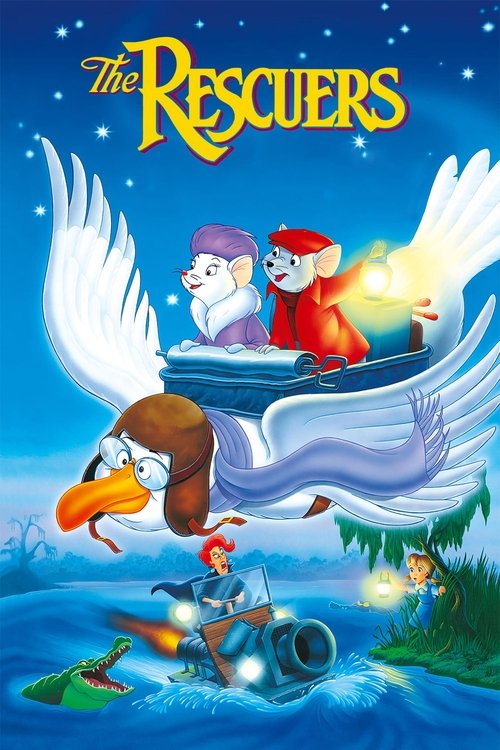
The Rescuers
1977 · Directed by Wolfgang Reitherman
Woke Score
CriticCritic Score
Audience
Ultra Based
Critics rated this 70 points above its woke score. Among Ultra Based films, this critic score ranks #513 of 1469.
Representation Casting
Score: 5/100
The cast is entirely animal characters with human voice actors. No human representation to evaluate, and voice casting reflects 1970s Hollywood norms with no particular attention to diversity.
LGBTQ+ Themes
Score: 0/100
No LGBTQ+ themes, representation, or subtext present. The male and female mouse leads have a traditional partnership dynamic with no romantic undertones.
Feminist Agenda
Score: 15/100
Bianca functions as a capable female lead who takes initiative, but this predates modern feminist framing and is not presented with contemporary consciousness. She exists as a character rather than a statement.
Racial Consciousness
Score: 0/100
The film contains no human characters and no racial representation to evaluate. The story ignores real-world geography and social context entirely.
Climate Crusade
Score: 0/100
No environmental or climate-related themes whatsoever. The setting is a swamp used purely as adventurous backdrop with no ecological consciousness.
Eat the Rich
Score: 8/100
The villain is motivated by greed and treasure hunting, presenting wealth-seeking as morally wrong, but without any structural critique of capitalism or systemic analysis.
Body Positivity
Score: 0/100
No body diversity representation or body positivity messaging. All characters are drawn in conventional animated style with no commentary on physical appearance.
Neurodivergence
Score: 0/100
No representation of neurodivergence or mental health considerations. Characters operate without any acknowledgment of disability or cognitive difference.
Revisionist History
Score: 0/100
The film is a fairy tale adventure with no historical setting or revisionist claims. It exists entirely outside historical context.
Lecture Energy
Score: 5/100
The film contains minimal moralizing beyond basic good-versus-evil storytelling. No characters deliver speeches about social issues or justice frameworks.


Synopsis
Two agents of the mouse-run International Rescue Aid Society search for a little orphan girl kidnapped by sinister treasure hunters.
Consciousness Assessment
The Rescuers exists in a pre-cultural-awakening era when Disney could produce an animated adventure film without considering the modern matrices of social consciousness that would later become mandatory viewing requirements. The film follows two mice from an international rescue organization attempting to save a kidnapped orphan from a female villain, a plot device that was unremarkable in 1977 and remains so. What makes this film particularly instructive for our purposes is precisely how little it concerns itself with representation or progressive sensibilities, which is to say almost nothing.
The female mouse character, Bianca, functions as the assertive half of the mouse duo, though this predates modern feminist framing by several decades. She is simply competent and takes charge when necessary, without any conscious commentary on gender dynamics. The orphan girl serves as a MacGuffin rather than a fully realized character with agency or trauma awareness. There is no attempt to address class structures beyond the basic good-versus-evil dichotomy, no climate messaging, no neurodivergence representation, and certainly no revisionist historical consciousness. The film is, in essence, ideologically inert by contemporary standards.
The Rescuers scores low not because it is regressive but because it simply does not engage with the specific cultural markers we are measuring. It is a film from an era when such engagement was neither expected nor desired, and it bears the mark of that innocence with absolute clarity.
Analysis generated by our Consciousness Algorithm
Critic Reviews
“One of the most rousing and appealing animated features ever made by the Disney studio. [24 June 1977, p.B1]”
“The Walt Disney animators returned to top form with this beautifully crafted and wonderfully expressive cartoon feature, the first major work to come out of the Disney studios in a decade. There are limitations to Disney's naturalistic style, but for every failure of imagination there is a triumph of craftsmanship. ”
“Efficiently short, charming, mildly scary in unimportant ways, and occasionally very funny. It's a perfect show for the very, very young who take their cartoons seriously.”
“There is one lovely character, though - Orville the albatross, who runs an airline service armed with goggles, scarf, and a sardine tin for his passengers to sit in. ”
Consciousness Markers
The cast is entirely animal characters with human voice actors. No human representation to evaluate, and voice casting reflects 1970s Hollywood norms with no particular attention to diversity.
No LGBTQ+ themes, representation, or subtext present. The male and female mouse leads have a traditional partnership dynamic with no romantic undertones.
Bianca functions as a capable female lead who takes initiative, but this predates modern feminist framing and is not presented with contemporary consciousness. She exists as a character rather than a statement.
The film contains no human characters and no racial representation to evaluate. The story ignores real-world geography and social context entirely.
No environmental or climate-related themes whatsoever. The setting is a swamp used purely as adventurous backdrop with no ecological consciousness.
The villain is motivated by greed and treasure hunting, presenting wealth-seeking as morally wrong, but without any structural critique of capitalism or systemic analysis.
No body diversity representation or body positivity messaging. All characters are drawn in conventional animated style with no commentary on physical appearance.
No representation of neurodivergence or mental health considerations. Characters operate without any acknowledgment of disability or cognitive difference.
The film is a fairy tale adventure with no historical setting or revisionist claims. It exists entirely outside historical context.
The film contains minimal moralizing beyond basic good-versus-evil storytelling. No characters deliver speeches about social issues or justice frameworks.