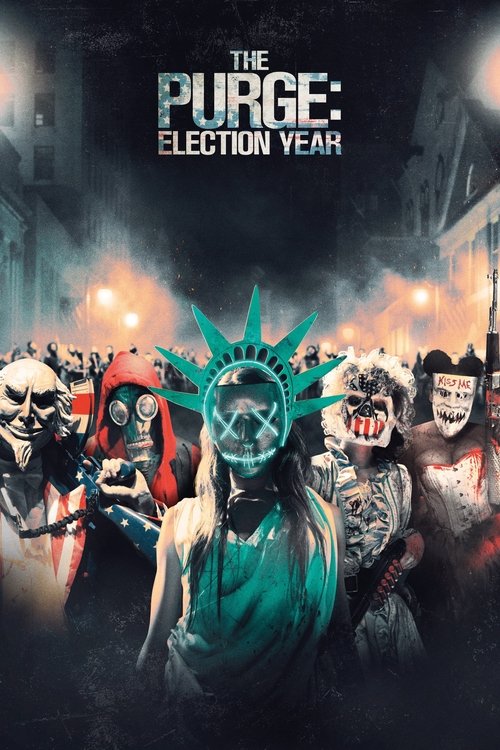
The Purge: Election Year
2016 · Directed by James DeMonaco
Woke Score
CriticCritic Score
Audience
Woke-Adjacent
Critics rated this 3 points above its woke score. Among Woke-Adjacent films, this critic score ranks #127 of 151.
Representation Casting
Score: 35/100
Features a racially diverse cast including Betty Gabriel and Mykelti Williamson, but narrative power remains centered on white protagonists Frank Grillo and Elizabeth Mitchell.
LGBTQ+ Themes
Score: 0/100
No evidence of LGBTQ+ themes, characters, or representation in the film.
Feminist Agenda
Score: 40/100
Senator Charlene Roan is a female presidential candidate and significant character, though she shares narrative focus with the male security chief rather than dominating the story.
Racial Consciousness
Score: 65/100
The film explicitly depicts how the Purge disproportionately targets poor and Black communities, and government corruption is tied to racial violence and elimination of vulnerable populations.
Climate Crusade
Score: 0/100
No evidence of climate change themes or environmental consciousness in the narrative.
Eat the Rich
Score: 70/100
The core premise critiques a capitalist system where the wealthy deploy legalized violence to eliminate poor and inconvenient populations as a form of social control.
Body Positivity
Score: 0/100
No evidence of body positivity themes or commentary on body diversity in the film.
Neurodivergence
Score: 0/100
No evidence of neurodivergence representation or themes in the narrative.
Revisionist History
Score: 0/100
No evidence of revisionist historical narratives or reinterpretation of historical events.
Lecture Energy
Score: 30/100
While the film's social commentary is thematically present, it functions primarily as action-movie scaffolding rather than extended preachy dialogue or explicit moralizing.


Synopsis
Two years after choosing not to kill the man who killed his son, former police sergeant Leo Barnes has become head of security for Senator Charlene Roan, the front runner in the next Presidential election due to her vow to eliminate the Purge. On the night of what should be the final Purge, a betrayal from within the government forces Barnes and Roan out onto the street where they must fight to survive the night.
Consciousness Assessment
The Purge: Election Year arrives as a franchise entry that has abandoned all pretense of subtlety regarding its political content. Where the original film operated as an allegory, this third installment simply names its targets: governmental corruption, class warfare, and the systematic elimination of the poor and vulnerable. The film's central premise that the wealthy deploy legalized violence as a tool of population control against marginalized communities reflects a particular strain of contemporary social consciousness, one that draws direct lines between institutional power and bodily harm.
Senator Charlene Roan, a female presidential candidate opposed to the Purge, serves as the film's moral center, though she shares narrative weight with the male security chief Leo Barnes. The casting includes Betty Gabriel and Mykelti Williamson in supporting roles, and the film does not shy away from depicting how the Purge disproportionately affects Black and poor communities. Yet the story remains fundamentally a white-led action narrative in which marginalized characters are protected rather than protagonists of their own liberation.
The film's critique of capitalism as a system that permits the powerful to dispose of the inconvenient is its most sustained thematic concern. However, this social commentary functions primarily as action-movie scaffolding rather than genuine interrogation. The result is a film that deploys progressive sensibilities as window dressing for a conventional thriller about survival and governmental overthrow, scoring respectably on specific markers while remaining fundamentally an entertainment product that aestheticizes rather than truly grapples with the inequalities it depicts.
Analysis generated by our Consciousness Algorithm
Critic Reviews
“DeMonaco has further upped his game with the third installment by working closely with franchise cinematographer Jacques Jouffret to design rewardingly more complex action sequences and well-focused set pieces that are both efficiently executed and visually engaging.”
“You’d think the concept would now be wearing thin, but Election Year, which feels like the final chapter in a trilogy...is the best “Purge” film yet. The action is excitingly sustained in a way that it wasn’t in the previous two, and the political dimension, while crude as hell, exerts a brute-force entertainment value.”
“The problem with the Purge films is they feel like they’re made for people who would actually take part in the purge.”
Consciousness Markers
Features a racially diverse cast including Betty Gabriel and Mykelti Williamson, but narrative power remains centered on white protagonists Frank Grillo and Elizabeth Mitchell.
No evidence of LGBTQ+ themes, characters, or representation in the film.
Senator Charlene Roan is a female presidential candidate and significant character, though she shares narrative focus with the male security chief rather than dominating the story.
The film explicitly depicts how the Purge disproportionately targets poor and Black communities, and government corruption is tied to racial violence and elimination of vulnerable populations.
No evidence of climate change themes or environmental consciousness in the narrative.
The core premise critiques a capitalist system where the wealthy deploy legalized violence to eliminate poor and inconvenient populations as a form of social control.
No evidence of body positivity themes or commentary on body diversity in the film.
No evidence of neurodivergence representation or themes in the narrative.
No evidence of revisionist historical narratives or reinterpretation of historical events.
While the film's social commentary is thematically present, it functions primarily as action-movie scaffolding rather than extended preachy dialogue or explicit moralizing.