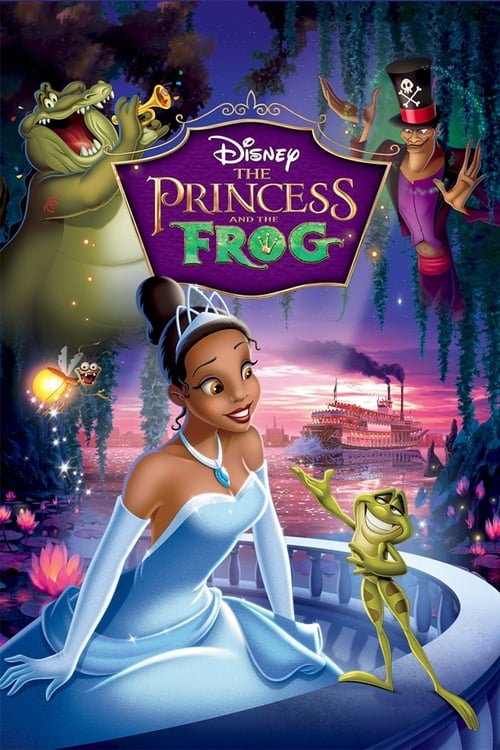
The Princess and the Frog
2009 · Directed by Ron Clements
Woke Score
CriticCritic Score
Audience
Based
Critics rated this 51 points above its woke score. Among Based films, this critic score ranks #131 of 345.
Representation Casting
Score: 65/100
Features Disney's first Black princess as the lead protagonist, with a diverse supporting cast including established Black performers. However, representation exists primarily as casting choice rather than as a platform for exploring identity or lived experience.
LGBTQ+ Themes
Score: 0/100
Contains no LGBTQ+ themes, representation, or subtext. The narrative centers exclusively on heterosexual romance with no acknowledgment of queer perspectives or identities.
Feminist Agenda
Score: 35/100
Tiana pursues economic independence and professional ambition, which offers a modest feminist angle. However, the film ultimately prioritizes romantic resolution and marriage as the endpoint of character growth, reinforcing rather than interrogating traditional narrative structures.
Racial Consciousness
Score: 28/100
While centered on a Black protagonist in a New Orleans setting with jazz and Creole cultural elements, the film avoids any substantive engagement with systemic racism, historical context, or racial inequality. Racial identity is present but not examined.
Climate Crusade
Score: 0/100
Contains no climate-related themes, environmental consciousness, or ecological commentary. The magical setting is untouched by contemporary environmental concerns.
Eat the Rich
Score: 15/100
Tiana's dream of restaurant ownership represents aspiration within the capitalist system rather than critique of it. The narrative celebrates entrepreneurial ambition and personal wealth accumulation as virtuous goals without questioning underlying economic structures.
Body Positivity
Score: 10/100
The animation presents conventionally attractive character designs. While not overtly body-shaming, the film offers no meaningful engagement with body diversity or acceptance of non-normative physical forms.
Neurodivergence
Score: 0/100
Contains no representation of neurodivergent characters or exploration of neurodiversity. All characters function within neurotypical frameworks without acknowledgment of alternative cognitive styles.
Revisionist History
Score: 20/100
Set in New Orleans with historical cultural elements, but presents a fairy tale fantasy world largely disconnected from actual historical or social context. The film uses historical setting as aesthetic backdrop rather than engaging with historical realities or complexities.
Lecture Energy
Score: 5/100
The film prioritizes entertainment and emotional engagement over preachy messaging. There is minimal expository dialogue explaining progressive concepts or social issues, allowing the narrative to unfold as straightforward fantasy romance.


Synopsis
A waitress, desperate to fulfill her dreams as a restaurant owner, is set on a journey to turn a frog prince back into a human being, but she has to face the same problem after she kisses him.
Consciousness Assessment
The Princess and the Frog arrives at an awkward historical juncture, released in 2009 when modern progressive cultural sensibilities were still coalescing into their current form. Disney's decision to cast Anika Noni Rose as the studio's first Black princess was genuinely significant, yet the film's actual engagement with racial consciousness remains largely superficial. Tiana exists as a capable, ambitious protagonist rather than a vehicle for social commentary on systemic inequality. The film sets itself in New Orleans and deploys jazz and Creole cultural aesthetics with genuine affection, but these elements function primarily as atmospheric flavor rather than as serious cultural representation. The supporting cast, featuring Oprah Winfrey, Keith David, and Jennifer Lewis, lends considerable vocal talent and cultural weight to what remains fundamentally a fairy tale romance.
What the film does accomplish is straightforward enough: it presents a Black female lead pursuing economic independence and personal fulfillment without apology or explanation. This matters as a simple fact of representation, though it hardly constitutes bold social commentary. The narrative arc emphasizes hard work, determination, and romantic love as paths to happiness, which aligns more closely with classical Disney mythology than with any particular progressive agenda. There is no meaningful interrogation of class structures, wealth disparity, or the historical context of New Orleans. The villain is not capitalism or systemic injustice but rather a generic supernatural antagonist. The film's feminist elements are modest, centering on Tiana's ambitions rather than any systematic critique of gender roles.
Viewed through the lens of contemporary progressive sensibilities, The Princess and the Frog reads as earnest but incomplete. It checks certain representational boxes without pushing particularly hard against narrative conventions or challenging the underlying ideological assumptions of the Disney princess formula. This is not a condemnation. The film succeeds as an entertaining animated feature that happens to center a Black protagonist. Whether that constitutes progressive filmmaking or merely progressive casting remains an open question.
Analysis generated by our Consciousness Algorithm
Critic Reviews
“What matters is that Tiana triumphs as both a girl and a frog, that dreams are fulfilled, wrongs are righted, love prevails, and music unites not only a princess and a frog but also kids and grown-ups.”
“In an amazing year for animation, The Princess and the Frog is up at the top. Go on, give it a big kiss.”
“The animation, sparkling and graceful, also ranks as the studio's best traditional work in ages.”
“It's a worthy cause and an honorable film, the first full-length Disney cartoon with an African-American heroine. But without a strong story, it's a case of one step forward and two steps back.”
Consciousness Markers
Features Disney's first Black princess as the lead protagonist, with a diverse supporting cast including established Black performers. However, representation exists primarily as casting choice rather than as a platform for exploring identity or lived experience.
Contains no LGBTQ+ themes, representation, or subtext. The narrative centers exclusively on heterosexual romance with no acknowledgment of queer perspectives or identities.
Tiana pursues economic independence and professional ambition, which offers a modest feminist angle. However, the film ultimately prioritizes romantic resolution and marriage as the endpoint of character growth, reinforcing rather than interrogating traditional narrative structures.
While centered on a Black protagonist in a New Orleans setting with jazz and Creole cultural elements, the film avoids any substantive engagement with systemic racism, historical context, or racial inequality. Racial identity is present but not examined.
Contains no climate-related themes, environmental consciousness, or ecological commentary. The magical setting is untouched by contemporary environmental concerns.
Tiana's dream of restaurant ownership represents aspiration within the capitalist system rather than critique of it. The narrative celebrates entrepreneurial ambition and personal wealth accumulation as virtuous goals without questioning underlying economic structures.
The animation presents conventionally attractive character designs. While not overtly body-shaming, the film offers no meaningful engagement with body diversity or acceptance of non-normative physical forms.
Contains no representation of neurodivergent characters or exploration of neurodiversity. All characters function within neurotypical frameworks without acknowledgment of alternative cognitive styles.
Set in New Orleans with historical cultural elements, but presents a fairy tale fantasy world largely disconnected from actual historical or social context. The film uses historical setting as aesthetic backdrop rather than engaging with historical realities or complexities.
The film prioritizes entertainment and emotional engagement over preachy messaging. There is minimal expository dialogue explaining progressive concepts or social issues, allowing the narrative to unfold as straightforward fantasy romance.