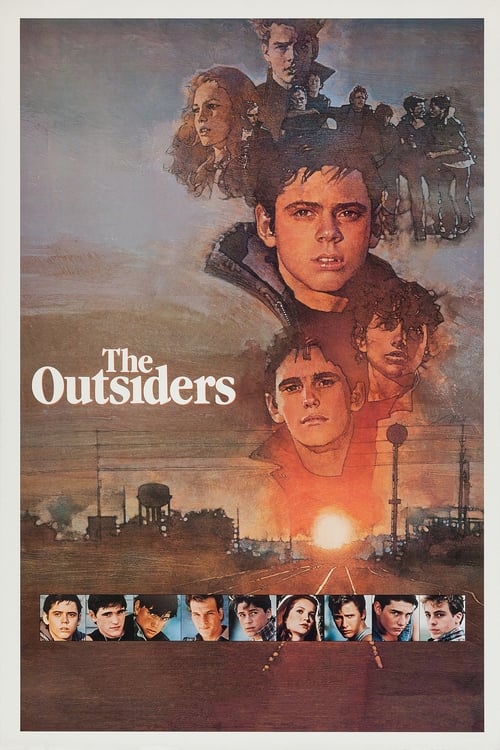
The Outsiders
1983 · Directed by Francis Ford Coppola
Woke Score
CriticCritic Score
Audience
Ultra Based
Critics rated this 41 points above its woke score. Among Ultra Based films, this critic score ranks #1272 of 1469.
Representation Casting
Score: 0/100
The cast is entirely white, with no racial or ethnic diversity represented despite the 1960s Oklahoma setting during the Civil Rights era.
LGBTQ+ Themes
Score: 0/100
No LGBTQ+ characters, themes, or representation appear in the film.
Feminist Agenda
Score: 0/100
Female characters are largely passive and secondary, existing primarily as objects of male desire or as victims of male violence, with no conscious feminist perspective.
Racial Consciousness
Score: 0/100
Set in a historical moment of significant racial upheaval, the film contains no examination of race, no diverse casting, and no racial themes whatsoever.
Climate Crusade
Score: 0/100
No environmental themes or climate-related content appear in the film.
Eat the Rich
Score: 25/100
The film depicts economic inequality and class conflict as sources of suffering and violence, presenting wealthy Socs as privileged antagonists. However, this is framed as tragic rather than as a systemic problem requiring change.
Body Positivity
Score: 0/100
No body positivity themes or representation of diverse body types appear in the film.
Neurodivergence
Score: 0/100
No representation of neurodivergence or discussion of neurodivergent experience.
Revisionist History
Score: 0/100
The film does not reframe or reinterpret historical events, though it is set in a historical period.
Lecture Energy
Score: 0/100
The film tells its story organically without preachy messaging about social issues or explicit moral instruction about systemic problems.


Synopsis
In 1960s Tulsa, class divisions ignite a violent rivalry between the working-class Greasers and the privileged Socs. When a deadly encounter forces two Greasers, Ponyboy and Johnny, to flee, their struggle for survival and redemption exposes the fragile innocence and enduring bonds of youth on the wrong side of town.
Consciousness Assessment
Francis Ford Coppola's adaptation of S.E. Hinton's novel presents class conflict as a natural fact of adolescent life, not as a systemic injustice requiring remediation. The Greasers suffer economically and socially, but their suffering is framed as tragic rather than as evidence of capitalist exploitation. The film mourns the loss of innocence among working-class youth without advocating for their liberation or offering any vision of a more just society. This is humanist drama, not progressive consciousness. The all-white cast, drawn entirely from the era's most bankable young male stars, reflects the film's complete indifference to racial or ethnic diversity. Even set in 1960s Oklahoma during the Civil Rights movement, the film remains hermetically sealed against any consideration of race, treating class as the sole axis of social division worthy of attention. The female characters exist primarily as objects of male desire or as casualties of male violence, lacking agency or interiority. The film's emotional power derives from its depiction of genuine suffering, but that suffering is presented as universal rather than as the product of specific systems that might be named or challenged. Coppola's direction yields a meditation on the bonds of brotherhood and the cruelty of circumstance, not a critique of the structures that create such circumstances. For all its technical skill and narrative force, the film remains a product of its era, operating within an older moral vocabulary that sees class struggle as inevitable rather than as a problem to be solved through consciousness-raising or systemic change.
Analysis generated by our Consciousness Algorithm
Critic Reviews
“This is a film that carries you along and there is an added savour in seeing those cherubic faces which have since settled into middle age.”
“The director gives us a small, sincere and nearly perfectly realized film about adolescence in Oklahoma, aptly entitled The Outsiders. [24 Mar 1983]”
“Francis Coppola's revision of his 1983 film of S.E. Hinton's best seller The Outsiders is funny, touching and revelatory, with twenty-two minutes of added footage and a new soundtrack featuring Elvis Presley. [Review of re-release]”
“Francis Ford Coppola's gang film is as moony about death as "One From the Heart" was over romance; the film is unremitting in its morbid sentimentality, running its teenage characters through a masochistic gamut of beatings, killings, burnings, and suicides.”
Consciousness Markers
The cast is entirely white, with no racial or ethnic diversity represented despite the 1960s Oklahoma setting during the Civil Rights era.
No LGBTQ+ characters, themes, or representation appear in the film.
Female characters are largely passive and secondary, existing primarily as objects of male desire or as victims of male violence, with no conscious feminist perspective.
Set in a historical moment of significant racial upheaval, the film contains no examination of race, no diverse casting, and no racial themes whatsoever.
No environmental themes or climate-related content appear in the film.
The film depicts economic inequality and class conflict as sources of suffering and violence, presenting wealthy Socs as privileged antagonists. However, this is framed as tragic rather than as a systemic problem requiring change.
No body positivity themes or representation of diverse body types appear in the film.
No representation of neurodivergence or discussion of neurodivergent experience.
The film does not reframe or reinterpret historical events, though it is set in a historical period.
The film tells its story organically without preachy messaging about social issues or explicit moral instruction about systemic problems.