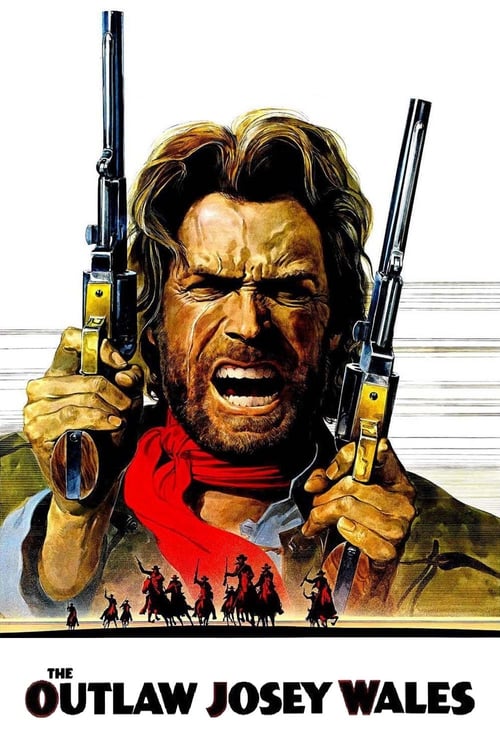
The Outlaw Josey Wales
1976 · Directed by Clint Eastwood
Woke Score
CriticCritic Score
Audience
Ultra Based
Critics rated this 65 points above its woke score. Among Ultra Based films, this critic score ranks #661 of 1469.
Representation Casting
Score: 15/100
Chief Dan George and Geraldine Keams provide Native American representation in supporting roles, with genuine character development, but they remain secondary to the white protagonist's narrative.
LGBTQ+ Themes
Score: 0/100
No LGBTQ+ themes or representation present in the film.
Feminist Agenda
Score: 20/100
Female characters exist in the narrative and demonstrate some agency, but within traditional rescue and protection frameworks typical of 1970s cinema.
Racial Consciousness
Score: 25/100
Native American characters are portrayed with dignity and given agency, but the film does not engage in explicit examination of racial injustice or indigenous displacement.
Climate Crusade
Score: 0/100
No environmental or climate-related messaging present in the film.
Eat the Rich
Score: 0/100
While the film contains anti-war sentiment, there is no critique of capitalism or wealth structures.
Body Positivity
Score: 0/100
No body positivity themes or messaging present in the film.
Neurodivergence
Score: 0/100
No representation of neurodivergence or related themes in the film.
Revisionist History
Score: 35/100
The film sympathetically portrays a pro-Confederate protagonist without requiring audiences to confront the moral weight of Confederate allegiance, participating in Lost Cause mythology.
Lecture Energy
Score: 5/100
Anti-war sentiment is present and woven into the narrative, but delivered organically rather than as explicit preachy commentary.


Synopsis
After avenging his family's brutal murder, Wales is pursued by a pack of soldiers. He prefers to travel alone, but ragtag outcasts are drawn to him - and Wales can't bring himself to leave them unprotected.
Consciousness Assessment
The Outlaw Josey Wales presents itself as a meditation on the costs of violence and the futility of revenge, which it is, but its relationship to historical accuracy and progressive sensibility proves more complicated. The film follows a Missouri farmer turned outlaw as he evades Union soldiers and accumulates a ragtag family of misfits, each with their own reasons for existing outside mainstream society. On its surface, the narrative offers something almost humanistic: the notion that even those cast out by civilization might find meaning in protecting one another.
Yet beneath this lie more troubling currents. The protagonist is a pro-Confederate guerrilla whose allegiance to the Confederacy is treated as a personal grievance rather than a moral reckoning. The film presents him as sympathetic without requiring audiences to confront what the Confederacy represented. This is the machinery of Lost Cause mythology operating at full efficiency, rehabilitating the Confederate soldier through a veneer of individualism and frontier virtue. The anti-war messaging, while present, functions primarily to critique the federal government's pursuit of Wales rather than to examine the war itself or its origins.
The film's representation of Native Americans, while respectful by 1976 standards, remains fundamentally limited. Chief Dan George delivers a memorable performance as Lone Watie, a Cherokee outlaw with genuine personality and agency. Geraldine Keams appears as a Navajo character who is initially in danger of assault before being incorporated into Wales' protective circle. These are not offensive portrayals, but they exist within a framework where the indigenous characters are secondary to the white protagonist's journey. The film acknowledges their humanity without centering their experience or examining the historical forces that have displaced them. It is a western that includes Native Americans as people rather than obstacles, which represents a modest step forward for the genre, but nothing more.
Analysis generated by our Consciousness Algorithm
Critic Reviews
“A truly great Western from Clint that is bleakly atmospheric and charming in turns.”
“After a period of directorial uncertainty, the film demonstrated Eastwood's ability to recreate his first starring role, as the mythic Man with No Name of the Italian Westerns, and to subtly undercut it through comedy and mockery.”
“A cautiously optimistic epic, deeply rooted in American history. Bolstered by Surtees's magnificent cinematography, Fielding's fine score and an excellent supporting cast highlighted by the scene-stealing dry wit of Chief Dan George, Josey Wales affirms life and community with bracing conviction.”
“The movie tends to muffle and sell short whatever points it may be trying to make. There seems to be a ghost of an attempt to assert the romantic individualism of the South against the cold expansionism of the North. Every Unionist is vicious and incompetent, whereas Wales, despite his spitting, is really a perfect gentleman. There is something cynical about this primitive one-sidedness in what is not only a historical context, but happens also to be our own historical context. To the degree a movie asserts history, it should at least attempt to do it fairly.”
Consciousness Markers
Chief Dan George and Geraldine Keams provide Native American representation in supporting roles, with genuine character development, but they remain secondary to the white protagonist's narrative.
No LGBTQ+ themes or representation present in the film.
Female characters exist in the narrative and demonstrate some agency, but within traditional rescue and protection frameworks typical of 1970s cinema.
Native American characters are portrayed with dignity and given agency, but the film does not engage in explicit examination of racial injustice or indigenous displacement.
No environmental or climate-related messaging present in the film.
While the film contains anti-war sentiment, there is no critique of capitalism or wealth structures.
No body positivity themes or messaging present in the film.
No representation of neurodivergence or related themes in the film.
The film sympathetically portrays a pro-Confederate protagonist without requiring audiences to confront the moral weight of Confederate allegiance, participating in Lost Cause mythology.
Anti-war sentiment is present and woven into the narrative, but delivered organically rather than as explicit preachy commentary.