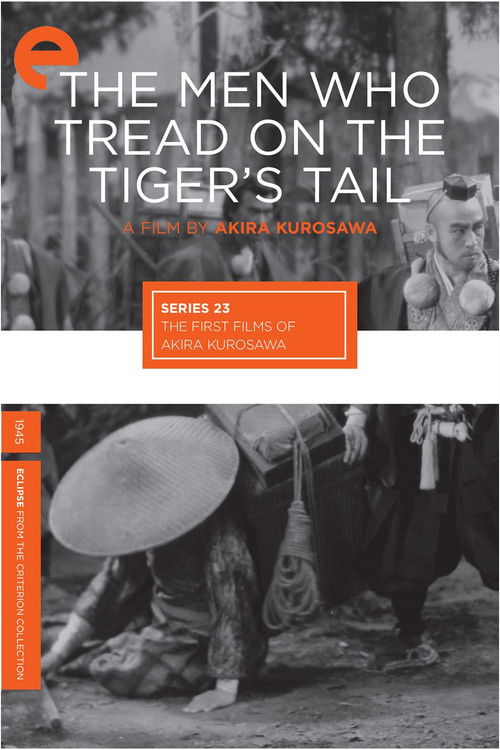
The Men Who Tread on the Tiger's Tail
1952 · Directed by Akira Kurosawa
Woke Score
CriticCritic Score
Ultra Based
Critics rated this 61 points above its woke score. Among Ultra Based films, this critic score ranks #782 of 1469.
Representation Casting
Score: 0/100
The film features an all-Japanese cast in feudal Japan, which reflects historical accuracy rather than any deliberate representation strategy. There is no evidence of casting designed to broaden demographic visibility.
LGBTQ+ Themes
Score: 0/100
No LGBTQ themes, representation, or subtext are present in this feudal adventure narrative.
Feminist Agenda
Score: 0/100
The film contains no feminist agenda or examination of gender dynamics. Female characters appear only peripherally in traditional supporting roles.
Racial Consciousness
Score: 0/100
No racial consciousness or examination of racial hierarchy is present. The film operates within a homogeneous historical setting without addressing such themes.
Climate Crusade
Score: 0/100
There is no climate-related content or environmental consciousness in this feudal samurai film.
Eat the Rich
Score: 0/100
While the film depicts feudal class structures, it offers no critique of economic systems or capitalist frameworks. It presents hierarchy as historical fact.
Body Positivity
Score: 0/100
No body positivity messaging or counter-normative representations of physical form are evident in the film.
Neurodivergence
Score: 0/100
The film contains no representation of neurodivergence or disability consciousness.
Revisionist History
Score: 0/100
The film presents feudal Japanese history within its conventional narrative framework without revisionist reinterpretation of historical events.
Lecture Energy
Score: 8/100
While not heavy-handed, the film does contain moments where Kurosawa pauses narrative momentum to examine themes of loyalty, deception, and honor through extended dialogue. The checkpoint sequence particularly features expository dialogue that interrupts pacing.


Synopsis
A fugitive lord and his six retainers disguise themselves as monks to bluff their way through a hostile checkpoint.
Consciousness Assessment
Kurosawa's 1952 entry into the samurai adventure canon presents the sort of historical spectacle that preceded modern consciousness by several decades. The narrative concerns itself with feudal loyalty, masculine honor codes, and the narrow escape of a lord through disguise and deception. There are no marginalized voices seeking platforms, no examination of systemic inequality, no interrogation of power structures through a contemporary lens. The film operates entirely within its own period context, treating feudal hierarchy as narrative furniture rather than as a subject for critique.
What minimal progressive elements exist are incidental rather than intentional. The cast is entirely Japanese and the production reflects no apparent anxiety about representation, which is to say it represents nothing in particular beyond the immediate story. The female characters exist peripherally, as they do in most samurai narratives of this era. There is no LGBTQ content, no discussion of climate or economic systems, no neurodivergent representation. The film is unconcerned with the cultural markers that define contemporary progressive discourse.
This is a straightforward historical adventure film made in the immediate post-war period, when such concerns had not yet calcified into cultural watchwords. Its lack of modern sensibility is not a failing but rather a historical fact. To score it as "woke" would be to commit an anachronism of spectacular proportions. It remains what it always was: a craftsman's exercise in period narrative and visual composition.
Analysis generated by our Consciousness Algorithm
Critic Reviews
“TheMenWhoTreadontheTiger'sTailis not Kurosawa's best, bust still a truly remarkable, detailed, and culturally conscious period drama, where the many ponderous Japanese virtues meet with an ostensibly stagnant atmosphere, all covered up in a package of truly minimalistic aspirations.”
“CriticDavid Conrad has said that the character of the porter, who does not exist in the original Noh or kabuki plays, prefigures Kurosawa's later commoner characters like the woodcutter in Rashomon and the villagers in Seven Samurai.”
“TheMenWhoTreadontheTiger'sTailwas fairly entertaining and a nostalgic look back at Kurosawa's fourth film. How well you enjoy it may depend on how well you enjoy the porter's antics and dialogue interspersed with song.”
Consciousness Markers
The film features an all-Japanese cast in feudal Japan, which reflects historical accuracy rather than any deliberate representation strategy. There is no evidence of casting designed to broaden demographic visibility.
No LGBTQ themes, representation, or subtext are present in this feudal adventure narrative.
The film contains no feminist agenda or examination of gender dynamics. Female characters appear only peripherally in traditional supporting roles.
No racial consciousness or examination of racial hierarchy is present. The film operates within a homogeneous historical setting without addressing such themes.
There is no climate-related content or environmental consciousness in this feudal samurai film.
While the film depicts feudal class structures, it offers no critique of economic systems or capitalist frameworks. It presents hierarchy as historical fact.
No body positivity messaging or counter-normative representations of physical form are evident in the film.
The film contains no representation of neurodivergence or disability consciousness.
The film presents feudal Japanese history within its conventional narrative framework without revisionist reinterpretation of historical events.
While not heavy-handed, the film does contain moments where Kurosawa pauses narrative momentum to examine themes of loyalty, deception, and honor through extended dialogue. The checkpoint sequence particularly features expository dialogue that interrupts pacing.