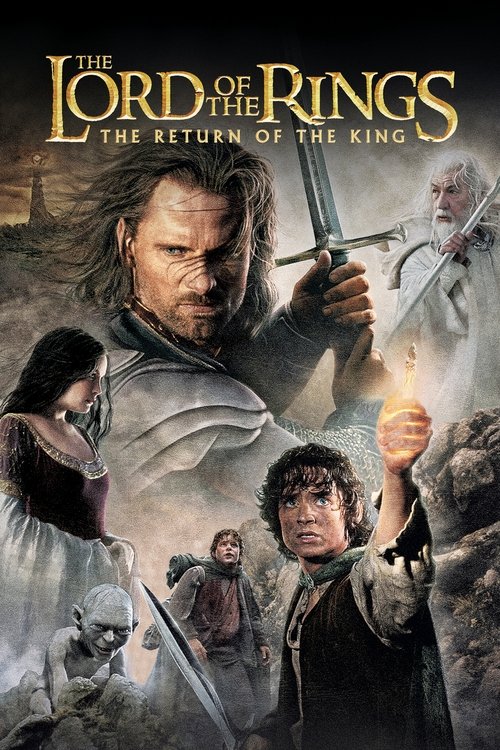
The Lord of the Rings: The Return of the King
2003 · Directed by Peter Jackson
Woke Score
CriticCritic Score
Audience
Ultra Based
Critics rated this 86 points above its woke score. Among Ultra Based films, this critic score ranks #67 of 1469.
Representation Casting
Score: 8/100
The cast is predominantly white and male. Female characters exist but are limited in number and agency. No deliberate effort toward diverse casting is evident.
LGBTQ+ Themes
Score: 0/100
No LGBTQ+ themes, representation, or subtext present. The film does not engage with sexual orientation or gender identity.
Feminist Agenda
Score: 12/100
Eowyn has a significant arc involving agency and military participation, but women remain subordinate in the narrative structure. The female perspective is peripheral to the main quest.
Racial Consciousness
Score: 5/100
Race and ethnicity are not interrogated as social categories. The film reflects Tolkien's eucatastrophic European medievalism without commentary on racial dynamics.
Climate Crusade
Score: 0/100
No environmental messaging or climate consciousness. The destruction of natural environments serves only as backdrop for battle scenes, not as critique.
Eat the Rich
Score: 15/100
The Ring's corrupting power metaphorically addresses desire for dominance, but this is not framed as critique of capitalist accumulation or economic systems.
Body Positivity
Score: 3/100
Characters are conventionally attractive or grotesquely monstrous. Gollum's physical form reflects evil rather than representing neurodivergent or atypical bodies positively.
Neurodivergence
Score: 0/100
No engagement with neurodivergence or disability representation. Gollum's mental fragmentation is purely narrative device, not representation.
Revisionist History
Score: 0/100
The film adapts Tolkien's fictional world faithfully. There is no rewriting of actual history or revisionist engagement with real events.
Lecture Energy
Score: 8/100
Occasional moments where characters articulate moral philosophy, but the film prioritizes action and emotion over preachy exposition about social values.


Synopsis
As armies mass for a final battle that will decide the fate of the world--and powerful, ancient forces of Light and Dark compete to determine the outcome--one member of the Fellowship of the Ring is revealed as the noble heir to the throne of the Kings of Men. Yet, the sole hope for triumph over evil lies with a brave hobbit, Frodo, who, accompanied by his loyal friend Sam and the hideous, wretched Gollum, ventures deep into the very dark heart of Mordor on his seemingly impossible quest to destroy the Ring of Power.
Consciousness Assessment
Peter Jackson's "The Return of the King" stands as a monument to pre-woke filmmaking, a three-hour epic that concerns itself primarily with narrative coherence, visual spectacle, and emotional authenticity rather than contemporary cultural markers. The film adapts Tolkien's 1950s source material with remarkable fidelity, preserving its inherent limitations along with its strengths. Frodo's journey to Mount Doom remains the emotional core, though the film's treatment of female characters, particularly Arwen and Eowyn, reflects both the author's original vision and the creative choices of 2003, neither of which prioritize modern progressive sensibilities. The Fellowship's composition mirrors the books: predominantly white, male-coded, with women relegated to supporting roles despite moments of agency.
The film's thematic preoccupations center on friendship, sacrifice, and the corrupting nature of power, concepts that operate independently of contemporary social consciousness. There is no meaningful engagement with representation as a deliberate choice, no visible infrastructure of diversity, no climate messaging, no interrogation of capitalism or economic systems. The villains are simply evil, not symptomatic of societal structures requiring dismantling. Andy Serkis's motion-capture performance as Gollum remains technically innovative and emotionally compelling, but the character serves narrative function rather than neurodivergent representation. The film's treatment of race and ethnicity stays faithful to Tolkien's eucatastrophic medievalism, a European-inflected fantasy landscape where difference is minimal and unremarked.
What emerges is a work of genuine artistic achievement that operates in an entirely different cultural register from contemporary filmmaking. "The Return of the King" succeeded because it prioritized story, craft, and emotional resonance. By contemporary standards, this registers as a significant deficit in progressive consciousness. The film simply does not attempt to address modern social categories or anxieties. It is, in the most literal sense, not trying.
Analysis generated by our Consciousness Algorithm
Critic Reviews
“The conclusion of Peter Jackson's masterwork is passionate and literate, detailed and expansive, and it's conceived with a risk-taking flair for old-fashioned movie magic at its most precious.”
“An epic success and a history-making production that finishes with a masterfully entertaining final installment.”
“The second installment was better than the first, and this one is best of all. It has spectacular action scenes and imaginary creatures, and it’s by far the most moving chapter. The performances have deepened.”
“Add a lot of dull acting -- except Sir Ian McKellen and Andy Serkis -- and you have an uneven movie with yawns aplenty.”
Consciousness Markers
The cast is predominantly white and male. Female characters exist but are limited in number and agency. No deliberate effort toward diverse casting is evident.
No LGBTQ+ themes, representation, or subtext present. The film does not engage with sexual orientation or gender identity.
Eowyn has a significant arc involving agency and military participation, but women remain subordinate in the narrative structure. The female perspective is peripheral to the main quest.
Race and ethnicity are not interrogated as social categories. The film reflects Tolkien's eucatastrophic European medievalism without commentary on racial dynamics.
No environmental messaging or climate consciousness. The destruction of natural environments serves only as backdrop for battle scenes, not as critique.
The Ring's corrupting power metaphorically addresses desire for dominance, but this is not framed as critique of capitalist accumulation or economic systems.
Characters are conventionally attractive or grotesquely monstrous. Gollum's physical form reflects evil rather than representing neurodivergent or atypical bodies positively.
No engagement with neurodivergence or disability representation. Gollum's mental fragmentation is purely narrative device, not representation.
The film adapts Tolkien's fictional world faithfully. There is no rewriting of actual history or revisionist engagement with real events.
Occasional moments where characters articulate moral philosophy, but the film prioritizes action and emotion over preachy exposition about social values.