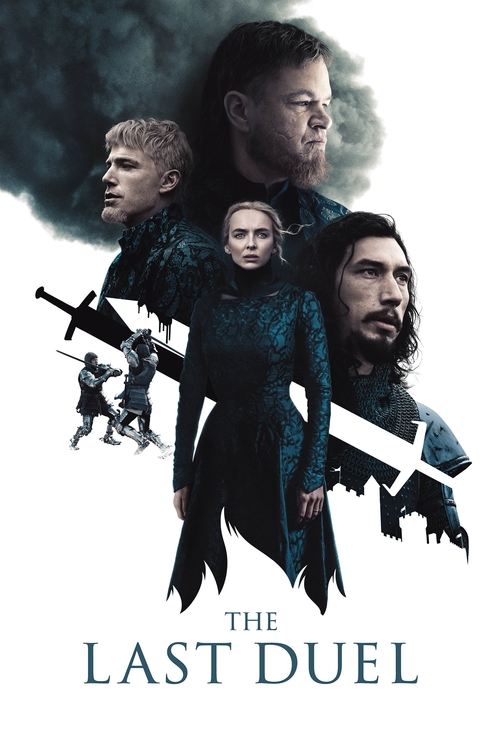
The Last Duel
2021 · Directed by Ridley Scott
Woke Score
CriticCritic Score
Audience
Woke-Adjacent
Critics rated this 19 points above its woke score. Among Woke-Adjacent films, this critic score ranks #90 of 151.
Representation Casting
Score: 55/100
The cast is predominantly white and European, appropriate for a 14th-century French historical drama, with no particular effort toward diverse representation beyond the necessary inclusion of Jodie Comer in a leading role.
LGBTQ+ Themes
Score: 0/100
No LGBTQ+ themes, representation, or subtext present in the film. The narrative is entirely focused on heterosexual male-female conflict.
Feminist Agenda
Score: 65/100
The film's three-perspective narrative structure deliberately elevates Marguerite's account and validates her experience of sexual assault. Her voice receives equal narrative weight to the men's versions of events, which is a notable progressive choice for a historical drama.
Racial Consciousness
Score: 0/100
The film makes no attempt to interrogate race or racial dynamics. It is a straightforward historical narrative set in medieval France with no commentary on racial or ethnic systems.
Climate Crusade
Score: 0/100
Climate themes are entirely absent from this medieval historical drama about judicial combat and sexual assault.
Eat the Rich
Score: 5/100
While feudal hierarchy is depicted, the film does not critique capitalism or economic systems in any meaningful way. The social order is presented as historical context rather than as a system to be interrogated.
Body Positivity
Score: 0/100
Body positivity is not a theme in this film. Characters are presented according to historical costume and period aesthetics without commentary on body diversity or acceptance.
Neurodivergence
Score: 0/100
No representation of neurodivergence or disability is present in the film. Characters are portrayed without reference to neurodivergent conditions or neurodiversity.
Revisionist History
Score: 20/100
The film adapts Eric Jager's historical scholarship but does not dramatically revise the historical record. The three-perspective structure is a narrative device rather than a historical correction, though it does emphasize Marguerite's agency in a way that some historical accounts may not.
Lecture Energy
Score: 30/100
The film trusts its narrative structure to convey meaning rather than resorting to explicit preachiness. However, the deliberate three-perspective device and the careful framing of Marguerite's account suggest some authorial instruction in how to interpret events.


Synopsis
King Charles VI declares that Knight Jean de Carrouges settle his dispute with his squire, Jacques Le Gris, by challenging him to a duel.
Consciousness Assessment
Ridley Scott's "The Last Duel" occupies an interesting middle ground in the landscape of contemporary historical cinema. The film's central narrative device, the three-perspective structure that grants Marguerite de Carrouges equal narrative weight to the men's accounts of the contested events, reads as deliberate commentary on whose stories get told and believed. Jodie Comer's performance and the film's refusal to dismiss her character's perspective create a progressive framework that would have been unthinkable in traditional medieval dramas of earlier decades. The film treats sexual violence with gravity and refuses to minimize its protagonist's trauma, presenting her not as a passive victim but as someone fighting for recognition and justice within the constraints of her historical moment.
Yet this progressive sensibility operates within a fundamentally conservative historical framework. The film is ultimately interested in the legal and martial traditions of 14th-century France rather than in any broader interrogation of systemic power structures or contemporary social dynamics. The rape accusation, while central to the plot, is treated as a personal matter between individuals rather than as a manifestation of patriarchal systems that might warrant explicit critique. There is no sense that the film is using history as a mirror for modern sexual politics in the way that more aggressively progressive cinema might. The film's feminism, such as it is, emerges from the narrative itself rather than from authorial commentary or preachy framing.
The film's progressive casting choices and the inclusion of Marguerite's voice place it above the baseline for older historical cinema, but its restraint in avoiding explicit modern social consciousness keeps it from reaching higher registers. This is a film that grants women agency and perspective while remaining fundamentally committed to the aesthetic and thematic traditions of prestige historical drama.
Analysis generated by our Consciousness Algorithm
Critic Reviews
“The Last Duel is a testament to male self-delusion and self-mythologizing, and the impact it has on the women around them.”
“The Last Duel, directed by Ridley Scott, gives us the texture of life in 14th century France, so much so that we feel that we are there, in this place that’s desperate and foreign and yet human and familiar.”
“Scott contrives a convincing resemblance to events leading up to the last court-sanctioned duel-to-the-death with a meticulous eye for specifics. He transfers a riveting piece of history into a riveting film—mostly. ”
“Degreasing a stove is a more enjoyable way to spend your Saturday night.”
Consciousness Markers
The cast is predominantly white and European, appropriate for a 14th-century French historical drama, with no particular effort toward diverse representation beyond the necessary inclusion of Jodie Comer in a leading role.
No LGBTQ+ themes, representation, or subtext present in the film. The narrative is entirely focused on heterosexual male-female conflict.
The film's three-perspective narrative structure deliberately elevates Marguerite's account and validates her experience of sexual assault. Her voice receives equal narrative weight to the men's versions of events, which is a notable progressive choice for a historical drama.
The film makes no attempt to interrogate race or racial dynamics. It is a straightforward historical narrative set in medieval France with no commentary on racial or ethnic systems.
Climate themes are entirely absent from this medieval historical drama about judicial combat and sexual assault.
While feudal hierarchy is depicted, the film does not critique capitalism or economic systems in any meaningful way. The social order is presented as historical context rather than as a system to be interrogated.
Body positivity is not a theme in this film. Characters are presented according to historical costume and period aesthetics without commentary on body diversity or acceptance.
No representation of neurodivergence or disability is present in the film. Characters are portrayed without reference to neurodivergent conditions or neurodiversity.
The film adapts Eric Jager's historical scholarship but does not dramatically revise the historical record. The three-perspective structure is a narrative device rather than a historical correction, though it does emphasize Marguerite's agency in a way that some historical accounts may not.
The film trusts its narrative structure to convey meaning rather than resorting to explicit preachiness. However, the deliberate three-perspective device and the careful framing of Marguerite's account suggest some authorial instruction in how to interpret events.