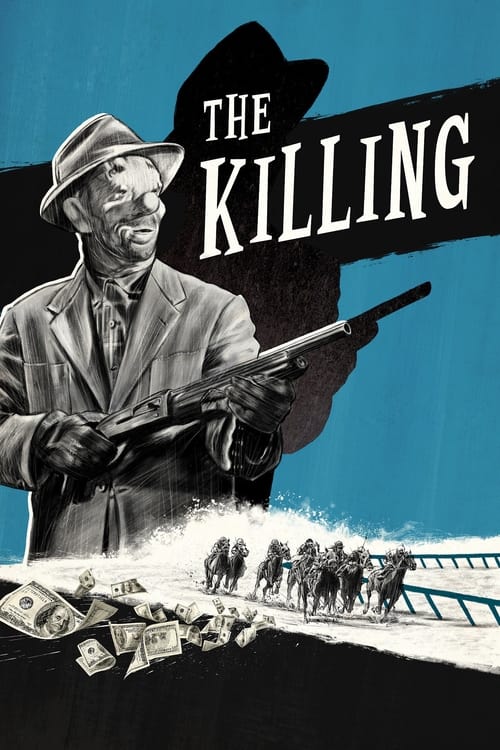
The Killing
1956 · Directed by Stanley Kubrick
Woke Score
CriticCritic Score
Audience
Ultra Based
Critics rated this 89 points above its woke score. Among Ultra Based films, this critic score ranks #118 of 1469.
Representation Casting
Score: 0/100
The cast is uniformly white and male in speaking roles, with women confined to supporting positions as wives and romantic interests. No attempt at diverse casting.
LGBTQ+ Themes
Score: 0/100
No LGBTQ characters, themes, or representation present in the film.
Feminist Agenda
Score: 0/100
Female characters exist as obstacles and romantic complications rather than as agents. No feminist agenda or consciousness evident.
Racial Consciousness
Score: 5/100
James Edwards appears in the cast, an African American actor, though his role appears minor and the film contains no racial consciousness or commentary.
Climate Crusade
Score: 0/100
No climate themes or environmental consciousness present.
Eat the Rich
Score: 0/100
While the plot involves theft from capitalist institutions, this is presented as crime narrative rather than social critique.
Body Positivity
Score: 0/100
No body positivity themes or discussion of physical diversity present.
Neurodivergence
Score: 0/100
No representation of or commentary on neurodivergence in the film.
Revisionist History
Score: 0/100
No historical revisionism or reinterpretation of past events presented.
Lecture Energy
Score: 0/100
The film maintains a straightforward crime thriller tone with no preachy or preachy elements about social issues.


Synopsis
Career criminal Johnny Clay recruits a sharpshooter, a crooked police officer, a bartender and a betting teller named George, among others, for one last job before he goes straight and gets married. But when George tells his restless wife about the scheme to steal millions from the racetrack where he works, she hatches a plot of her own.
Consciousness Assessment
Stanley Kubrick's "The Killing" stands as a monument to the pre-consciousness era of American cinema, a time when social awareness had not yet calcified into the specific cultural markers we now measure. This 1956 heist thriller concerns itself entirely with plot mechanics, character motivation, and the inexorable collision of ambition with circumstance. The film moves through its narrative with the efficiency of a cocked pistol, indifferent to any consideration of who occupies the frame or what identities they might represent. The cast, uniformly male and white in the speaking roles, commits fully to the criminal enterprise at hand, and we are invited to follow their planning and execution without pause for reflection on systemic representation. The women who appear do so as wives and romantic complications, obstacles to be navigated rather than agents of their own narrative. This is not presented as problematic; it is simply how the world of the film constructs itself. Kubrick was interested in the mechanics of betrayal and the mathematics of crime, not in interrogating the social fabric from which his characters emerged. The film contains no lecture, no agenda beyond the immediate tension of whether the heist will succeed before it collapses under its own complexity. In the context of contemporary cultural measurement, "The Killing" registers as essentially inert, a document from a moment before the sensibilities we now catalog had achieved their current cultural salience. It remains a masterwork of its form, which is precisely the point: excellence and progressive consciousness operate in entirely different registers.
Analysis generated by our Consciousness Algorithm
Critic Reviews
“Orson Welles was so taken with this film that after seeing it he declared Kubrick could do no wrong; not to be missed.”
“The kind of Swiss-watch precision and attention to detail that would eventually get Kubrick labeled Hollywood's most notorious perfectionist.”
“As good as the story and direction are, though, the true strength of The Killing lies in the characters and characterizations. ”
“This story of a $2 million race track holdup and steps leading up to the robbery, occasionally told in a documentary style which at first tends to be somewhat confusing, soon settles into a tense and suspenseful vein which carries through to an unexpected and ironic windup.”
Consciousness Markers
The cast is uniformly white and male in speaking roles, with women confined to supporting positions as wives and romantic interests. No attempt at diverse casting.
No LGBTQ characters, themes, or representation present in the film.
Female characters exist as obstacles and romantic complications rather than as agents. No feminist agenda or consciousness evident.
James Edwards appears in the cast, an African American actor, though his role appears minor and the film contains no racial consciousness or commentary.
No climate themes or environmental consciousness present.
While the plot involves theft from capitalist institutions, this is presented as crime narrative rather than social critique.
No body positivity themes or discussion of physical diversity present.
No representation of or commentary on neurodivergence in the film.
No historical revisionism or reinterpretation of past events presented.
The film maintains a straightforward crime thriller tone with no preachy or preachy elements about social issues.