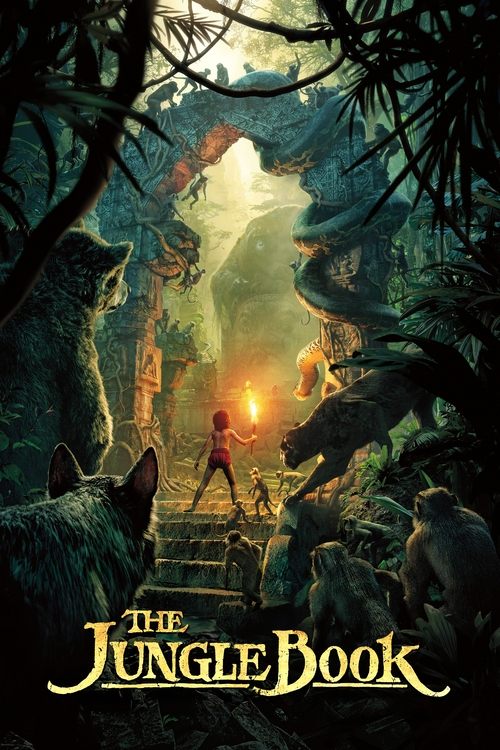
The Jungle Book
2016 · Directed by Jon Favreau
Woke Score
CriticCritic Score
Audience
Based
Critics rated this 30 points above its woke score. Among Based films, this critic score ranks #200 of 345.
Representation Casting
Score: 60/100
Strong diverse voice cast with prominent roles for actors of color including Idris Elba, Lupita Nyong'o, and Giancarlo Esposito. However, diversity exists without explicit celebration or structural engagement with representation as a theme.
LGBTQ+ Themes
Score: 5/100
No LGBTQ+ themes or representation. A children's adventure film about animals and a boy that makes no attempt to incorporate such elements.
Feminist Agenda
Score: 25/100
Raksha serves as a protective maternal figure but lacks agency beyond this role. The narrative centers male characters and male perspectives throughout.
Racial Consciousness
Score: 40/100
Set in India with a diverse cast, but treats the setting as exotic backdrop rather than engaging with postcolonial themes or racial history in meaningful ways.
Climate Crusade
Score: 35/100
Environmental destruction appears through drought and predation, but framed as natural conflict rather than systemic problem warranting contemporary activism or intervention.
Eat the Rich
Score: 15/100
No anti-capitalist messaging or economic critique. The film remains fundamentally apolitical regarding systems of power and wealth.
Body Positivity
Score: 10/100
No representation of body diversity. All characters conform to conventional physical ideals within their animal forms.
Neurodivergence
Score: 0/100
No representation of neurodivergence or discussion of cognitive differences among characters.
Revisionist History
Score: 20/100
Kipling's source material carries colonial baggage, which the film neither meaningfully deconstructs nor explicitly endorses, instead sidestepping the issue entirely.
Lecture Energy
Score: 15/100
Primarily entertainment-focused with themes of belonging and maturation, but lacks preachy messaging or preaching about social issues.


Synopsis
After a threat from the tiger Shere Khan, Mowgli, a man-cub fostered by wolves, is forced to flee the jungle, and he embarks on a journey of self-discovery with the help of the panther, Bagheera, and the free-spirited bear, Baloo.
Consciousness Assessment
Jon Favreau's 2016 adaptation of Kipling's classic presents itself as a progressive update through its casting choices, assembling a voice ensemble of considerable diversity: Idris Elba, Lupita Nyong'o, and Giancarlo Esposito alongside more established names. The film's commitment to photorealistic spectacle and its setting in India create an impression of cultural engagement that proves largely superficial upon examination. The narrative remains fundamentally apolitical, content to use the jungle as a visually stunning backdrop for a coming-of-age story that privileges male perspective and agency.
The film's approach to its source material is notably conservative. Where one might expect a contemporary adaptation to interrogate or reframe the colonial underpinnings of Kipling's original work, this version instead treats such concerns as beside the point. Environmental destruction appears in the form of a drought and Shere Khan's predation, yet the film frames these as natural conflicts rather than systemic problems warranting intervention or activism. The maternal figure of Raksha, despite being voiced by Lupita Nyong'o, exists primarily to demonstrate protective instinct rather than to embody agency or complexity.
What one observes in this project is a film that has hired progressive casting without committing to progressive storytelling. The diversity of its voice cast serves primarily as a marker of contemporary respectability rather than as evidence of meaningful engagement with social consciousness. A family adventure that happens to feature actors of color is not thereby a film of social consequence, and this distinction matters when attempting to measure cultural sensibilities with any precision. The Jungle Book 2016 represents a halfway gesture, competent and well-intentioned but ultimately hollow.
Analysis generated by our Consciousness Algorithm
Critic Reviews
“It's a slight tale, of course, and incredibly short, but the characters and songs are pretty much perfect viewing time and again.”
“Based loosely on Rudyard Kipling's Mowgli stories, this glowing little picture should be grand fun for all ages.”
“Like Disney's other adaptations of children's classics, The Jungle Book is based on the Kipling original in the same way that a fox hunt is based on foxes. Nonetheless, the result is thoroughly delightful.”
“A serious disappointment, recommended only for inveterate Disney fans and very young people.”
Consciousness Markers
Strong diverse voice cast with prominent roles for actors of color including Idris Elba, Lupita Nyong'o, and Giancarlo Esposito. However, diversity exists without explicit celebration or structural engagement with representation as a theme.
No LGBTQ+ themes or representation. A children's adventure film about animals and a boy that makes no attempt to incorporate such elements.
Raksha serves as a protective maternal figure but lacks agency beyond this role. The narrative centers male characters and male perspectives throughout.
Set in India with a diverse cast, but treats the setting as exotic backdrop rather than engaging with postcolonial themes or racial history in meaningful ways.
Environmental destruction appears through drought and predation, but framed as natural conflict rather than systemic problem warranting contemporary activism or intervention.
No anti-capitalist messaging or economic critique. The film remains fundamentally apolitical regarding systems of power and wealth.
No representation of body diversity. All characters conform to conventional physical ideals within their animal forms.
No representation of neurodivergence or discussion of cognitive differences among characters.
Kipling's source material carries colonial baggage, which the film neither meaningfully deconstructs nor explicitly endorses, instead sidestepping the issue entirely.
Primarily entertainment-focused with themes of belonging and maturation, but lacks preachy messaging or preaching about social issues.