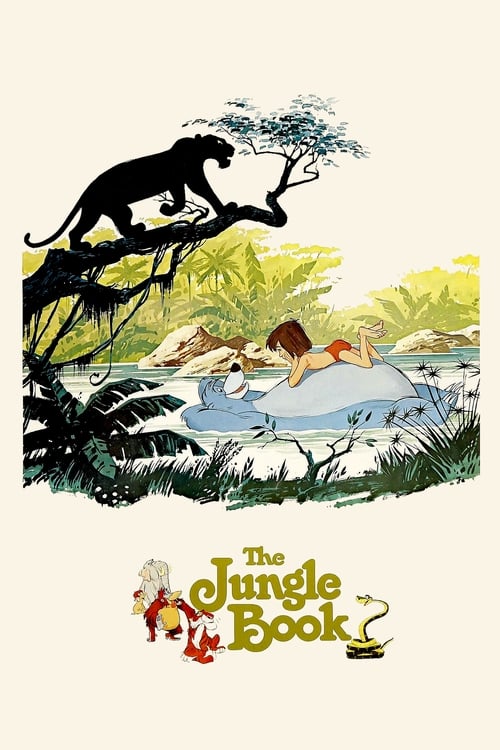
The Jungle Book
1967 · Directed by Wolfgang Reitherman
Woke Score
CriticCritic Score
Audience
Ultra Based
Critics rated this 57 points above its woke score. Among Ultra Based films, this critic score ranks #780 of 1469.
Representation Casting
Score: 15/100
All-white voice cast in a story set in India with no attempt at authentic or representative casting. The absence of South Asian voices is notable but typical of 1967 animation practices.
LGBTQ+ Themes
Score: 0/100
No LGBTQ+ themes, characters, or messaging present in the film. The story contains no romantic or sexual content of any kind.
Feminist Agenda
Score: 5/100
Minimal female presence in the film. Characters like Shanti are peripheral and serve traditional roles. No feminist agenda or commentary is evident.
Racial Consciousness
Score: 20/100
King Louie's characterization, while meant as comic relief, invokes uncomfortable racial associations through the pairing of an ape character with jazz vernacular and vocal performance.
Climate Crusade
Score: 0/100
No environmental messaging or climate advocacy. The jungle is treated as a setting rather than a subject of environmental consciousness.
Eat the Rich
Score: 0/100
No anti-capitalist themes or critique of wealth and class systems. The narrative contains no economic messaging whatsoever.
Body Positivity
Score: 0/100
No body positivity messaging or commentary on physical appearance. Characters are designed for aesthetic appeal without any progressive body consciousness.
Neurodivergence
Score: 0/100
No representation of neurodivergence or neurodivergent characters. The film does not engage with neurodiversity in any form.
Revisionist History
Score: 35/100
The narrative frames civilization (the man-village) as progress and destiny, reflecting colonial assumptions about 'civilizing' indigenous populations. The source material's colonial context is left unexamined.
Lecture Energy
Score: 5/100
The film prioritizes entertainment and charm over preachy messaging. Baloo's philosophy is presented as wisdom rather than lecture, and the overall tone avoids preachiness.


Synopsis
The boy Mowgli makes his way to the man-village with Bagheera, the wise panther. Along the way he meets jazzy King Louie, the hypnotic snake Kaa and the lovable, happy-go-lucky bear Baloo, who teaches Mowgli "The Bare Necessities" of life and the true meaning of friendship.
Consciousness Assessment
Disney's final animated feature overseen by Walt himself presents a curious artifact of 1967 sensibilities, one that modern viewers must approach with the caution of an archaeologist examining a relic. The film is not aggressively progressive by any measure, yet it contains enough troubling elements to warrant careful examination. The casting of King Louie, an ape character voiced by Louis Prima and performed in jazz vernacular, remains the most discussed flashpoint. Scholars have noted how the character invokes uncomfortable historical associations, though the film itself seems oblivious to these implications. The narrative trajectory, wherein Mowgli must abandon the jungle for the "man-village" to achieve his destiny, carries colonial assumptions about civilization and progress that feel dated even for its era.
What redeems the film from scoring higher is its fundamental lack of engagement with any modern progressive frameworks whatsoever. There is no representation consciousness, no feminist messaging, no racial consciousness, no environmental advocacy, and certainly no anti-capitalist sensibility. The animals exist as colorful personalities without commentary on their treatment. The all-white voice cast performing an Indian setting is notable but not unusual for 1967 animation. The film's problems are largely those of omission rather than commission, the casual erasure of a culture rather than active vilification. It is a product of its moment, neither aggressive in its retrograde views nor particularly forward-thinking.
This places The Jungle Book in a peculiar zone: problematic by modern standards yet insufficiently engaged with modern social consciousness to register as truly progressive in either direction. It scores modestly on revisionist history for its colonial framing and slightly higher on representation casting for the complete absence of Asian voices in an Asian setting, but elsewhere the film simply does not engage with the cultural markers we are measuring. It remains what it was: a charming, well-crafted animated musical that happened to be made in an era when such oversights were standard practice.
Analysis generated by our Consciousness Algorithm
Critic Reviews
“It's a slight tale, of course, and incredibly short, but the characters and songs are pretty much perfect viewing time and again.”
“Based loosely on Rudyard Kipling's Mowgli stories, this glowing little picture should be grand fun for all ages.”
“Like Disney's other adaptations of children's classics, The Jungle Book is based on the Kipling original in the same way that a fox hunt is based on foxes. Nonetheless, the result is thoroughly delightful.”
“A serious disappointment, recommended only for inveterate Disney fans and very young people.”
Consciousness Markers
All-white voice cast in a story set in India with no attempt at authentic or representative casting. The absence of South Asian voices is notable but typical of 1967 animation practices.
No LGBTQ+ themes, characters, or messaging present in the film. The story contains no romantic or sexual content of any kind.
Minimal female presence in the film. Characters like Shanti are peripheral and serve traditional roles. No feminist agenda or commentary is evident.
King Louie's characterization, while meant as comic relief, invokes uncomfortable racial associations through the pairing of an ape character with jazz vernacular and vocal performance.
No environmental messaging or climate advocacy. The jungle is treated as a setting rather than a subject of environmental consciousness.
No anti-capitalist themes or critique of wealth and class systems. The narrative contains no economic messaging whatsoever.
No body positivity messaging or commentary on physical appearance. Characters are designed for aesthetic appeal without any progressive body consciousness.
No representation of neurodivergence or neurodivergent characters. The film does not engage with neurodiversity in any form.
The narrative frames civilization (the man-village) as progress and destiny, reflecting colonial assumptions about 'civilizing' indigenous populations. The source material's colonial context is left unexamined.
The film prioritizes entertainment and charm over preachy messaging. Baloo's philosophy is presented as wisdom rather than lecture, and the overall tone avoids preachiness.