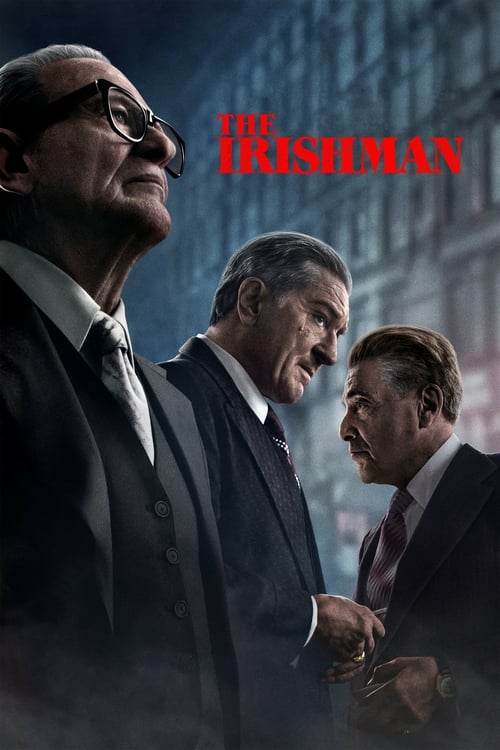
The Irishman
2019 · Directed by Martin Scorsese
Woke Score
CriticCritic Score
Audience
Ultra Based
Critics rated this 86 points above its woke score. Among Ultra Based films, this critic score ranks #63 of 1469.
Representation Casting
Score: 20/100
Supporting cast includes diverse performers, but this appears incidental rather than intentional representation. Anna Paquin's minimal role undermines any strong representation argument.
LGBTQ+ Themes
Score: 0/100
No LGBTQ+ themes, representation, or content present in the film.
Feminist Agenda
Score: 0/100
The narrative centers entirely on male characters and male power structures. Female characters exist primarily in relation to male protagonists.
Racial Consciousness
Score: 5/100
The film depicts organized crime across ethnic lines but without explicit racial consciousness or commentary on systemic racism.
Climate Crusade
Score: 0/100
No climate themes or environmental consciousness present.
Eat the Rich
Score: 15/100
The film depicts corruption and moral decay within capitalist systems, but presents this as moral commentary rather than anti-capitalist critique.
Body Positivity
Score: 0/100
No body positivity themes. The use of de-aging technology is a technical choice, not a cultural statement.
Neurodivergence
Score: 0/100
No representation or exploration of neurodivergence in the film.
Revisionist History
Score: 0/100
The film adapts a book about real events but presents them in conventional historical narrative without revisionist intent.
Lecture Energy
Score: 10/100
The film explores themes of mortality and the cost of a criminal life, but these are expressed through narrative and character rather than explicit preachy messaging.


Synopsis
Pennsylvania, 1956. Frank Sheeran, a war veteran of Irish origin who works as a truck driver, accidentally meets mobster Russell Bufalino. Once Frank becomes his trusted man, Bufalino sends him to Chicago with the task of helping Jimmy Hoffa, a powerful union leader related to organized crime, with whom Frank will maintain a close friendship for nearly twenty years.
Consciousness Assessment
Martin Scorsese's three-and-a-half-hour meditation on organized crime and mortality arrives as a thoroughly traditional gangster narrative, dressed in the formal attire of prestige cinema but harboring no interest in progressive cultural commentary. The film concerns itself with the inner lives of male criminals, their relationships with other male criminals, and the slow erosion of their bodies and consciences across decades. This is cinema in the service of examining human darkness, not social consciousness.
The supporting cast includes performers of various ethnic backgrounds, and this diversity serves the story's verisimilitude rather than any programmatic representation agenda. Anna Paquin's notorious seven-word appearance as Frank's estranged daughter generated discourse about female representation in Scorsese films, though the role itself reads less as a progressive statement than as a narrative device to register moral judgment. The film depicts systemic corruption across American institutions, but presents this as a portrait of moral decay rather than a critique of capitalism itself.
The work remains committed to classical storytelling and the examination of masculine violence as a life choice with consequences. The de-aging technology used on aging stars is a technical innovation, not a cultural statement. The film received ten Oscar nominations and won none, a fate perhaps fitting for a work that operates entirely outside the contemporary conversation about social consciousness in cinema.
Analysis generated by our Consciousness Algorithm
Critic Reviews
“The Irishman is a remarkable achievement that proves the best may yet to come from one of the most essential American filmmakers to ever live.”
“The Irishman, which feels like the work of an older, wiser, less flashy filmmaker, is much more preoccupied with the soul of Frank Sheeran and reckoning with his choices.”
“Martin Scorsese’s The Irishman is a coldly enthralling, long-form knockout — a majestic Mob epic with ice in its veins. It’s the film that, I think, a lot us wanted to see from Scorsese: a stately, ominous, suck-in-your-breath summing up, not just a drama but a reckoning, a vision of the criminal underworld that’s rippling with echoes of the director’s previous Mob films, but that also takes us someplace bold and new.”
“Does this stylistically unstylish picture stand with the lurid glories of “Casino,” the pulse-pounding narrative drive and cinema semiotics of “The Departed,” or the charismatic cynicism of “Goodfellas?” Give me a freaking break.”
Consciousness Markers
Supporting cast includes diverse performers, but this appears incidental rather than intentional representation. Anna Paquin's minimal role undermines any strong representation argument.
No LGBTQ+ themes, representation, or content present in the film.
The narrative centers entirely on male characters and male power structures. Female characters exist primarily in relation to male protagonists.
The film depicts organized crime across ethnic lines but without explicit racial consciousness or commentary on systemic racism.
No climate themes or environmental consciousness present.
The film depicts corruption and moral decay within capitalist systems, but presents this as moral commentary rather than anti-capitalist critique.
No body positivity themes. The use of de-aging technology is a technical choice, not a cultural statement.
No representation or exploration of neurodivergence in the film.
The film adapts a book about real events but presents them in conventional historical narrative without revisionist intent.
The film explores themes of mortality and the cost of a criminal life, but these are expressed through narrative and character rather than explicit preachy messaging.