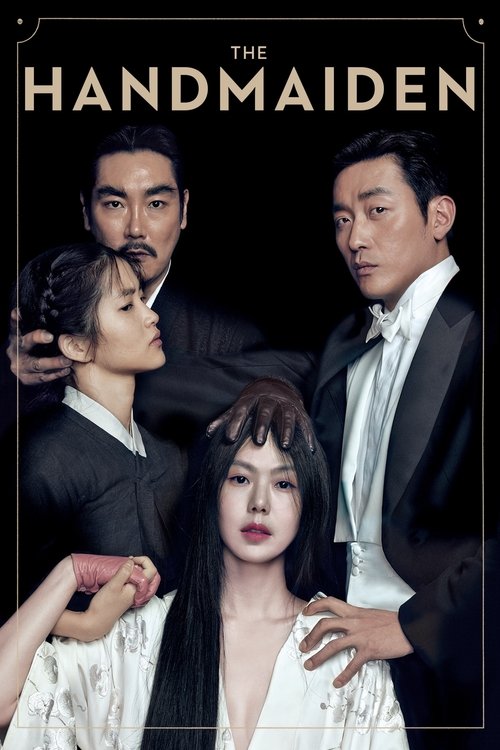
The Handmaiden
2016 · Directed by Park Chan-wook
Woke Score
Critic Score
Audience
Woke
Critics rated this 35 points above its woke score. Among Woke films, this critic score ranks #6 of 57.
Representation Casting
Score: 75/100
Both female leads are fully realized, complex characters with agency and interiority. The representation reflects intentional casting choices rather than contemporary diversity mandates, though the film centers women in roles typically dominated by men in period thrillers.
LGBTQ+ Themes
Score: 85/100
The romantic and sexual relationship between the two female leads is central and transformative. The film presents this relationship with nuance and emotional weight, earning recognition as a significant work in LGBTQ+ cinema.
Feminist Agenda
Score: 80/100
The narrative explicitly explores women's autonomy, sexuality, and liberation from patriarchal control. Both female characters resist male authority and find agency through mutual alliance, subverting gendered tropes inherent in the crime genre.
Racial Consciousness
Score: 75/100
The film engages directly with Japanese colonial occupation and power dynamics between Korean and Japanese characters through a postcolonial lens. However, the focus remains primarily on gender dynamics rather than explicitly centering racial justice as a political project.
Climate Crusade
Score: 0/100
No climate themes present in this 1930s period thriller about colonial Korea and financial crime. The film contains no environmental messaging or climate consciousness.
Eat the Rich
Score: 35/100
Class dynamics and wealth inequality are present through the con scheme targeting a wealthy heiress. However, the protagonists pursue theft for personal gain rather than ideological resistance to capitalism. The film is not fundamentally anti-capitalist.
Body Positivity
Score: 0/100
No body positivity messaging or challenge to beauty standards. The film does not engage with contemporary body positivity discourse or celebrate diverse body types.
Neurodivergence
Score: 0/100
No representation of neurodivergent characters or thematic engagement with disability or neurodiversity. The film contains no such elements.
Revisionist History
Score: 20/100
While the film uses historical setting and depicts colonial occupation as oppressive (historically accurate), it does not substantially revise historical narratives through a modern progressive lens or impose contemporary identity frameworks onto the period.
Lecture Energy
Score: 25/100
The film trusts its audience to understand its themes through narrative and visual language rather than explicit exposition. Postcolonial and feminist themes emerge organically from the story, avoiding didactic messaging that would characterize higher lecture energy.


Synopsis
1930s Korea, in the period of Japanese occupation, a new girl, Sookee, is hired as a handmaiden to a Japanese heiress, Hideko, who lives a secluded life on a large countryside estate with her domineering Uncle Kouzuki. But the maid has a secret. She is a pickpocket recruited by a swindler posing as a Japanese Count to help him seduce the Lady to steal her fortune.
Consciousness Assessment
Park Chan-wook's adaptation of Sarah Waters' "Fingersmith" transplants a Victorian crime novel to 1930s colonial Korea with such deliberate precision that one might mistake the setting change for mere window dressing. It is not. The film harnesses the postcolonial landscape to amplify its exploration of power, gender, and the possibility of liberation through intimate alliance. The two female leads operate within multiple systems of domination, each layer coded through the film's visual language and narrative architecture. Their relationship functions simultaneously as romance, con, and quiet revolution against the patriarchal structures that contain them.
The film's progressive sensibilities emerge not from didactic messaging but from its formal and narrative choices. Women are not rescued by men; they rescue themselves and each other through cunning and mutual desire. The romantic and sexual relationship between the Korean handmaiden and Japanese heiress receives the same visual and emotional weight as any heterosexual romance, presented with neither apology nor explanation. Critics have noted that the film navigates cultural taboos with a sophistication that distinguishes it from more heavy-handed treatments. The postcolonial dimension adds texture without overwhelming the intimate story, though one might argue the film remains more interested in gender dynamics than in explicitly centering racial consciousness as a political project.
What prevents a higher score is the film's ambivalence about its own politics. It does not lecture. It does not announce its themes. The con narrative suggests that theft and deception are tools for survival rather than ideologically motivated resistance. The film is aesthetically progressive without being programmatically so, which is precisely what makes it endure as cinema rather than as message delivery. It asks us to recognize the intelligence and agency of its female characters without requiring us to celebrate their choices. This restraint is a virtue in the art form, even if it complicates its standing as a work of overt cultural consciousness.
Analysis generated by our Consciousness Algorithm
Critic Reviews
“Expectations are fully met in Park Chan-wook's exquisitely filmed The Handmaiden (Agassi), an amusingly kinky erotic thriller and love story that brims with delicious surprises, making its two-and-a-half hours fly by.”
“Perhaps the most surprising turn in The Handmaiden is that Park has knowingly subverted his own iconography by delivering one of the most beautifully romantic films of the year.”
“Thoroughly entertaining, startling and highly erotic film.”
“It is voluptuously beautiful, frankly sexual, occasionally perverse and horrifically violent.”
“The Handmaiden is film at its most exhilarating by a director at the height of his powers, and it's the kind of singular rarity that must be savored when it comes around.”
“Elegantly depraved and immaculately degenerate, Park Chan Wook's The Handmaiden is an astonishment. The filmmaking is masterful, very near to Hitchcock in its sly, controlled teasing of the audience.”
Consciousness Markers
Both female leads are fully realized, complex characters with agency and interiority. The representation reflects intentional casting choices rather than contemporary diversity mandates, though the film centers women in roles typically dominated by men in period thrillers.
The romantic and sexual relationship between the two female leads is central and transformative. The film presents this relationship with nuance and emotional weight, earning recognition as a significant work in LGBTQ+ cinema.
The narrative explicitly explores women's autonomy, sexuality, and liberation from patriarchal control. Both female characters resist male authority and find agency through mutual alliance, subverting gendered tropes inherent in the crime genre.
The film engages directly with Japanese colonial occupation and power dynamics between Korean and Japanese characters through a postcolonial lens. However, the focus remains primarily on gender dynamics rather than explicitly centering racial justice as a political project.
No climate themes present in this 1930s period thriller about colonial Korea and financial crime. The film contains no environmental messaging or climate consciousness.
Class dynamics and wealth inequality are present through the con scheme targeting a wealthy heiress. However, the protagonists pursue theft for personal gain rather than ideological resistance to capitalism. The film is not fundamentally anti-capitalist.
No body positivity messaging or challenge to beauty standards. The film does not engage with contemporary body positivity discourse or celebrate diverse body types.
No representation of neurodivergent characters or thematic engagement with disability or neurodiversity. The film contains no such elements.
While the film uses historical setting and depicts colonial occupation as oppressive (historically accurate), it does not substantially revise historical narratives through a modern progressive lens or impose contemporary identity frameworks onto the period.
The film trusts its audience to understand its themes through narrative and visual language rather than explicit exposition. Postcolonial and feminist themes emerge organically from the story, avoiding didactic messaging that would characterize higher lecture energy.