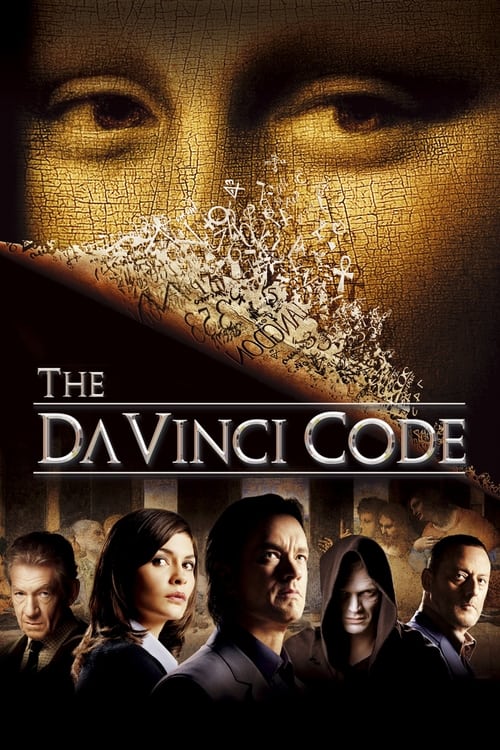
The Da Vinci Code
2006 · Directed by Ron Howard
Woke Score
CriticCritic Score
Audience
Ultra Based
Critics rated this 28 points above its woke score. Among Ultra Based films, this critic score ranks #1246 of 1469.
Representation Casting
Score: 8/100
Predominantly white cast with Audrey Tautou as the sole non-American lead. No intentional diversity consciousness or representation beyond traditional Hollywood casting conventions.
LGBTQ+ Themes
Score: 0/100
No LGBTQ+ themes, representation, or storylines present in the film.
Feminist Agenda
Score: 15/100
Sophie Neveu is capable but functions primarily as supporting character and love interest. Male protagonist remains narrative center with no examination of gender power dynamics.
Racial Consciousness
Score: 2/100
Set in Paris with near-total white cast. No engagement with racial themes, racial consciousness, or interrogation of racial dynamics.
Climate Crusade
Score: 0/100
Climate themes are completely absent from this religious mystery thriller.
Eat the Rich
Score: 5/100
Limited engagement with economic systems. Focus on institutional religious power rather than capitalist critique.
Body Positivity
Score: 0/100
Body positivity is not a theme in this thriller.
Neurodivergence
Score: 2/100
Silas's albinism is presented as part of his character design rather than positive representation or neurodivergent consciousness.
Revisionist History
Score: 35/100
The film directly challenges Catholic Church orthodoxy and presents alternative historical narratives about Mary Magdalene and Jesus's lineage, though this operates in a pre-modern-social-justice framework.
Lecture Energy
Score: 22/100
Heavy expository passages delivered through Langdon's professorial explanations create lecture-hall atmosphere, but this serves plot mechanics rather than preachy social messaging.


Synopsis
A murder in Paris' Louvre Museum and cryptic clues in some of Leonardo da Vinci's most famous paintings lead to the discovery of a religious mystery. For 2,000 years a secret society closely guards information that should it come to light could rock the very foundations of Christianity.
Consciousness Assessment
Ron Howard's adaptation of Dan Brown's theological thriller is a straightforward mystery vehicle for Tom Hanks, arriving in that pre-social consciousness era when a film could generate international controversy primarily through its religious revisionism rather than its cultural representation. The narrative dutifully connects Leonardo da Vinci's paintings to a secret history of Christianity, presenting a world where institutional power structures guard dangerous truths. Yet this engagement with religious orthodoxy operates in a fundamentally different register than modern progressive consciousness. Sophie Neveu functions as a capable co-protagonist and love interest, but her presence reflects the action-movie conventions of the mid-2000s rather than any deliberate interrogation of gender dynamics or power imbalance.
The film's heavy expository passages, delivered primarily through Langdon's professorial monologues, create a lecture-hall atmosphere that serves plot mechanics rather than social instruction. We move through Paris monuments and historical revelations with the efficiency of a museum docent, collecting clues and explanations at a brisk pace. The albino assassin Silas is a religious extremist, his condition incidental to rather than central to his characterization. There is no attempt at representation consciousness, body positivity, climate awareness, or LGBTQ+ inclusion, nor should we expect such markers from a 2006 commercial thriller.
The Da Vinci Code occupies that curious middle space of pre-2015 cultural production, sophisticated enough to challenge religious institutions but innocent of the specific markers of contemporary progressive sensibility. It is a film about secrets and power, yes, but the power structures examined are religious and historical rather than social or systemic. In this sense, it remains a product of its moment, ambitious in scope but unconcerned with the frameworks that would come to dominate cultural discourse a decade later.
Analysis generated by our Consciousness Algorithm
Critic Reviews
“Ron Howard's splendid The Da Vinci Code is the Holy Grail of summer blockbusters: a crackling, fast-moving thriller that's every bit as brainy and irresistible as Dan Brown's controversial bestseller.”
“A crackling rendition of Dan Brown's novel, siphoning off unneeded fat and fancy and leaving us with a streamlined train of a picture that never stops moving.”
“The film has an exciting visual texture that gives body to Brown's bestseller-ese prose, and uniformly strong performances that give dimension, depth and interest to characters that the author never entirely brought to life. In this sense, I found it much more entertaining and satisfying than the novel.”
“The Catholic Church has nothing to fear from this film. It is not just tripe. It is self-evident, spirit-lowering tripe that could not conceivably cause a single member of the flock to turn aside from the faith.”
Consciousness Markers
Predominantly white cast with Audrey Tautou as the sole non-American lead. No intentional diversity consciousness or representation beyond traditional Hollywood casting conventions.
No LGBTQ+ themes, representation, or storylines present in the film.
Sophie Neveu is capable but functions primarily as supporting character and love interest. Male protagonist remains narrative center with no examination of gender power dynamics.
Set in Paris with near-total white cast. No engagement with racial themes, racial consciousness, or interrogation of racial dynamics.
Climate themes are completely absent from this religious mystery thriller.
Limited engagement with economic systems. Focus on institutional religious power rather than capitalist critique.
Body positivity is not a theme in this thriller.
Silas's albinism is presented as part of his character design rather than positive representation or neurodivergent consciousness.
The film directly challenges Catholic Church orthodoxy and presents alternative historical narratives about Mary Magdalene and Jesus's lineage, though this operates in a pre-modern-social-justice framework.
Heavy expository passages delivered through Langdon's professorial explanations create lecture-hall atmosphere, but this serves plot mechanics rather than preachy social messaging.