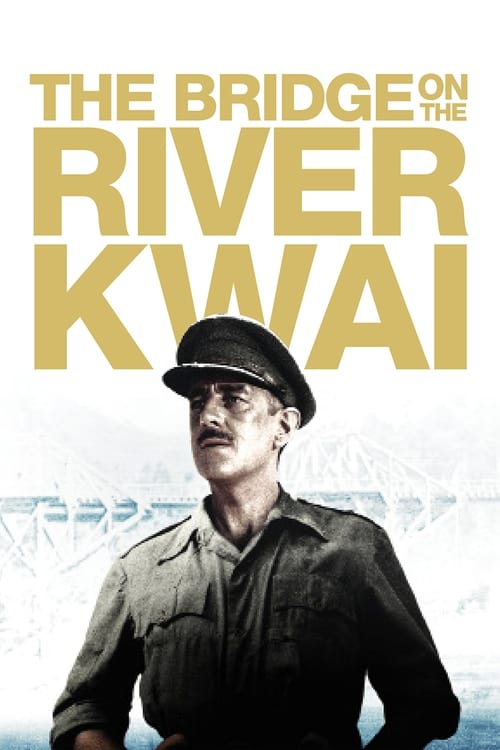
The Bridge on the River Kwai
1957 · Directed by David Lean
Woke Score
CriticCritic Score
Audience
Ultra Based
Critics rated this 84 points above its woke score. Among Ultra Based films, this critic score ranks #184 of 1469.
Representation Casting
Score: 5/100
The cast is entirely white British and American officers with the exception of Sessue Hayakawa as the Japanese commandant. The Burmese setting and people are absent from the narrative focus.
LGBTQ+ Themes
Score: 0/100
No LGBTQ+ themes, representation, or subtext present in the film. The narrative is entirely heteronormative and centered on masculine military culture.
Feminist Agenda
Score: 0/100
The film contains no female characters of significance. It is a thoroughly male-centered war narrative focused on masculine pride and honor.
Racial Consciousness
Score: 3/100
While Hayakawa's dignified portrayal of the Japanese commandant prevents outright racial caricature, the film shows no interest in exploring the perspectives of colonized or occupied peoples.
Climate Crusade
Score: 0/100
Environmental themes are entirely absent from this 1957 war epic. The natural setting exists only as scenery.
Eat the Rich
Score: 0/100
The film presents no critique of capitalism or wealth structures. Its concerns are military, personal, and psychological rather than economic.
Body Positivity
Score: 0/100
Body positivity is not a relevant category for this film. Physical appearance is presented conventionally within 1950s Hollywood norms.
Neurodivergence
Score: 0/100
Neurodiversity is not addressed or represented in the film. Characters are presented through conventional psychological frameworks.
Revisionist History
Score: 15/100
The film takes considerable liberty with historical events, particularly regarding the bridge's construction and the dynamics between the commanders, though it does not appear to revise history through an explicitly progressive lens.
Lecture Energy
Score: 2/100
The film is primarily concerned with narrative momentum and spectacle rather than preachy exposition. It contains minimal moralizing or instructional tone.


Synopsis
The classic story of English POWs in Burma forced to build a bridge to aid the war effort of their Japanese captors. British and American intelligence officers conspire to blow up the structure, but Col. Nicholson, the commander who supervised the bridge's construction, has acquired a sense of pride in his creation and tries to foil their plans.
Consciousness Assessment
Released in 1957, "The Bridge on the River Kwai" stands as a monument to classical Hollywood filmmaking, which is to say it operates with the cultural assumptions of its moment without apology or self-consciousness. The film presents a war story concerned primarily with masculine honor, military discipline, and individual pride in craftsmanship. Its representation of Japanese culture and personnel exists purely in service to the narrative requirements of a Hollywood war picture, not as a vehicle for exploring the humanity or complexity of colonized or occupied peoples. Sessue Hayakawa delivers a compelling performance as Colonel Saito, but the character remains fundamentally a foil for Alec Guinness's Colonel Nicholson.
The film's treatment of the Burmese setting and its people is characteristically incurious. Burma functions as a backdrop, a location where events happen rather than a place with its own stakes or significance. The bridge itself becomes the true protagonist, and the moral conflict centers on the psychology of the British officers rather than on the violence of occupation itself. There are no female characters of consequence, no exploration of alternative perspectives, and no interrogation of empire or power structures beyond the personal drama of two commanders locked in mutual respect across enemy lines.
This is not a film preoccupied with social consciousness or contemporary awareness of representation. It is, instead, a technical and narrative achievement evaluated on its own mid-century terms. For the purposes of measuring modern progressive sensibilities, it registers as remarkably inert, a work that predates by decades the cultural frameworks that would later scrutinize such narratives.
Analysis generated by our Consciousness Algorithm
Critic Reviews
“The story in the jungle moves ahead neatly, economically, powerfully.”
“Possibly Lean's most complicated movie, Kwai is a towering work.”
“A gripping drama, expertly put together and handled with skill in all departments. Its potency stems only partly from the boxoffice draw of William Holden and, to a lesser degree, Alec Guinness. What elevates “Kwai” to the rank of an artistic and financial triumph for producer Sam Spiegel is the engrossing entertainment it purveys, including some scenes which will be listed as among the best of film memorabilia.”
“For what it is, it ain't bad, though it serves mainly as an illustration of the ancient quandary of revisionist moviemakers: if all you do is systematically invert cliches, you simply end up creating new ones. ”
Consciousness Markers
The cast is entirely white British and American officers with the exception of Sessue Hayakawa as the Japanese commandant. The Burmese setting and people are absent from the narrative focus.
No LGBTQ+ themes, representation, or subtext present in the film. The narrative is entirely heteronormative and centered on masculine military culture.
The film contains no female characters of significance. It is a thoroughly male-centered war narrative focused on masculine pride and honor.
While Hayakawa's dignified portrayal of the Japanese commandant prevents outright racial caricature, the film shows no interest in exploring the perspectives of colonized or occupied peoples.
Environmental themes are entirely absent from this 1957 war epic. The natural setting exists only as scenery.
The film presents no critique of capitalism or wealth structures. Its concerns are military, personal, and psychological rather than economic.
Body positivity is not a relevant category for this film. Physical appearance is presented conventionally within 1950s Hollywood norms.
Neurodiversity is not addressed or represented in the film. Characters are presented through conventional psychological frameworks.
The film takes considerable liberty with historical events, particularly regarding the bridge's construction and the dynamics between the commanders, though it does not appear to revise history through an explicitly progressive lens.
The film is primarily concerned with narrative momentum and spectacle rather than preachy exposition. It contains minimal moralizing or instructional tone.