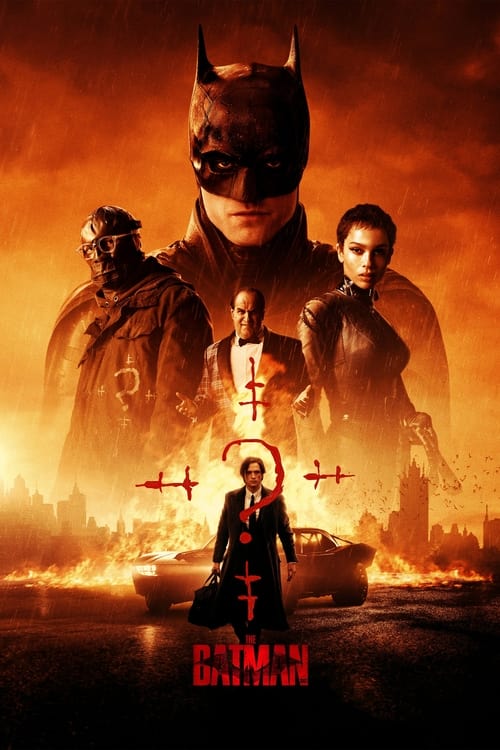
The Batman
2022 · Directed by Matt Reeves
Woke Score
CriticCritic Score
Audience
Based
Critics rated this 34 points above its woke score. Among Based films, this critic score ranks #140 of 345.
Representation Casting
Score: 62/100
Diverse casting of Kravitz and Wright in substantial roles reflects contemporary color-blind casting practices. No tokenism, but also no explicit celebration of representation.
LGBTQ+ Themes
Score: 5/100
Minimal to no LGBTQ+ representation or themes. The film does not engage with sexuality or gender identity as meaningful categories.
Feminist Agenda
Score: 15/100
Catwoman is competent and complex, but the narrative remains fundamentally male-centered. No interrogation of patriarchal structures or gender dynamics.
Racial Consciousness
Score: 48/100
Diverse casting and Jeffrey Wright's prominent role as Gordon suggests racial awareness, but the film does not explicitly engage with race as a theme or plot element.
Climate Crusade
Score: 35/100
Gotham's environmental decay and flooding suggest climate catastrophe, but this functions as aesthetic backdrop rather than thematic engagement or advocacy.
Eat the Rich
Score: 55/100
The film demonstrates genuine class consciousness, with the Riddler's motivation rooted in resentment toward systemic inequality and institutional neglect. Yet it stops short of advocating systemic change.
Body Positivity
Score: 8/100
No engagement with body diversity, body image, or body positivity. The film maintains conventional action-hero aesthetics.
Neurodivergence
Score: 15/100
The Riddler exhibits obsessive-compulsive tendencies, but this is presented as pathology and motivation for villainy rather than authentic neurodivergent representation.
Revisionist History
Score: 0/100
The film does not engage in historical revisionism. It operates within established Batman canon with minimal reinterpretation of historical narrative.
Lecture Energy
Score: 18/100
The film maintains restraint and does not pause to explain its social awareness. Progressive sensibilities are embedded rather than articulated through exposition.


Synopsis
In his second year of fighting crime, Batman uncovers corruption in Gotham City that connects to his own family while facing a serial killer known as the Riddler.
Consciousness Assessment
Matt Reeves' The Batman presents Gotham City as a decaying monument to systemic corruption, where the wealthy insulate themselves from the drowning masses below. The film's casting choices, particularly Zoë Kravitz as Catwoman and Jeffrey Wright as Commissioner Gordon, reflect contemporary approaches to color-blind casting in prestige blockbusters. These actors are given substantial, complex roles that do not exist to service the narrative's social consciousness. The Riddler's motivation emerges from class resentment and institutional abandonment, suggesting that the film understands inequality as a structural problem rather than a moral failing of individuals. Yet the film never lectures. It does not pause to explain its own social awareness. The progressive sensibilities remain embedded in the mise-en-scene rather than articulated through dialogue or plot mechanics.
What distinguishes The Batman from genuinely progressive cinema is its restraint. There are no scenes dedicated to discussing representation or social justice. The diverse cast simply exists within the world without commentary. The environmental degradation of Gotham functions as noir aesthetic rather than climate advocacy. The film's engagement with class consciousness, while present, does not escalate into preachiness. One finds no neurodivergent representation, minimal LGBTQ+ content, and no feminist interrogation of its male-dominated structure. The film is progressive in sensibility without being progressive in method.
The result is a work that sits comfortably within the contemporary cultural consensus without pushing against its boundaries. It is a film that knows how to perform contemporary values without fully committing to their expression. This is neither damning nor praiseworthy. It is simply the current baseline for prestige filmmaking.
Analysis generated by our Consciousness Algorithm
Critic Reviews
“Matt Reeves’ violent, thrilling, darkly beautiful take on The Batman more than justifies its place in the franchise’s canon.”
“The two stars generate an astonishing sensual charge in a brilliant addition to the Batman canon that refuses to behave like a blockbuster ”
“This grounded, frequently brutal and nearly three-hour film noir registers among the best of the genre, even if — or more aptly, because — what makes the film so great is its willingness to dismantle and interrogate the very concept of superheroes.”
“Nothing that works here adds up to anything worth a long slog in a movie theater, watching Pattinson punching guys and knocking guns out of their hands. From start to finish, The Batman is mostly just a collection of bad ideas.”
Consciousness Markers
Diverse casting of Kravitz and Wright in substantial roles reflects contemporary color-blind casting practices. No tokenism, but also no explicit celebration of representation.
Minimal to no LGBTQ+ representation or themes. The film does not engage with sexuality or gender identity as meaningful categories.
Catwoman is competent and complex, but the narrative remains fundamentally male-centered. No interrogation of patriarchal structures or gender dynamics.
Diverse casting and Jeffrey Wright's prominent role as Gordon suggests racial awareness, but the film does not explicitly engage with race as a theme or plot element.
Gotham's environmental decay and flooding suggest climate catastrophe, but this functions as aesthetic backdrop rather than thematic engagement or advocacy.
The film demonstrates genuine class consciousness, with the Riddler's motivation rooted in resentment toward systemic inequality and institutional neglect. Yet it stops short of advocating systemic change.
No engagement with body diversity, body image, or body positivity. The film maintains conventional action-hero aesthetics.
The Riddler exhibits obsessive-compulsive tendencies, but this is presented as pathology and motivation for villainy rather than authentic neurodivergent representation.
The film does not engage in historical revisionism. It operates within established Batman canon with minimal reinterpretation of historical narrative.
The film maintains restraint and does not pause to explain its social awareness. Progressive sensibilities are embedded rather than articulated through exposition.