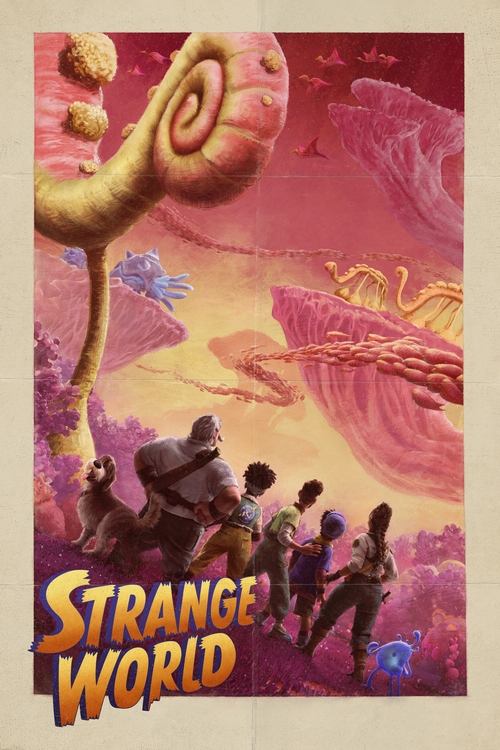
Strange World
2022 · Directed by Don Hall
Woke Score
Critic Score
Audience
Woke
Critics rated this 9 points above its woke score. Among Woke films, this critic score ranks #42 of 57.
Representation Casting
Score: 78/100
The cast demonstrates intentional racial and ethnic diversity, with prominent roles for Gabrielle Union, Lucy Liu, and others. The ensemble reflects contemporary Hollywood casting practices that prioritize non-white representation.
LGBTQ+ Themes
Score: 85/100
Features Disney's first openly LGBTQ+ lead character in an animated feature. Ethan Clade's romantic interest in a male character is treated as a natural part of his characterization rather than a plot twist or issue requiring resolution.
Feminist Agenda
Score: 45/100
While the film includes strong female characters like Gabrielle Union's Meridian Clade, there is limited explicit engagement with feminist themes or critique of gender systems. The female characters function within the adventure narrative without particular emphasis on gender dynamics.
Racial Consciousness
Score: 62/100
Diversity in casting suggests attention to representation, but the film does not substantially engage with racial consciousness, historical injustice, or systemic inequality. Racial diversity exists without explicit thematic development.
Climate Crusade
Score: 55/100
The Pando plant functions as an environmental plot device central to the story, suggesting some environmental consciousness. However, the film does not develop sophisticated climate critique or systemic environmental analysis.
Eat the Rich
Score: 25/100
There is minimal engagement with anti-capitalist critique or examination of economic systems. The film centers on family dynamics and personal growth rather than structural economic analysis.
Body Positivity
Score: 30/100
The animated character designs do not appear to deliberately emphasize body diversity or challenge conventional beauty standards. This aspect remains largely unremarked upon in the narrative.
Neurodivergence
Score: 20/100
There is no apparent engagement with neurodivergence representation or themes related to neurological difference in the film's narrative or characterization.
Revisionist History
Score: 15/100
As a contemporary fantasy adventure with no historical setting, the film does not engage in revisionist history. Its worldbuilding is entirely fictional rather than reinterpreting actual historical events.
Lecture Energy
Score: 35/100
The film generally avoids explicit didactic messaging, allowing its representation choices to speak for themselves. However, the casual treatment of LGBTQ+ representation may itself read as a form of subtle cultural messaging rather than traditional lecturing.


Synopsis
A journey deep into an uncharted and treacherous land, where fantastical creatures await the legendary Clades—a family of explorers whose differences threaten to topple their latest, and by far most crucial, mission.
Consciousness Assessment
Strange World stands as a peculiar artifact of contemporary Disney animation, a film that achieved the rare distinction of being simultaneously groundbreaking in representation and commercially catastrophic. The movie features the studio's first openly LGBTQ+ leading character in an animated feature, with Ethan Clade's romantic subplot treated as an unremarkable element of his character development rather than a plot point requiring explanation. This approach represents a genuine evolution in how mainstream family entertainment handles queer representation, though the subtlety may be precisely why the film found itself at the center of culture war debates that likely contributed to its $147 million loss.
The film's progressive sensibilities extend beyond its central representation. The ensemble cast reflects deliberate attention to racial and ethnic diversity, with Gabrielle Union, Lucy Liu, and Jaboukie Young-White among the supporting players. The narrative architecture itself carries mild environmental consciousness, with the Pando plant serving as a plot device around which the family must reconcile their conflicting philosophies. However, these elements remain relatively surface-level; the film traffics more in the aesthetics of inclusivity than in substantive engagement with systemic critique or deeper ideological positioning.
Where Strange World distinguishes itself is in its apparent confidence that representation itself constitutes sufficient thematic weight. The film does not lecture extensively about social justice or labor exploitation, nor does it position itself as a corrective to historical wrongs. Its cultural consciousness manifests primarily through casting and the casual inclusion of a same-sex romantic interest. For audiences seeking a modern family film with straightforward representation, this represents a modest but genuine advancement. For those tracking the specific markers of 2020s progressive sensibility, it occupies the middle ground of a mainstream tentpole attempting to acknowledge contemporary social values without allowing those values to substantially disrupt its adventure narrative.
Analysis generated by our Consciousness Algorithm
Critic Reviews
“This breathtaking, funny, and heartwarming tale is creativity and sincere storytelling at its finest.”
“Strange World feels like a new iteration of Disney, one that is more thoughtful and inclusive without sacrificing any of the humor or fun.”
“The film is cute and funny, but it's also action-packed and much more thrilling than you might expect from a Disney movie, with the same heartwarming lessons you would expect. It's a gem in Disney's new catalog.”
“The end of Strange World comes together as one would expect of a Disney offering, but there's a sweetness to it that may move even the most committed cynic.”
“Though Strange World has no meme-worthy songs like "Encanto," its imagery is singular and unforgettable, and its adventurous spirit is genuine and thrilling. This is the kind of thing Disney should make more often.”
“One of Strange World's triumphs is the vibrant, weird, visually stunning subterranean world that the film's heroes stumble upon during their quest to save their way of life. From its lush palette to its cute and deadly flora and fauna, this strange, mysterious world is very much deserving of its status as the film's title character.”
Consciousness Markers
The cast demonstrates intentional racial and ethnic diversity, with prominent roles for Gabrielle Union, Lucy Liu, and others. The ensemble reflects contemporary Hollywood casting practices that prioritize non-white representation.
Features Disney's first openly LGBTQ+ lead character in an animated feature. Ethan Clade's romantic interest in a male character is treated as a natural part of his characterization rather than a plot twist or issue requiring resolution.
While the film includes strong female characters like Gabrielle Union's Meridian Clade, there is limited explicit engagement with feminist themes or critique of gender systems. The female characters function within the adventure narrative without particular emphasis on gender dynamics.
Diversity in casting suggests attention to representation, but the film does not substantially engage with racial consciousness, historical injustice, or systemic inequality. Racial diversity exists without explicit thematic development.
The Pando plant functions as an environmental plot device central to the story, suggesting some environmental consciousness. However, the film does not develop sophisticated climate critique or systemic environmental analysis.
There is minimal engagement with anti-capitalist critique or examination of economic systems. The film centers on family dynamics and personal growth rather than structural economic analysis.
The animated character designs do not appear to deliberately emphasize body diversity or challenge conventional beauty standards. This aspect remains largely unremarked upon in the narrative.
There is no apparent engagement with neurodivergence representation or themes related to neurological difference in the film's narrative or characterization.
As a contemporary fantasy adventure with no historical setting, the film does not engage in revisionist history. Its worldbuilding is entirely fictional rather than reinterpreting actual historical events.
The film generally avoids explicit didactic messaging, allowing its representation choices to speak for themselves. However, the casual treatment of LGBTQ+ representation may itself read as a form of subtle cultural messaging rather than traditional lecturing.