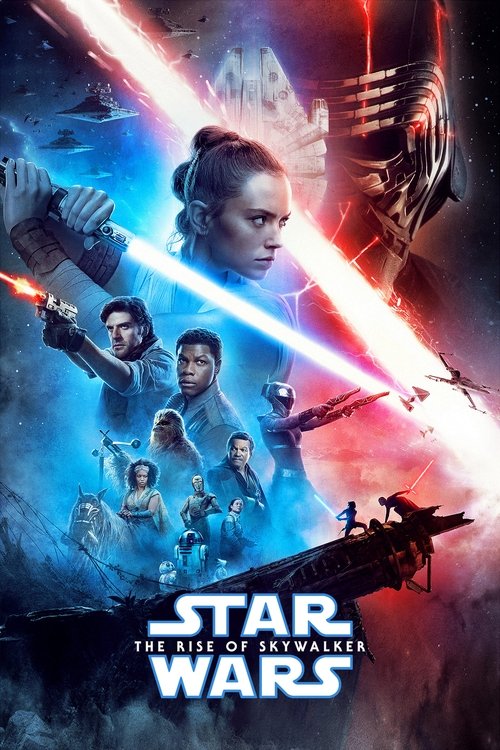
Star Wars: The Rise of Skywalker
2019 · Directed by J.J. Abrams
Woke Score
CriticCritic Score
Woke-Adjacent
Critics rated this 5 points above its woke score. Among Woke-Adjacent films, this critic score ranks #131 of 151.
Representation Casting
Score: 65/100
The film features a diverse ensemble including a female lead, Black male protagonists, and Latino representation. However, character development is uneven and some roles feel underdeveloped relative to their narrative importance.
LGBTQ+ Themes
Score: 15/100
While some viewers detected queer subtext in character relationships, the film contains no explicit LGBTQ+ representation or themes. A brief moment of same-sex couple visibility appears in background shots with minimal narrative weight.
Feminist Agenda
Score: 48/100
Rey functions as a powerful female protagonist, but her arc generated significant debate about agency and narrative choices. The film presents female power without sustained interrogation of its meaning or cost.
Racial Consciousness
Score: 35/100
The film features Black and Latino characters in significant roles, but their experiences and identities are rarely centered thematically. Race functions as a casting choice rather than a narrative concern.
Climate Crusade
Score: 0/100
The film contains no engagement with climate themes, environmental consciousness, or ecological concerns. The space opera setting does not invite such commentary.
Eat the Rich
Score: 20/100
The narrative centers on fighting tyranny and authoritarianism but does not critique economic systems or wealth inequality. The conflict remains framed in terms of good versus evil rather than systemic critique.
Body Positivity
Score: 25/100
The film features conventionally attractive actors in leading roles with no notable engagement with body diversity or body positivity themes. Villains are occasionally coded through physical appearance.
Neurodivergence
Score: 0/100
The film contains no representation of neurodivergent characters or exploration of neurodiversity. No characters are coded as autistic, ADHD, or otherwise neurodivergent.
Revisionist History
Score: 10/100
The film engages with its own fictional history through legacy and lineage, but this is presented as mythological rather than revisionist. No reinterpretation of actual historical events occurs.
Lecture Energy
Score: 40/100
The film occasionally expounds on themes of belonging, identity, and power, but stops short of preachy preaching. Dialogue tends toward action-adventure efficiency rather than extended moral exposition.


Synopsis
The surviving Resistance faces the First Order once again as the journey of Rey, Finn and Poe Dameron continues. With the power and knowledge of generations behind them, the final battle begins.
Consciousness Assessment
Star Wars: The Rise of Skywalker arrives as a film caught between several cultural moments. Released in late 2019, it inherits the diversity commitments of its predecessors while simultaneously retreating from some of their more provocative thematic choices. The ensemble cast is undeniably mixed in terms of race and gender, with Daisy Ridley's Rey positioned as the narrative center and John Boyega's Finn as a key protagonist. Yet the film's relationship to these casting choices remains oddly passive, as though diversity itself were sufficient without sustained character development or thematic engagement.
The narrative arc of Rey generates the most tension. She functions as a powerful female hero capable of commanding the story, though her ultimate trajectory prompted considerable debate about agency and whether her climactic choices represent genuine empowerment or capitulation to patriarchal structures. The film never quite commits to interrogating these tensions with any depth. Poe Dameron's character and the possible romantic subtext between him and Finn were noted by some viewers as reflecting contemporary approaches to masculinity and queer coding, though the film stops short of any explicit acknowledgment. The broader mythology, centered on legacy and inheritance, skews conservative in its ultimate message.
The result is a film that ticks boxes without quite believing in them. The representation is there. The female hero is there. The diverse ensemble is there. But the film treats these elements as inherited obligations from the Disney mandate rather than as opportunities for genuine cultural exploration. It is the work of filmmakers managing expectations rather than challenging them.
Analysis generated by our Consciousness Algorithm
Critic Reviews
“The Rise of Skywalker rates right up there with the 1977 original, 'A New Hope,' and 1980's 'The Empire Strikes Back.'”
“The movie snaps together like a jigsaw puzzle, a series of concluding beats that seem inevitable and perfect, and designed to please all parties, so long as you don't dwell on the logic too much.”
“It's a breakneck conclusion to what's been a breakneck restart.”
“Although director J.J. Abrams tries his darndest to finish the job, conjuring up nostalgia like a TV medium, 'Rise' doesn't feel like the last chapter of the biggest American movie franchise. It's just another well-made 'Star Wars' flick.”
Consciousness Markers
The film features a diverse ensemble including a female lead, Black male protagonists, and Latino representation. However, character development is uneven and some roles feel underdeveloped relative to their narrative importance.
While some viewers detected queer subtext in character relationships, the film contains no explicit LGBTQ+ representation or themes. A brief moment of same-sex couple visibility appears in background shots with minimal narrative weight.
Rey functions as a powerful female protagonist, but her arc generated significant debate about agency and narrative choices. The film presents female power without sustained interrogation of its meaning or cost.
The film features Black and Latino characters in significant roles, but their experiences and identities are rarely centered thematically. Race functions as a casting choice rather than a narrative concern.
The film contains no engagement with climate themes, environmental consciousness, or ecological concerns. The space opera setting does not invite such commentary.
The narrative centers on fighting tyranny and authoritarianism but does not critique economic systems or wealth inequality. The conflict remains framed in terms of good versus evil rather than systemic critique.
The film features conventionally attractive actors in leading roles with no notable engagement with body diversity or body positivity themes. Villains are occasionally coded through physical appearance.
The film contains no representation of neurodivergent characters or exploration of neurodiversity. No characters are coded as autistic, ADHD, or otherwise neurodivergent.
The film engages with its own fictional history through legacy and lineage, but this is presented as mythological rather than revisionist. No reinterpretation of actual historical events occurs.
The film occasionally expounds on themes of belonging, identity, and power, but stops short of preachy preaching. Dialogue tends toward action-adventure efficiency rather than extended moral exposition.