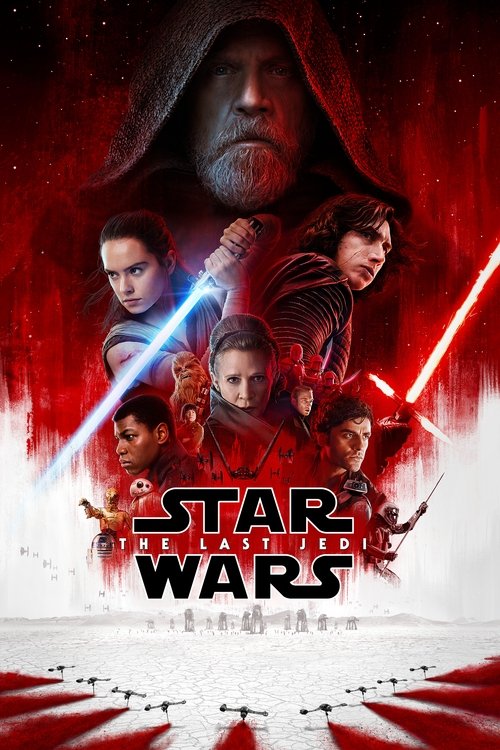
Star Wars: The Last Jedi
2017 · Directed by Rian Johnson
Woke
Consciousness Score: 74%
Representation Casting
Score: 85/100
Female characters occupy central roles including the protagonist, commanding officer, and resistance leaders. Diverse racial casting with substantial roles for actors of color in key positions.
LGBTQ+ Themes
Score: 0/100
No meaningful LGBTQ representation or themes present in the film. Characters are presented without any explicit sexual orientation or gender identity exploration.
Feminist Agenda
Score: 80/100
Explicit emphasis on female agency, leadership, and competence. Admiral Holdo's command authority is central to the plot, and Rey's power is treated as exceptional and worthy rather than secondary.
Racial Consciousness
Score: 70/100
Diverse casting with actors of color in substantial roles, though the film does not explicitly engage with racial themes or systemic racial issues within its narrative.
Climate Crusade
Score: 0/100
No climate or environmental themes present. The destruction of worlds and ecosystems receives no commentary or narrative engagement.
Eat the Rich
Score: 45/100
A single sequence depicts war profiteering and arms dealers, with explicit moral criticism. However, this critique is isolated and does not permeate the broader narrative.
Body Positivity
Score: 15/100
The film features conventionally attractive actors in conventional body types. No meaningful engagement with body diversity or positive representation of varying body types.
Neurodivergence
Score: 0/100
No representation of neurodivergent characters or engagement with disability and neurodivergence themes.
Revisionist History
Score: 55/100
The film deconstructs Star Wars mythology and hero narratives, suggesting previous heroes were flawed. However, this serves primarily as plot device rather than genuine historical revisionism.
Lecture Energy
Score: 60/100
The film contains moments of preachy messaging, particularly around the arms dealing sequence and themes of institutional failure. The tone occasionally shifts toward explicit moral instruction.


Synopsis
Rey develops her newly discovered abilities with the guidance of Luke Skywalker, who is unsettled by the strength of her powers. Meanwhile, the Resistance prepares to do battle with the First Order.
Consciousness Assessment
Star Wars: The Last Jedi arrives as a galaxy-spanning meditation on the proper distribution of authority, presented with the subtlety of a Star Destroyer crashing through a space station. Director Rian Johnson has constructed a narrative in which women occupy nearly every position of consequence: Rey serves as the hero and Force-user, Admiral Holdo commands the Resistance fleet, and even the secondary characters who populate the frame consist largely of female soldiers, officers, and rebels. This is not accidental. The film dwells with visible satisfaction on scenes of female competence and decision-making, as though ensuring we have registered the point.
The casting extends beyond gender politics into the realm of racial diversity, with John Boyega, Oscar Isaac, and Lupita Nyong'o occupying substantial roles rather than peripheral ones. The treatment of these characters varies, though Nyong'o's Maz Kanata remains underutilized. The film also dabbles in what might be termed anti-capitalist sentiment through its critique of war profiteering, though this is largely confined to a single sequence that many viewers found preachy. Where the film's progressive sensibilities become most pronounced is in its willingness to deconstruct the heroic mythology itself, suggesting that even the galaxy's saviors must learn humility and that power corrupts even the righteous.
Yet the film stops short of more ambitious social consciousness. There is no meaningful engagement with disability or neurodivergence, the environmental destruction of worlds receives no comment, and the narrative contains no LGBTQ representation whatsoever. The body diversity remains minimal, and the film's revisionist approach to the Star Wars legend, while present, functions primarily as a plot mechanism rather than a genuine interrogation of historical narratives. Rian Johnson understood which cultural conversations mattered most to his moment.
Analysis generated by our Consciousness Algorithm
Consciousness Markers
Female characters occupy central roles including the protagonist, commanding officer, and resistance leaders. Diverse racial casting with substantial roles for actors of color in key positions.
No meaningful LGBTQ representation or themes present in the film. Characters are presented without any explicit sexual orientation or gender identity exploration.
Explicit emphasis on female agency, leadership, and competence. Admiral Holdo's command authority is central to the plot, and Rey's power is treated as exceptional and worthy rather than secondary.
Diverse casting with actors of color in substantial roles, though the film does not explicitly engage with racial themes or systemic racial issues within its narrative.
No climate or environmental themes present. The destruction of worlds and ecosystems receives no commentary or narrative engagement.
A single sequence depicts war profiteering and arms dealers, with explicit moral criticism. However, this critique is isolated and does not permeate the broader narrative.
The film features conventionally attractive actors in conventional body types. No meaningful engagement with body diversity or positive representation of varying body types.
No representation of neurodivergent characters or engagement with disability and neurodivergence themes.
The film deconstructs Star Wars mythology and hero narratives, suggesting previous heroes were flawed. However, this serves primarily as plot device rather than genuine historical revisionism.
The film contains moments of preachy messaging, particularly around the arms dealing sequence and themes of institutional failure. The tone occasionally shifts toward explicit moral instruction.