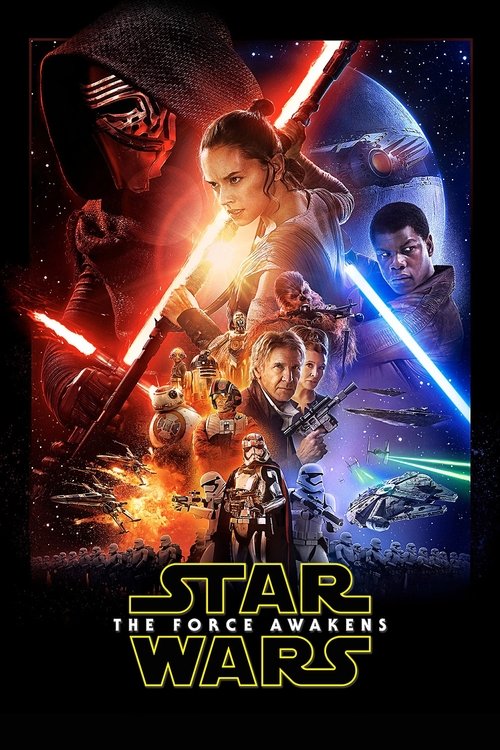
Star Wars: The Force Awakens
2015 · Directed by J.J. Abrams
Woke Score
CriticCritic Score
Woke-Adjacent
Critics rated this 37 points above its woke score. Among Woke-Adjacent films, this critic score ranks #12 of 151.
Representation Casting
Score: 78/100
The film features a diverse ensemble cast including a female lead protagonist, a Black male lead, and performers of various ethnicities in prominent roles. This was a significant departure from the original trilogy and was celebrated as progressive casting.
LGBTQ+ Themes
Score: 0/100
No LGBTQ+ themes or representation are present in the film. All relationships depicted are heterosexual, and there is no acknowledgment of queer identity or experience.
Feminist Agenda
Score: 48/100
Rey is portrayed as capable and independent, though her arc largely concerns proving herself to male authority figures and discovering her lineage. The film does not interrogate gender dynamics or power structures between male and female characters.
Racial Consciousness
Score: 42/100
While the film features prominent Black and Asian characters, it does not engage with racial themes, history, or systemic inequality. Representation exists without commentary or thematic integration.
Climate Crusade
Score: 0/100
There is no engagement with climate change, environmental destruction, or ecological consciousness. The film's conflicts are purely political and military.
Eat the Rich
Score: 0/100
The film presents no critique of capitalism, wealth inequality, or economic systems. Both the Resistance and First Order are framed as military or political entities without economic analysis.
Body Positivity
Score: 5/100
The film features conventionally attractive actors in conventionally attractive bodies. There is minimal representation of body diversity or any thematic engagement with body positivity.
Neurodivergence
Score: 0/100
No characters are portrayed as neurodivergent, and there is no engagement with disability, mental health, or neurodiversity as a thematic concern.
Revisionist History
Score: 15/100
The film presents the First Order rising from the Empire's ashes, but does not substantially reframe or reinterpret the historical conflict between Empire and Rebellion. The mythic structure remains largely intact.
Lecture Energy
Score: 25/100
The film generally allows its diverse casting and female protagonist to speak for themselves without explicit preachiness. However, some scenes with General Leia and other female characters carry faint notes of messaging about women's authority and competence.


Synopsis
Thirty years after defeating the Galactic Empire, Han Solo and his allies face a new threat from the evil Kylo Ren and his army of Stormtroopers.
Consciousness Assessment
Star Wars: The Force Awakens arrived at a cultural inflection point in late 2015, a moment when mainstream blockbuster entertainment was beginning to reckon with representation as a box office imperative. The film features a female protagonist in Rey, a Black male lead in Finn, and a notably diverse ensemble cast that reflects contemporary casting sensibilities rather than the original trilogy's homogeneity. These choices were celebrated by progressive audiences, though the film's approach remains fundamentally integrationist rather than interrogative about power structures or systemic inequality. The narrative does not pause to lecture audiences about these casting decisions; they simply exist as the texture of this universe.
The film's progressive markers are present but largely incidental to its plot machinery. Kylo Ren, played by Adam Driver, functions as a portrait of toxic masculinity and entitled rage, a villain defined by his inability to process emotion and his violent tantrums when denied what he believes he deserves. This characterization occasionally courts a satirical reading of masculine fragility, though the film itself does not seem particularly interested in that analysis. Rey's competence and agency are treated as straightforward character traits rather than as political statements, which is perhaps the film's most progressive instinct: allowing female characters to simply be capable without fanfare.
The Force Awakens does not reach for higher consciousness on climate, capitalism, or systemic oppression. It is a film about inheriting a conflict, not reimagining its foundations. The Resistance fights the First Order, but we are not asked to question the militarism of either faction or the colonial logics that underpin galactic politics. The film's progressive sensibilities are primarily aesthetic and demographic, a matter of who occupies the frame rather than what the frame is trying to say about the world. This is not a criticism so much as an observation: the film is comfortable with representation as supplement, not as transformation.
Analysis generated by our Consciousness Algorithm
Critic Reviews
“With great pleasure and a nearly pitch perfect blend of innovation and reminiscence, J.J. Abrams promised, and now has delivered, all that anyone could hope for with Star Wars: The Force Awakens.”
“This epic space opera introduces us to such great characters, heroes and villains alike.”
“Star Wars: The Force Awakens gives new life to a franchise of hope, resilience, courage and family that's been missing from theatres for far too long.”
“When The Force Awakens gets going, you couldn't ask for a more propulsive, joyous or witty Star Wars film.”
Consciousness Markers
The film features a diverse ensemble cast including a female lead protagonist, a Black male lead, and performers of various ethnicities in prominent roles. This was a significant departure from the original trilogy and was celebrated as progressive casting.
No LGBTQ+ themes or representation are present in the film. All relationships depicted are heterosexual, and there is no acknowledgment of queer identity or experience.
Rey is portrayed as capable and independent, though her arc largely concerns proving herself to male authority figures and discovering her lineage. The film does not interrogate gender dynamics or power structures between male and female characters.
While the film features prominent Black and Asian characters, it does not engage with racial themes, history, or systemic inequality. Representation exists without commentary or thematic integration.
There is no engagement with climate change, environmental destruction, or ecological consciousness. The film's conflicts are purely political and military.
The film presents no critique of capitalism, wealth inequality, or economic systems. Both the Resistance and First Order are framed as military or political entities without economic analysis.
The film features conventionally attractive actors in conventionally attractive bodies. There is minimal representation of body diversity or any thematic engagement with body positivity.
No characters are portrayed as neurodivergent, and there is no engagement with disability, mental health, or neurodiversity as a thematic concern.
The film presents the First Order rising from the Empire's ashes, but does not substantially reframe or reinterpret the historical conflict between Empire and Rebellion. The mythic structure remains largely intact.
The film generally allows its diverse casting and female protagonist to speak for themselves without explicit preachiness. However, some scenes with General Leia and other female characters carry faint notes of messaging about women's authority and competence.