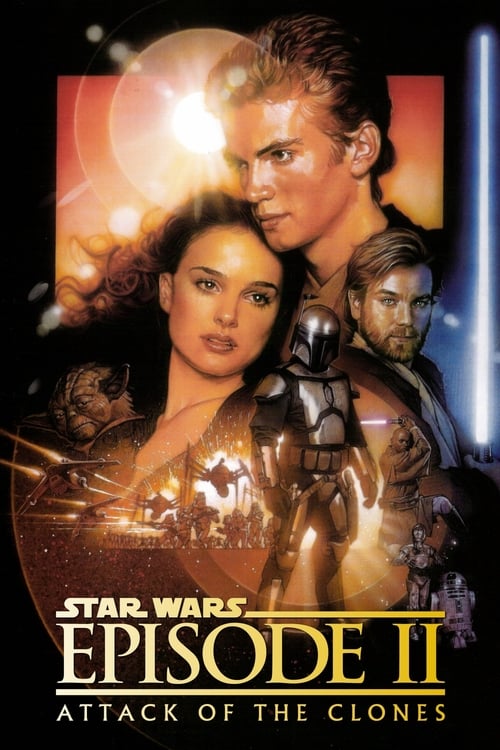
Star Wars: Episode II - Attack of the Clones
2002 · Directed by George Lucas
Woke Score
CriticCritic Score
Audience
Ultra Based
Critics rated this 39 points above its woke score. Among Ultra Based films, this critic score ranks #1069 of 1469.
Representation Casting
Score: 25/100
Predominantly white cast with Samuel L. Jackson in a supporting role. For 2002, unremarkable diversity; does not reflect deliberate contemporary casting practices.
LGBTQ+ Themes
Score: 5/100
No LGBTQ+ themes, representation, or subtext. The narrative centers entirely on heterosexual romance.
Feminist Agenda
Score: 20/100
Padmé holds political office but is primarily defined by romantic entanglement and passive positions requiring male protection. No interrogation of gender dynamics.
Racial Consciousness
Score: 15/100
Diverse alien species serve worldbuilding purposes only. No meaningful exploration of race or racial themes in the narrative.
Climate Crusade
Score: 0/100
No environmental or climate-related themes present in the film.
Eat the Rich
Score: 10/100
The Separatist conflict is framed as good versus evil rather than as systemic economic critique. No interrogation of capitalist structures.
Body Positivity
Score: 0/100
No body diversity or body positivity messaging. Cast features conventionally attractive actors in idealized forms.
Neurodivergence
Score: 0/100
No representation of neurodivergent characters or exploration of neurodiversity.
Revisionist History
Score: 5/100
The fictional Star Wars universe is presented as constructed, but the film does not engage in revisionist reinterpretation of actual historical events.
Lecture Energy
Score: 15/100
Expository dialogue about politics and the Clone Wars serves plot and worldbuilding rather than delivering contemporary cultural messages or moral instruction.


Synopsis
Following an assassination attempt on Senator Padmé Amidala, Jedi Knights Anakin Skywalker and Obi-Wan Kenobi investigate a mysterious plot into the heart of the Separatist movement and the beginning of the Clone Wars.
Consciousness Assessment
Star Wars Episode II arrives as a thoroughly conventional blockbuster from the early 2000s, a period when the constellation of progressive sensibilities that would later dominate cultural discourse had barely begun to coalesce. The film presents a galaxy populated by diverse alien species and a female senator in a position of political authority, markers that might appear progressive in isolation but function here purely as worldbuilding apparatus rather than as deliberate engagement with contemporary social consciousness.
The gender dynamics prove particularly instructive in this regard. Padmé Amidala, despite her senatorial status, spends much of the narrative in passive positions, pursued by Anakin Skywalker and requiring protection from male Jedi. She is defined primarily by her romantic entanglement rather than by her political agency or personal ambitions. The film's approach to her character reflects the conventions of 2002 blockbuster filmmaking, not any meaningful interrogation of gender relations or feminist critique. Compare this to the conscious gender-conscious casting and character construction that would become standard practice in contemporary franchise cinema, and the gap becomes apparent.
The film's racial composition, meanwhile, reflects the casting practices of its era. Samuel L. Jackson appears as Mace Windu, a Jedi Council member, but within a predominantly white ensemble. The diverse alien species that populate the galaxy function as exotic spectacle rather than as meaningful representation or commentary on racial dynamics. This is not a film that wrestles with questions of representation or attempts to interrogate systemic inequities. It is a space adventure that takes its fictional universe as given and proceeds accordingly. One observes a work of entertainment from a different cultural moment, one that had not yet absorbed the vocabulary of social consciousness that would later become pervasive.
Analysis generated by our Consciousness Algorithm
Critic Reviews
“Attack of the Clones celebrates a certain youthful spirit in both moviemaking and movie watching; because it's as much phenomenon as movie, audiences will either ride with or reject it. I was happy to take the ride.”
“Don't go if "Star Wars" isn't your bag: You'll only resist and resent it. But if you're a fan, it's hard to see how you'd be disappointed. Me? I can't wait for May 2005. "Episode III": Hot diggity!”
“George Lucas has reached deep into the trove of his self-generated mythological world to produce a grand entertainment that offers a satisfying balance among the series' epic, narrative, technological and emotional qualities.”
Consciousness Markers
Predominantly white cast with Samuel L. Jackson in a supporting role. For 2002, unremarkable diversity; does not reflect deliberate contemporary casting practices.
No LGBTQ+ themes, representation, or subtext. The narrative centers entirely on heterosexual romance.
Padmé holds political office but is primarily defined by romantic entanglement and passive positions requiring male protection. No interrogation of gender dynamics.
Diverse alien species serve worldbuilding purposes only. No meaningful exploration of race or racial themes in the narrative.
No environmental or climate-related themes present in the film.
The Separatist conflict is framed as good versus evil rather than as systemic economic critique. No interrogation of capitalist structures.
No body diversity or body positivity messaging. Cast features conventionally attractive actors in idealized forms.
No representation of neurodivergent characters or exploration of neurodiversity.
The fictional Star Wars universe is presented as constructed, but the film does not engage in revisionist reinterpretation of actual historical events.
Expository dialogue about politics and the Clone Wars serves plot and worldbuilding rather than delivering contemporary cultural messages or moral instruction.