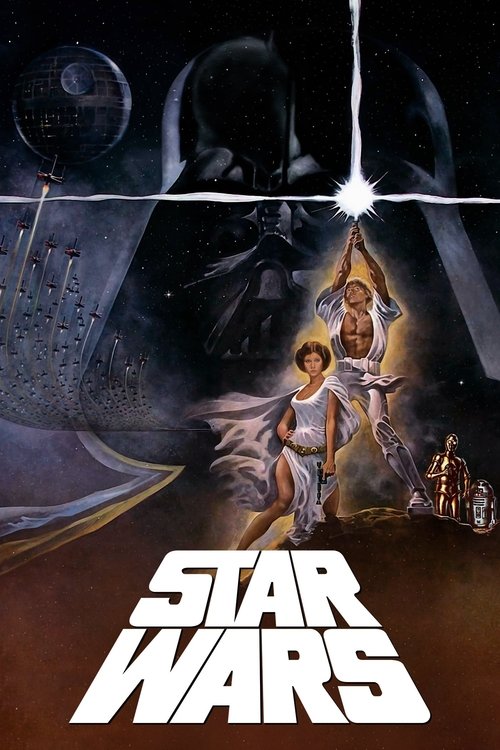
Star Wars
1977 · Directed by George Lucas
Woke Score
CriticCritic Score
Ultra Based
Critics rated this 62 points above its woke score. Among Ultra Based films, this critic score ranks #753 of 1469.
Representation Casting
Score: 15/100
The film features primarily white leads with minimal representation of actors of color. James Earl Jones voices Darth Vader but is not seen on screen, reflecting standard 1970s Hollywood casting practices rather than conscious inclusion efforts.
LGBTQ+ Themes
Score: 0/100
No LGBTQ+ themes, characters, or content are present in the film. The narrative contains no engagement with sexual orientation or gender identity.
Feminist Agenda
Score: 20/100
Princess Leia is capable and articulate but functions primarily as an object to be rescued within a male-centered narrative. Her agency is constrained by the plot structure, though her character is not entirely passive.
Racial Consciousness
Score: 5/100
The film makes no explicit engagement with racial themes or demonstrates racial consciousness. It is a space fantasy that exists outside any framework of racial commentary.
Climate Crusade
Score: 0/100
As a 1977 space opera, the film contains no environmental consciousness, climate advocacy, or ecological themes whatsoever.
Eat the Rich
Score: 5/100
While the Empire is portrayed as oppressive, the film does not mount any specific critique of capitalism or economic systems. The conflict is framed in terms of good versus evil rather than structural critique.
Body Positivity
Score: 0/100
The film features conventionally attractive leads and makes no effort to represent diverse body types or challenge beauty standards.
Neurodivergence
Score: 0/100
Neurodivergence is not addressed, represented, or engaged with in any way within the narrative.
Revisionist History
Score: 0/100
The film is a work of fantasy rather than historical fiction, so revisionism of history is not applicable.
Lecture Energy
Score: 5/100
The film prioritizes narrative and action over preachy monologues about social issues. It conveys its story primarily through dramatic events rather than explicit commentary.


Synopsis
Princess Leia is captured and held hostage by the evil Imperial forces in their effort to take over the galactic Empire. Venturesome Luke Skywalker and dashing captain Han Solo team together with the loveable robot duo R2-D2 and C-3PO to rescue the beautiful princess and restore peace and justice in the Empire.
Consciousness Assessment
Star Wars stands as a monument to the technical and narrative ambitions of late-1970s cinema, a film that revolutionized special effects and the very economics of blockbuster filmmaking. Yet by the standards of contemporary progressive cultural consciousness, it registers as utterly quiescent. The film exists in a different historical moment, one in which the specific constellation of social awareness markers that define modern activism had not yet crystallized into the cultural force they would become in subsequent decades.
The cast reflects the unremarkable demographics of mainstream Hollywood in 1977: primarily white and male leads, with Princess Leia serving as the sole significant female presence. She is resourceful and articulate, certainly, but ultimately functions within a narrative structure designed around her rescue. This is not the result of conscious ideological positioning but rather the default operating procedure of the era. James Earl Jones provides the voice of Darth Vader, though his physicality remains hidden behind costume and prosthetics, a fact that speaks more to the limitations of 1970s casting practices than to any deliberate statement about representation or diversity.
The film makes no gestures toward the environmental consciousness, anti-capitalist rhetoric, or pedagogical earnestness that would come to characterize socially aware cinema of later decades. It is instead a work of pure narrative escapism, concerned with mythic archetypes and spectacular action rather than the examination of structural power or social hierarchy. To apply the framework of 2020s progressive sensibilities to this artifact would be historically incoherent. Star Wars is not reactionary; it is simply pre-woke, a film made in an era before the category existed.
Analysis generated by our Consciousness Algorithm
Critic Reviews
“Star Wars is a magnificent film that succeeds brilliantly in making the biggest possible adventure fantasy out of memories of serials and older action epics.”
“Star Wars taps the pulp fantasies buried in our memories, and because it's done so brilliantly, it reactivates old thrills, fears, and exhilarations we thought we'd abandoned.”
“Star Wars is the most elaborate, most expensive, most beautiful movie serial ever made and is fun and funny.”
“Strip Star Wars of its often striking images and you get a story, characters, and dialogue of overwhelming banality.”
Consciousness Markers
The film features primarily white leads with minimal representation of actors of color. James Earl Jones voices Darth Vader but is not seen on screen, reflecting standard 1970s Hollywood casting practices rather than conscious inclusion efforts.
No LGBTQ+ themes, characters, or content are present in the film. The narrative contains no engagement with sexual orientation or gender identity.
Princess Leia is capable and articulate but functions primarily as an object to be rescued within a male-centered narrative. Her agency is constrained by the plot structure, though her character is not entirely passive.
The film makes no explicit engagement with racial themes or demonstrates racial consciousness. It is a space fantasy that exists outside any framework of racial commentary.
As a 1977 space opera, the film contains no environmental consciousness, climate advocacy, or ecological themes whatsoever.
While the Empire is portrayed as oppressive, the film does not mount any specific critique of capitalism or economic systems. The conflict is framed in terms of good versus evil rather than structural critique.
The film features conventionally attractive leads and makes no effort to represent diverse body types or challenge beauty standards.
Neurodivergence is not addressed, represented, or engaged with in any way within the narrative.
The film is a work of fantasy rather than historical fiction, so revisionism of history is not applicable.
The film prioritizes narrative and action over preachy monologues about social issues. It conveys its story primarily through dramatic events rather than explicit commentary.