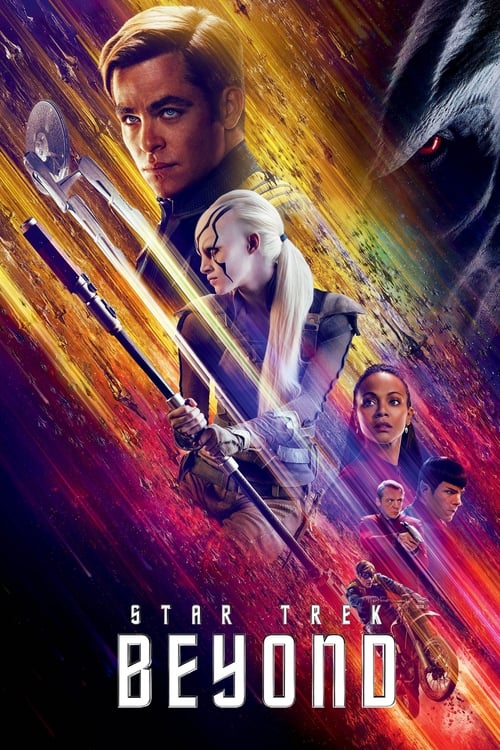
Star Trek Beyond
2016 · Directed by Justin Lin
Woke Score
CriticCritic Score
Audience
Ultra Based
Critics rated this 50 points above its woke score. Among Ultra Based films, this critic score ranks #672 of 1469.
Representation Casting
Score: 55/100
The film maintains the Star Trek franchise tradition of multicultural ensemble casting with actors of various backgrounds in significant roles, though this reflects franchise convention rather than innovative representation.
LGBTQ+ Themes
Score: 25/100
Sulu's same-sex relationship is revealed through a brief scene showing his husband and adopted daughter, representing minimal LGBTQ+ inclusion that avoids sustained thematic exploration.
Feminist Agenda
Score: 15/100
Sofia Boutella's Jaylah participates in action sequences competently, but the film makes no particular thematic investment in feminist perspectives or gender commentary.
Racial Consciousness
Score: 10/100
While the cast is racially diverse, the film demonstrates no explicit racial consciousness or engagement with racial themes in its narrative structure.
Climate Crusade
Score: 0/100
The film contains no climate-related themes or environmental commentary.
Eat the Rich
Score: 0/100
The narrative presents no critique of capitalism or economic systems; the Federation operates as a given structural reality without interrogation.
Body Positivity
Score: 0/100
The film demonstrates no engagement with body diversity or body positivity messaging.
Neurodivergence
Score: 0/100
There is no representation of or thematic engagement with neurodivergence in the film.
Revisionist History
Score: 0/100
The film does not engage in historical revisionism or reexamination of canonical narratives.
Lecture Energy
Score: 5/100
The film maintains the franchise's occasional tendency toward exposition about Federation principles, though it prioritizes action over philosophical dialogue.


Synopsis
The USS Enterprise crew explores the furthest reaches of uncharted space, where they encounter a mysterious new enemy who puts them and everything the Federation stands for to the test.
Consciousness Assessment
Star Trek Beyond arrives as a competent action spectacle that inherits the franchise's long-standing commitment to multicultural casting without substantially advancing progressive sensibilities. The film dutifully populates its bridge with actors of various backgrounds and includes a notable subplot revealing that Hikaru Sulu maintains a same-sex relationship, a development that registers as modest representation in the context of 2016 blockbuster cinema. Sofia Boutella's Jaylah provides a capable female warrior character who participates fully in the action sequences without particular emphasis on her gender as thematic material.
Yet the film resists the temptation to engage in genuine social consciousness. Its narrative concerns itself with straightforward space opera mechanics: discovering new enemies, surviving their attacks, and reaffirming Federation values through conventional heroism. The diverse casting functions as baseline expectation rather than statement. When the film acknowledges Sulu's domestic life, it does so with such casual brevity that one might miss it entirely, treating his husband and child as a minor biographical detail rather than a moment deserving of narrative weight or thematic exploration.
The result is a film that embodies the progressive posture of contemporary blockbuster production without committing itself to the labor of actual cultural interrogation. It performs diversity while declining to interrogate power structures, institutional hierarchies, or systemic inequities. This represents the dominant strategy of 2016 tentpole cinema: sufficient representation to avoid criticism, insufficient engagement to provoke genuine reflection. Star Trek Beyond proves that casting choices and representation metrics need not correlate with substantive progressive messaging.
Analysis generated by our Consciousness Algorithm
Critic Reviews
“There’s a brisk sense of invention to the film, and it feels like it is breathlessly told, something that is due in large part to Justin Lin, who has been developing a very particular approach to blockbuster filmmaking. Yes, he’s fine with the big action mayhem that is par for the course with these films, but he understands that the thing that makes any of it interesting is making sure the audience really enjoys spending time with these characters.”
“Star Trek Beyond is a vast improvement from the sloppy Into Darkness, bringing it on par with the excellent ’09 reboot in terms of sheer quality and chemistry.”
“I do hope there will be many more future installments. I’d like to spend more time with these folks. ”
“If you go out into the furthest reaches of Star Trek's filmography today, you're in for an unsettling discovery: the final frontier looks oddly familiar. It's brightly coloured eye-bait, Jim, exactly as we know it - outpacing your visual field in an attempt to convince you that something exciting is going on.”
Consciousness Markers
The film maintains the Star Trek franchise tradition of multicultural ensemble casting with actors of various backgrounds in significant roles, though this reflects franchise convention rather than innovative representation.
Sulu's same-sex relationship is revealed through a brief scene showing his husband and adopted daughter, representing minimal LGBTQ+ inclusion that avoids sustained thematic exploration.
Sofia Boutella's Jaylah participates in action sequences competently, but the film makes no particular thematic investment in feminist perspectives or gender commentary.
While the cast is racially diverse, the film demonstrates no explicit racial consciousness or engagement with racial themes in its narrative structure.
The film contains no climate-related themes or environmental commentary.
The narrative presents no critique of capitalism or economic systems; the Federation operates as a given structural reality without interrogation.
The film demonstrates no engagement with body diversity or body positivity messaging.
There is no representation of or thematic engagement with neurodivergence in the film.
The film does not engage in historical revisionism or reexamination of canonical narratives.
The film maintains the franchise's occasional tendency toward exposition about Federation principles, though it prioritizes action over philosophical dialogue.