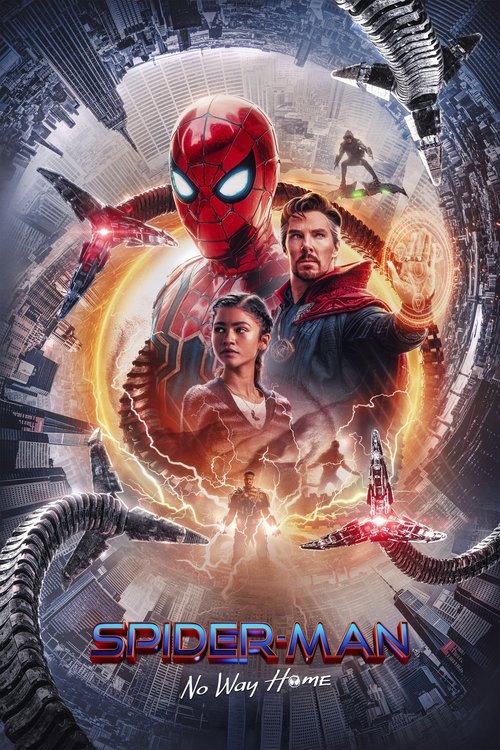
Spider-Man: No Way Home
2021 · Directed by Jon Watts
Woke Score
CriticCritic Score
Audience
Based
Critics rated this 49 points above its woke score. Among Based films, this critic score ranks #151 of 345.
Representation Casting
Score: 52/100
The film features diverse casting with Zendaya (mixed race), Jacob Batalon (Filipino-American), and Tony Revolori (Guatemalan-American) in significant roles. However, the diversity is largely incidental to the narrative rather than meaningfully integrated into character development or thematic exploration.
LGBTQ+ Themes
Score: 0/100
No LGBTQ+ themes, characters, or representation appear in the film. The narrative is entirely heteronormative with no acknowledgment of queer identities among the principal or supporting cast.
Feminist Agenda
Score: 15/100
MJ and Aunt May have agency within their scenes, but both characters exist primarily to support Peter's emotional arc. MJ's role is predominantly that of romantic interest and emotional anchor rather than an independent protagonist with her own stakes.
Racial Consciousness
Score: 8/100
The film contains no substantive engagement with race or racial dynamics. Diverse characters are present but their identities are never discussed, centered, or thematized in any meaningful way.
Climate Crusade
Score: 0/100
Climate change and environmental concerns are entirely absent from the narrative. The film contains no reference to ecological themes or sustainability.
Eat the Rich
Score: 5/100
The film presents no critique of wealth or capitalism. Wealthy characters like Tony Stark's legacy and Doctor Strange's resources are treated as positive forces that enable heroism rather than as systems worth questioning.
Body Positivity
Score: 0/100
No body positivity themes are present. The film features conventionally attractive leads and contains no representation of diverse body types or disabilities in significant roles.
Neurodivergence
Score: 0/100
No neurodivergent characters or themes appear in the film. Mental health and neurodiversity are not addressed or represented.
Revisionist History
Score: 0/100
The film contains no engagement with historical narratives or revisionist takes on American history. It operates in a fictional superhero universe with no real-world historical content.
Lecture Energy
Score: 10/100
The film avoids heavy-handed preachiness. While Peter learns moral lessons about responsibility, these are delivered through character interaction and consequence rather than explicit exposition or moral lectures.


Synopsis
Peter Parker is unmasked and no longer able to separate his normal life from the high-stakes of being a super-hero. When he asks for help from Doctor Strange the stakes become even more dangerous, forcing him to discover what it truly means to be Spider-Man.
Consciousness Assessment
Spider-Man: No Way Home presents a textbook case of mainstream superhero cinema with modest progressive window-dressing. The film features a lead actor of mixed descent, a Latina love interest with agency, and a South Asian best friend, all of which register as surface-level diversity rather than interrogation. Zendaya's MJ functions primarily as a romantic plot device, her character arc tied entirely to Peter's emotional journey rather than her own arc. The film makes no genuine effort to complicate these relationships or explore their social dimensions; they simply exist as part of the narrative furniture. This is representation in the most literal sense: casting choices that reflect contemporary demographics without any meaningful engagement with why that matters.
The film's thematic concerns center exclusively on masculine responsibility and the burden of power, a narrative so deeply embedded in the superhero genre that it barely registers as contemporary. Peter must learn what it means to be Spider-Man through suffering and sacrifice, a coming-of-age through pain that the film treats with considerable gravity. There is no examination of systemic injustice, no interrogation of class or economics, no acknowledgment that a teenager is being conscripted into a violent conflict with cosmic entities. The film operates in a moral universe where individual heroism solves all problems, where the wealthy and connected (Happy, Doctor Strange, the Avengers) provide mentorship and resources without question.
No Way Home succeeds as entertainment precisely because it avoids any serious engagement with the anxieties of 2021. It offers spectacle, nostalgia, and the comfort of familiar narrative beats. It is not a bad film, nor is it a film with a particular political spine to examine. It is, in the most damning sense, a film that assumes its audience wants nothing more than to see Spider-Man swing through New York while attractive people deliver well-timed quips. In that limited ambition, it succeeds entirely.
Analysis generated by our Consciousness Algorithm
Critic Reviews
“A monumentally successful Spider-instalment which pulls off a tricky and ambitious narrative trick with all the grace of a balcony-top backflip. At the risk of getting cheesy, it won't just make you cheer, it'll make you want to hug your friends, too.”
“This is how superhero movies are supposed to be: thrilling and funny and moving and full of popcorn-fueled joy.”
“The film's real superpowers are its endearing performances, and a screenplay by Chris McKenna and Erik Sommers that interweaves teen-angst soap opera and cosmic calamity with all the goofy logic and tonal nimbleness that make the best superhero comics so appealing.”
“It’s not just the action and the magic that flop. Even the film’s more intimate moments fall flat.”
Consciousness Markers
The film features diverse casting with Zendaya (mixed race), Jacob Batalon (Filipino-American), and Tony Revolori (Guatemalan-American) in significant roles. However, the diversity is largely incidental to the narrative rather than meaningfully integrated into character development or thematic exploration.
No LGBTQ+ themes, characters, or representation appear in the film. The narrative is entirely heteronormative with no acknowledgment of queer identities among the principal or supporting cast.
MJ and Aunt May have agency within their scenes, but both characters exist primarily to support Peter's emotional arc. MJ's role is predominantly that of romantic interest and emotional anchor rather than an independent protagonist with her own stakes.
The film contains no substantive engagement with race or racial dynamics. Diverse characters are present but their identities are never discussed, centered, or thematized in any meaningful way.
Climate change and environmental concerns are entirely absent from the narrative. The film contains no reference to ecological themes or sustainability.
The film presents no critique of wealth or capitalism. Wealthy characters like Tony Stark's legacy and Doctor Strange's resources are treated as positive forces that enable heroism rather than as systems worth questioning.
No body positivity themes are present. The film features conventionally attractive leads and contains no representation of diverse body types or disabilities in significant roles.
No neurodivergent characters or themes appear in the film. Mental health and neurodiversity are not addressed or represented.
The film contains no engagement with historical narratives or revisionist takes on American history. It operates in a fictional superhero universe with no real-world historical content.
The film avoids heavy-handed preachiness. While Peter learns moral lessons about responsibility, these are delivered through character interaction and consequence rather than explicit exposition or moral lectures.