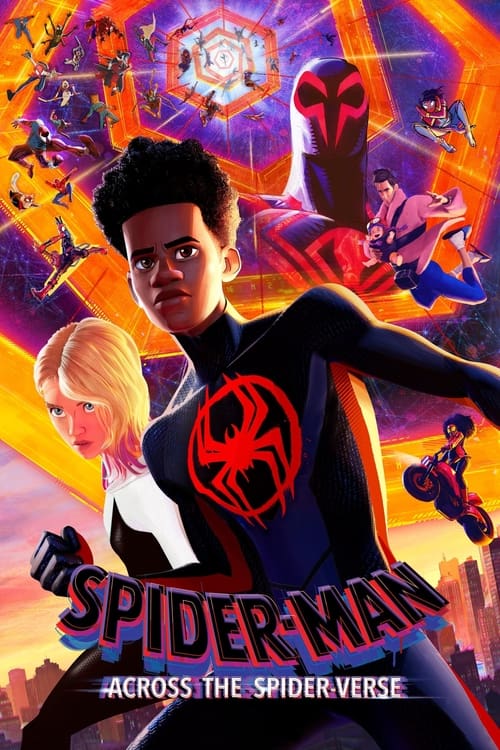
Spider-Man: Across the Spider-Verse
2023 · Directed by Kemp Powers
Woke Score
CriticCritic Score
Audience
Woke
Critics rated this 18 points above its woke score. Among Woke films, this critic score ranks #15 of 88.
Representation Casting
Score: 85/100
The film features Miles Morales as a Black Latino protagonist with significant screen time and emotional focus. Supporting cast includes diverse actors in meaningful roles (Hailee Steinfeld as Gwen Stacy, Brian Tyree Henry, Issa Rae, Daniel Kaluuya), demonstrating conscious casting across multiple universes.
LGBTQ+ Themes
Score: 25/100
While Gwen Stacy's storyline involves her identity and agency as a female hero, there are no explicit LGBTQ+ themes or characters presented in a prominent way. The film does not foreground queer representation as a narrative element.
Feminist Agenda
Score: 60/100
Gwen Stacy functions as a competent, capable hero with her own narrative arc and agency. However, the film does not explicitly engage with feminist theory or gender politics as central themes, presenting female heroism as simply normalized rather than as a statement.
Racial Consciousness
Score: 75/100
Miles Morales' identity as a Black Latino protagonist in Brooklyn is central to the narrative. His father's role as a police officer and their relationship touches on systemic themes. The film demonstrates racial awareness in its casting and character backgrounds, though it stops short of sustained social critique.
Climate Crusade
Score: 5/100
The film contains no meaningful engagement with climate change or environmental themes. The multiverse setting provides no opportunity for or exploration of ecological consciousness.
Eat the Rich
Score: 15/100
While the Spider Society could be read as an institutional authority structure that Miles must resist, the film does not engage with anti-capitalist themes or critique of economic systems. The conflict is personal and generational rather than ideological.
Body Positivity
Score: 10/100
The film presents animated characters with varied body types, but this reflects the conventions of animation design rather than an explicit body positivity agenda. No narrative focus is placed on challenging body standards or beauty norms.
Neurodivergence
Score: 20/100
While Miles experiences stress and internal conflict, the film does not explicitly engage with neurodivergence as a theme or present neurodivergent characters. Any representation of mental health or difference is incidental rather than intentional.
Revisionist History
Score: 30/100
The film operates within the Marvel continuity and comic book mythology without attempting to reinterpret historical events. Its use of multiverse narratives is speculative fiction rather than historical revisionism.
Lecture Energy
Score: 65/100
The film occasionally lapses into moments where characters seem to articulate values and perspectives for the audience's benefit rather than organic to the narrative. However, it generally trusts the audience to understand its thematic concerns through story and character action rather than explicit exposition.


Synopsis
After reuniting with Gwen Stacy, Brooklyn's full-time, friendly neighborhood Spider-Man is catapulted across the Multiverse, where he encounters the Spider Society, a team of Spider-People charged with protecting the Multiverse's very existence. But when the heroes clash on how to handle a new threat, Miles finds himself pitted against the other Spiders and must set out on his own to save those he loves most.
Consciousness Assessment
Spider-Man: Across the Spider-Verse presents itself as a multiverse-spanning adventure that cannot resist pausing frequently to remind us of its progressive sensibilities. The film centers Miles Morales, a Black Latino protagonist whose identity is not incidental to the narrative but rather the primary vehicle for its thematic preoccupations. His family dynamics, including his relationship with his police officer father, serve as a backdrop for exploring themes of generational conflict and systemic expectations, though these elements function more as atmospheric texture than as genuine interrogation. The Spider Society itself constitutes a roster of demographically diverse heroes, each representing a distinct visual and cultural archetype, which feels less like organic storytelling and more like the careful ticking of representational boxes.
What distinguishes the film is its earnest commitment to depicting its protagonist's struggle as fundamentally about his right to choose his own path against paternal authority and institutional pressure. This becomes the film's central preoccupation, and it carries a certain weight, even if the execution sometimes veers toward the preachy. The animation is technically accomplished, employing distinct visual styles for different universes, though this stylistic variation occasionally serves to distance the viewer rather than engage them. The film's exploration of what constitutes heroism and sacrifice has moments of genuine insight, but these are frequently interrupted by sequences that feel designed primarily to showcase the film's demographic range rather than advance character development.
The film's ultimate weakness lies in its apparent need to ensure that we understand its values, its commitments, and its awareness of contemporary social concerns. There is little subtext here, little faith in the audience's capacity to draw conclusions. Instead, we receive a film that has done its homework, ticked its lists, and presents itself as evidence of cultural progress. Whether this constitutes genuine artistic vision or a particularly expensive exercise in institutional self-satisfaction remains a matter of interpretation.
Analysis generated by our Consciousness Algorithm
Critic Reviews
“It is a smart, thrilling piece of work that reminded me of other great part twos like “The Dark Knight” and “The Empire Strikes Back."”
“Across the Spider-Verse isn't just easily one of the best films of 2023 and one of the best animated films in years, it's also in the running for best superhero film ever, and arguably cements Miles Morales as the best Spider-Man we've seen on the screen so far. ”
“Visually astonishing, emotionally daring, this spectacular sequel has enough wit, imagination and thrills to fill several worlds. But prepare to be left hanging till the sequel hits screens.”
“As visually hypercaffeinated as the film is—mixing animation styles, cramming the screen with imagery, and cutting rapidly around each donnybrook—it’s a bit sleepy when it comes to the plot, which doesn’t really kick in until the second half of the movie. ”
Consciousness Markers
The film features Miles Morales as a Black Latino protagonist with significant screen time and emotional focus. Supporting cast includes diverse actors in meaningful roles (Hailee Steinfeld as Gwen Stacy, Brian Tyree Henry, Issa Rae, Daniel Kaluuya), demonstrating conscious casting across multiple universes.
While Gwen Stacy's storyline involves her identity and agency as a female hero, there are no explicit LGBTQ+ themes or characters presented in a prominent way. The film does not foreground queer representation as a narrative element.
Gwen Stacy functions as a competent, capable hero with her own narrative arc and agency. However, the film does not explicitly engage with feminist theory or gender politics as central themes, presenting female heroism as simply normalized rather than as a statement.
Miles Morales' identity as a Black Latino protagonist in Brooklyn is central to the narrative. His father's role as a police officer and their relationship touches on systemic themes. The film demonstrates racial awareness in its casting and character backgrounds, though it stops short of sustained social critique.
The film contains no meaningful engagement with climate change or environmental themes. The multiverse setting provides no opportunity for or exploration of ecological consciousness.
While the Spider Society could be read as an institutional authority structure that Miles must resist, the film does not engage with anti-capitalist themes or critique of economic systems. The conflict is personal and generational rather than ideological.
The film presents animated characters with varied body types, but this reflects the conventions of animation design rather than an explicit body positivity agenda. No narrative focus is placed on challenging body standards or beauty norms.
While Miles experiences stress and internal conflict, the film does not explicitly engage with neurodivergence as a theme or present neurodivergent characters. Any representation of mental health or difference is incidental rather than intentional.
The film operates within the Marvel continuity and comic book mythology without attempting to reinterpret historical events. Its use of multiverse narratives is speculative fiction rather than historical revisionism.
The film occasionally lapses into moments where characters seem to articulate values and perspectives for the audience's benefit rather than organic to the narrative. However, it generally trusts the audience to understand its thematic concerns through story and character action rather than explicit exposition.