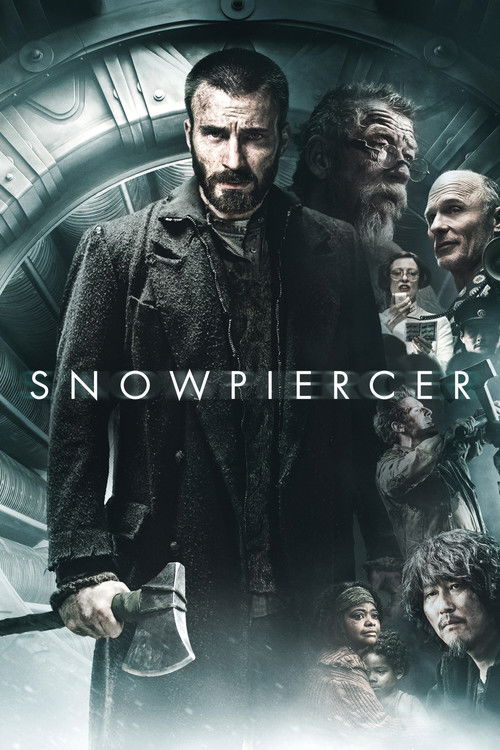
Snowpiercer
2013 · Directed by Bong Joon Ho
Woke Score
CriticCritic Score
Audience
Based
Critics rated this 46 points above its woke score. Among Based films, this critic score ranks #46 of 345.
Representation Casting
Score: 15/100
The cast includes actors of various racial backgrounds and genders, but diversity is incidental rather than intentionally foregrounded as a progressive value. Characters are deployed for thematic purposes within the narrative.
LGBTQ+ Themes
Score: 0/100
No evidence of LGBTQ+ representation, themes, or engagement with sexual orientation or gender identity in the film.
Feminist Agenda
Score: 10/100
While Tilda Swinton delivers a powerful performance as the authoritarian Minister Mason, the film does not advance feminist critique or center women's experiences as a thematic concern.
Racial Consciousness
Score: 25/100
The ensemble cast includes racial diversity and academic sources note transnational and decolonial themes, but the film does not explicitly thematize race or racial justice within its narrative.
Climate Crusade
Score: 35/100
The film opens with a failed climate engineering experiment as the apocalyptic trigger, critiquing technocratic solutions to climate change rather than advocating contemporary climate activism.
Eat the Rich
Score: 75/100
The entire narrative structure is built around class conflict, resource hoarding by the wealthy, and working-class rebellion. The critique of capitalism and inequality is the film's organizing principle.
Body Positivity
Score: 0/100
No engagement with body diversity, disability representation, or body positivity discourse. Characters' physical attributes are not thematized.
Neurodivergence
Score: 5/100
A young boy in the tail appears to have developmental differences, but the film does not engage with neurodivergence as a theme or provide progressive framing.
Revisionist History
Score: 0/100
The film is set in a fictional future scenario and does not reframe or reinterpret historical events.
Lecture Energy
Score: 30/100
The film articulates its class critique through dialogue and visual language, but maintains restraint and trusts its allegory rather than pausing to explicitly lecture the audience.


Synopsis
In a future where a failed global-warming experiment kills off most life on the planet, a class system evolves aboard the Snowpiercer; a train that travels around the globe via a perpetual-motion engine.
Consciousness Assessment
Snowpiercer presents itself as an elaborate class allegory set within the confines of a perpetually moving train, where the wealthy occupy the front cars and the desperate poor are packed into the tail. Director Bong Joon Ho constructs a narrative that functions as a systemic critique of capitalism and resource inequality, presenting the revolution of the working class not as moral ambiguity but as structural necessity. The film's visual language reinforces this argument through careful cinematography that emphasizes the stark contrast between the sterile luxury of the front and the squalor of the rear.
Yet the film operates within a classical leftist framework rather than within the contemporary cultural consciousness that emerged in the 2020s. Its engagement with identity categories remains peripheral. The cast includes performers of diverse backgrounds, but the film does not mobilize representation as a progressive value or thematize race, gender, or sexuality in ways that align with current social justice discourse. The anti-capitalist messaging is explicit, yet the film trusts its allegory rather than pausing to lecture. Characters discuss the system, but they do so within the logic of the narrative rather than stepping outside it to address the audience.
The film's most notable blind spot is its treatment of climate catastrophe. Rather than framing climate change as an activist cause requiring contemporary mobilization, Snowpiercer presents it as a consequence of technocratic hubris and failed geoengineering. This is a critique of a particular approach to environmental management rather than an embrace of climate activism. The result is a film of considerable political seriousness that speaks to inequality and systemic violence, but one that predates and does not fully inhabit the specific cultural markers of modern progressive consciousness.
Analysis generated by our Consciousness Algorithm
Critic Reviews
“Snowpiercer evolves steadily, growing richer with every step and slowly feeding us morsels of information - enriching this ludicrous premise with enough magic and wonder to suspend our disbelief entirely.”
“The action sequences in the film are spectacular, and there's one in particular that I think is an all-timer, both in the way it's imagined and in the way it's accomplished on film, but this isn't a film about empty sensation. It's a richly realized science-fiction world, and the cast is just tremendous.”
“In superlative previous films like “The Host” and “Mother,” Bong elevated, then transcended, the humble genres of the monster movie and the murder mystery by refashioning them into exquisitely heart-wrenching human drama. Disappointingly, then, his alchemical touch is absent here. Snowpiercer warms the heart, but doesn't penetrate it.”
Consciousness Markers
The cast includes actors of various racial backgrounds and genders, but diversity is incidental rather than intentionally foregrounded as a progressive value. Characters are deployed for thematic purposes within the narrative.
No evidence of LGBTQ+ representation, themes, or engagement with sexual orientation or gender identity in the film.
While Tilda Swinton delivers a powerful performance as the authoritarian Minister Mason, the film does not advance feminist critique or center women's experiences as a thematic concern.
The ensemble cast includes racial diversity and academic sources note transnational and decolonial themes, but the film does not explicitly thematize race or racial justice within its narrative.
The film opens with a failed climate engineering experiment as the apocalyptic trigger, critiquing technocratic solutions to climate change rather than advocating contemporary climate activism.
The entire narrative structure is built around class conflict, resource hoarding by the wealthy, and working-class rebellion. The critique of capitalism and inequality is the film's organizing principle.
No engagement with body diversity, disability representation, or body positivity discourse. Characters' physical attributes are not thematized.
A young boy in the tail appears to have developmental differences, but the film does not engage with neurodivergence as a theme or provide progressive framing.
The film is set in a fictional future scenario and does not reframe or reinterpret historical events.
The film articulates its class critique through dialogue and visual language, but maintains restraint and trusts its allegory rather than pausing to explicitly lecture the audience.