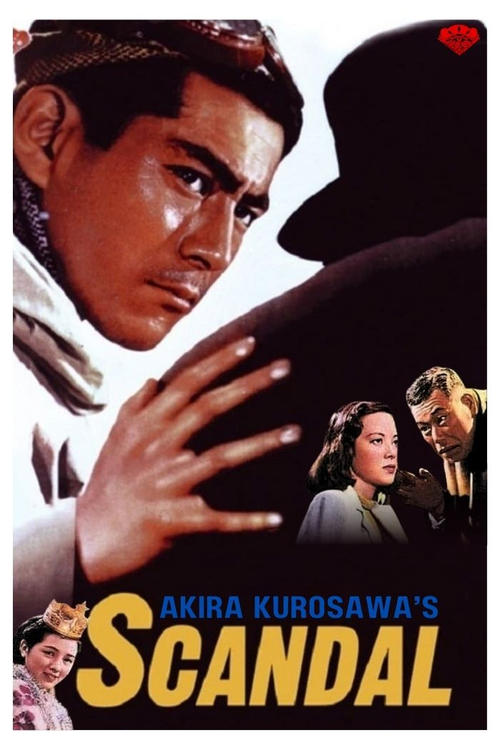
Scandal
1950 · Directed by Akira Kurosawa
Woke Score
CriticCritic Score
Ultra Based
Critics rated this 58 points above its woke score. Among Ultra Based films, this critic score ranks #857 of 1469.
Representation Casting
Score: 0/100
The cast reflects the Japanese society of 1950 without deliberate considerations of diverse representation. No evidence of intentional casting choices motivated by modern representation principles.
LGBTQ+ Themes
Score: 0/100
No LGBTQ+ themes, characters, or subtext present in the film.
Feminist Agenda
Score: 15/100
The female singer is depicted as a victim of systemic injustice and false accusation, which carries some implicit critique of how women are treated by media and legal systems. However, this is not framed in modern feminist discourse or with explicit gender-consciousness analysis.
Racial Consciousness
Score: 0/100
No engagement with racial consciousness or racial themes. The film is set in post-war Japan and features a Japanese cast, but race is not a subject of examination.
Climate Crusade
Score: 0/100
No climate-related themes or messaging present.
Eat the Rich
Score: 20/100
The film critiques profit-driven media and institutional corruption, showing how capitalist incentives lead to dishonesty and harm. However, this critique lacks the specific language and framework of contemporary anti-capitalist discourse.
Body Positivity
Score: 0/100
No body positivity messaging or themes related to body image and acceptance present in the film.
Neurodivergence
Score: 0/100
No representation or discussion of neurodivergence or neurodivergent characters.
Revisionist History
Score: 0/100
The film does not engage in revisionist history. It is a contemporary drama set in its own present (1950 Japan) rather than an interpretation of historical events.
Lecture Energy
Score: 5/100
The film presents its moral arguments through narrative and character action rather than preachy exposition. There is minimal 'lecture energy,' though the ending does include some explicit moral commentary about the cost of injustice.

Synopsis
A celebrity photograph sparks a court case as a tabloid magazine spins a scandalous yarn over a painter and a famous singer.
Consciousness Assessment
Kurosawa's "Scandal" remains a remarkably prescient meditation on the destructive power of tabloid media, though it operates from a humanist rather than a contemporary progressive framework. The film depicts how a fabricated narrative in a gossip magazine destroys the lives of two innocent people, a painter and a singer, through the mechanisms of public shame and legal machinery. There is genuine social consciousness here, but it emerges from a mid-century moral philosophy concerned with justice and the dignity of individuals rather than from the specific constellation of modern progressive sensibilities that define contemporary cultural awareness. The female singer character (Yoshiko Yamaguchi) is presented as a victim of systemic injustice, which carries some proto-feminist weight, yet the film does not interrogate gender dynamics explicitly or engage with the language of modern intersectionality.
The picture functions primarily as a critique of institutional corruption and the media's capacity for harm. A lawyer cynically manufactures false evidence to win his case, tabloid editors knowingly publish lies for profit, and the judicial system becomes complicit in perpetuating falsehoods. This is anti-capitalist in the broadest sense, showing how profit motive corrupts institutions, but it lacks the specific modern markers of anti-capitalist discourse. We see no systematic examination of class structures, wealth inequality, or revolutionary consciousness. The film is a serious work of social critique from the immediate post-war period, when Japanese cinema was grappling with questions of truth, authority, and institutional integrity in a society rebuilding itself after occupation. Its power lies in its moral clarity, not in its alignment with any particular contemporary cultural movement.
Analysis generated by our Consciousness Algorithm
Critic Reviews
“This is an awkward comedy made just before Kurosawa's breakthrough film, Rashomon.”
“It's a sentimental, maudlin melodrama with comical flourishes, not as ambitious or epic as the director's best work.”
Consciousness Markers
The cast reflects the Japanese society of 1950 without deliberate considerations of diverse representation. No evidence of intentional casting choices motivated by modern representation principles.
No LGBTQ+ themes, characters, or subtext present in the film.
The female singer is depicted as a victim of systemic injustice and false accusation, which carries some implicit critique of how women are treated by media and legal systems. However, this is not framed in modern feminist discourse or with explicit gender-consciousness analysis.
No engagement with racial consciousness or racial themes. The film is set in post-war Japan and features a Japanese cast, but race is not a subject of examination.
No climate-related themes or messaging present.
The film critiques profit-driven media and institutional corruption, showing how capitalist incentives lead to dishonesty and harm. However, this critique lacks the specific language and framework of contemporary anti-capitalist discourse.
No body positivity messaging or themes related to body image and acceptance present in the film.
No representation or discussion of neurodivergence or neurodivergent characters.
The film does not engage in revisionist history. It is a contemporary drama set in its own present (1950 Japan) rather than an interpretation of historical events.
The film presents its moral arguments through narrative and character action rather than preachy exposition. There is minimal 'lecture energy,' though the ending does include some explicit moral commentary about the cost of injustice.