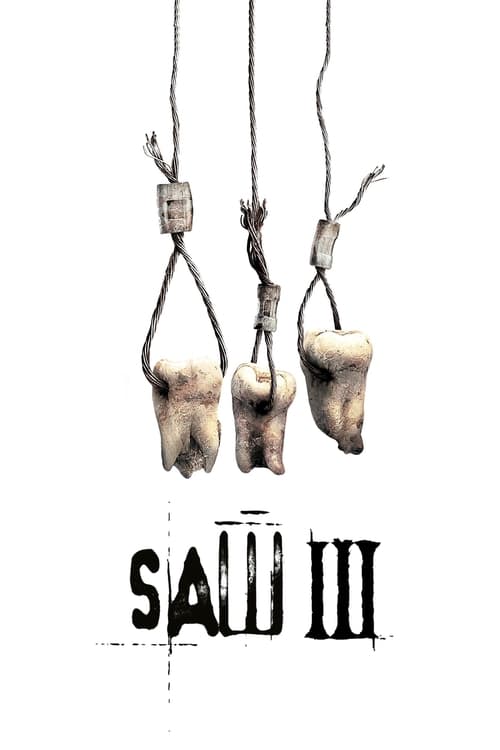
Saw III
2006 · Directed by Darren Lynn Bousman
Woke Score
CriticCritic Score
Audience
Ultra Based
Critics rated this 44 points above its woke score. Among Ultra Based films, this critic score ranks #1207 of 1469.
Representation Casting
Score: 5/100
The cast includes actors of various racial and ethnic backgrounds, but their presence is incidental to the narrative rather than meaningfully integrated into the story's themes or character development.
LGBTQ+ Themes
Score: 0/100
There is no evidence of LGBTQ+ representation or thematic engagement in the film.
Feminist Agenda
Score: 8/100
Shawnee Smith's Amanda character is a violent antagonist who acts alongside the male lead, though this is framed as moral corruption rather than empowerment, and other female characters remain victims or supporting roles.
Racial Consciousness
Score: 0/100
The film contains no exploration of racial themes, systemic racism, or racial consciousness despite its diverse cast.
Climate Crusade
Score: 0/100
Climate change or environmental concerns play no role in the film's narrative or thematic structure.
Eat the Rich
Score: 0/100
The film contains no critique of capitalism, wealth inequality, or class systems.
Body Positivity
Score: 0/100
Body positivity or acceptance of diverse body types is not a concern of this torture-focused horror film.
Neurodivergence
Score: 0/100
There is no representation of or engagement with neurodivergence in the film.
Revisionist History
Score: 0/100
The film does not engage with history or historical narratives in any form.
Lecture Energy
Score: 10/100
Jigsaw delivers moral monologues about personal responsibility and accountability throughout the film, presenting his philosophy as a form of philosophical instruction to his victims.


Synopsis
Jigsaw has disappeared. Along with his new apprentice Amanda, the puppet-master behind the cruel, intricate games that have terrified a community and baffled police has once again eluded capture and vanished. While city detectives scrambles to locate him, Doctor Lynn Denlon and Jeff Reinhart are unaware that they are about to become the latest pawns on his vicious chessboard.
Consciousness Assessment
Saw III belongs to that particular species of horror sequel concerned primarily with escalating gore and narrative complication, a project that treats social consciousness as an afterthought if it acknowledges it at all. The film operates within a framework of moral absolutism that predates contemporary progressive sensibilities by decades. Jigsaw's philosophy, such as it is, concerns personal accountability through suffering, a notion that sits uncomfortably with modern conceptions of rehabilitation or systemic justice. The cast includes actors of various ethnic backgrounds, though their presence functions as window dressing rather than meaningful representation, a phenomenon one might charitably call colorblind casting and less charitably call indifference.
The film's relationship to gender is similarly unremarkable. Shawnee Smith returns as Amanda, a character granted agency primarily through her willingness to perpetrate violence alongside the male antagonist, a dynamic that mistakes brutality for empowerment. The supporting female characters are victims, witnesses, or collateral damage, their roles defined by proximity to the male characters' narratives. There is no evidence of engagement with contemporary debates about gender, sexuality, disability, or any other axis of identity that might constitute modern progressive discourse. The film simply does not concern itself with such matters.
What emerges from Saw III is a work singularly focused on the mechanics of torture, the psychology of obsession, and the continuation of a commercial franchise. It is a film of its moment, 2006, before the cultural conversations we now take for granted had fully crystallized in popular cinema. To score it as though it harbors latent progressive sensibilities would be to misapply our critical apparatus entirely. It is a horror film made for audiences who wanted more elaborate traps and plot twists, nothing more or less than that.
Analysis generated by our Consciousness Algorithm
Critic Reviews
“That may not exactly thrill those who admire the Saw films only for their splatter quotient, but all told, this is a more affecting study in grief, guilt and human frailty than "Babel."”
“Admit it: It's not every horror film that can make you feel preached at and slimed at the same time.”
“While Saw III provides a decent number of new twists, psychological as well as torture-wise, it necessarily lacks the originality of its predecessors.”
“While "Saw" and "Saw II" were pretty good splatter films hampered by spectacularly unbelievable endings, Saw III is annoying for almost the duration of the movie.”
Consciousness Markers
The cast includes actors of various racial and ethnic backgrounds, but their presence is incidental to the narrative rather than meaningfully integrated into the story's themes or character development.
There is no evidence of LGBTQ+ representation or thematic engagement in the film.
Shawnee Smith's Amanda character is a violent antagonist who acts alongside the male lead, though this is framed as moral corruption rather than empowerment, and other female characters remain victims or supporting roles.
The film contains no exploration of racial themes, systemic racism, or racial consciousness despite its diverse cast.
Climate change or environmental concerns play no role in the film's narrative or thematic structure.
The film contains no critique of capitalism, wealth inequality, or class systems.
Body positivity or acceptance of diverse body types is not a concern of this torture-focused horror film.
There is no representation of or engagement with neurodivergence in the film.
The film does not engage with history or historical narratives in any form.
Jigsaw delivers moral monologues about personal responsibility and accountability throughout the film, presenting his philosophy as a form of philosophical instruction to his victims.