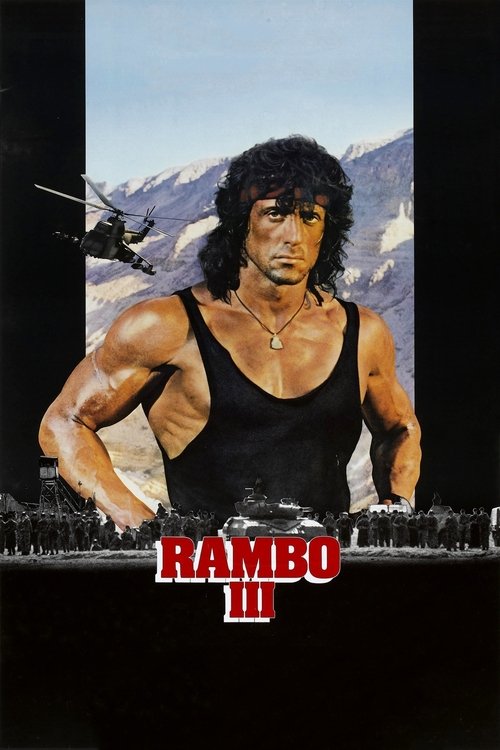
Rambo III
1988 · Directed by Peter MacDonald
Woke Score
CriticCritic Score
Audience
Ultra Based
Critics rated this 32 points above its woke score. Among Ultra Based films, this critic score ranks #1391 of 1469.
Representation Casting
Score: 5/100
Afghan characters appear in the film but primarily as background figures serving Stallone's narrative. No meaningful representation or agency given to non-American characters.
LGBTQ+ Themes
Score: 0/100
No LGBTQ+ themes, representation, or subtext present in the film.
Feminist Agenda
Score: 2/100
Rambo III is a male action vehicle with minimal female presence and entirely traditional gender dynamics. Women serve supporting roles with no agency.
Racial Consciousness
Score: 3/100
Afghan people are portrayed in monolithic fashion as either allies or enemies. No contemporary racial consciousness or interrogation of representation present.
Climate Crusade
Score: 0/100
Climate concerns are entirely absent from this 1988 action thriller about Cold War intervention.
Eat the Rich
Score: 0/100
The film is explicitly anti-communist, not anti-capitalist. It celebrates American intervention and capitalist ideology.
Body Positivity
Score: 0/100
Standard 1980s action film masculinity dominates. No body positivity messaging or inclusive representation of different body types.
Neurodivergence
Score: 0/100
No representation of or engagement with neurodivergence in the film.
Revisionist History
Score: 10/100
While the film takes a strong political stance on Afghanistan and the Soviet invasion, it does not engage in the kind of revisionist historical reframing typical of contemporary progressive discourse.
Lecture Energy
Score: 5/100
The film contains ideological messaging about Cold War politics but not in the expository, preachy manner characteristic of modern progressive cinema with high lecture energy.


Synopsis
Combat has taken its toll on Rambo, but he's finally begun to find inner peace in a monastery. When Rambo's friend and mentor Col. Trautman asks for his help on a top secret mission to Afghanistan, Rambo declines but must reconsider when Trautman is captured.
Consciousness Assessment
Rambo III arrives as a document of late Cold War anxieties, a moment when American cinema could still deploy anti-communist rhetoric without irony or self-examination. The film is not progressive by any measure, but neither does it exhibit the specific markers of contemporary social consciousness that define the modern cultural phenomenon we are measuring. It is instead a straightforward action vehicle motivated by geopolitical ideology of its moment, not by the identity-conscious sensibilities that emerged in the 2010s and 2020s.
The film's treatment of Afghanistan and its people serves the narrative requirements of American heroism. Afghan characters exist primarily as supporting figures in Rambo's mission, their nation rendered as a backdrop for his vendetta. There is no attempt at nuanced representation, no interrogation of colonial intervention, no awareness of the complexity that would later become commonplace in progressive discourse. The film simply does not operate in that register.
What saves Rambo III from a higher score is precisely its refusal to engage with contemporary cultural markers at all. It is a relic of an earlier ideological moment, uncomplicated and unapologetic in its Cold War triumphalism. It contains no lecture energy, no performative representation, no progressive reframing. It is, in this sense, almost refreshingly honest in its simplicity, even if that simplicity now reads as dated and ideologically crude.
Analysis generated by our Consciousness Algorithm
Critic Reviews
“This is a comic book movie, its outcome as predictable as it is satisfying, which is part of its charm. [25 May 1988, p.7]”
“The battle scenes in Rambo III are explosive, conflagratory tableaux that make for wrenching, frequently terrifying viewing. Always at ground zero in the chaos is Rambo - gloriously, inhumanly impervious to fear and danger - whose character is inhabited by Stallone with messianic intensity.”
“Rambo's self-important, weight-of-the-world manner and his taste for political posturing would make him genuinely silly were they not counterbalanced by Mr. Stallone's startling, energetic physical presence and the film's stabs at self-mocking humor.”
“This time Rambo pulls off his superhuman Soviet-blasting stunts in Afghanistan, not quite as late on the scene as he was in Vietnam. Not very exciting; very noisy. [2 Jun 1988, p.1]”
Consciousness Markers
Afghan characters appear in the film but primarily as background figures serving Stallone's narrative. No meaningful representation or agency given to non-American characters.
No LGBTQ+ themes, representation, or subtext present in the film.
Rambo III is a male action vehicle with minimal female presence and entirely traditional gender dynamics. Women serve supporting roles with no agency.
Afghan people are portrayed in monolithic fashion as either allies or enemies. No contemporary racial consciousness or interrogation of representation present.
Climate concerns are entirely absent from this 1988 action thriller about Cold War intervention.
The film is explicitly anti-communist, not anti-capitalist. It celebrates American intervention and capitalist ideology.
Standard 1980s action film masculinity dominates. No body positivity messaging or inclusive representation of different body types.
No representation of or engagement with neurodivergence in the film.
While the film takes a strong political stance on Afghanistan and the Soviet invasion, it does not engage in the kind of revisionist historical reframing typical of contemporary progressive discourse.
The film contains ideological messaging about Cold War politics but not in the expository, preachy manner characteristic of modern progressive cinema with high lecture energy.