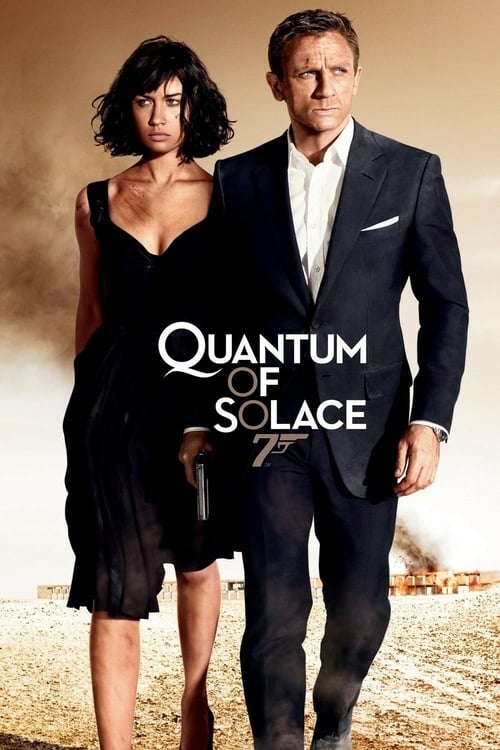
Quantum of Solace
2008 · Directed by Marc Forster
Woke Score
CriticCritic Score
Audience
Ultra Based
Critics rated this 43 points above its woke score. Among Ultra Based films, this critic score ranks #963 of 1469.
Representation Casting
Score: 25/100
Female characters present in action sequences (Olga Kurylenko, Gemma Arterton, Judi Dench) but subordinate to Bond's narrative. Cast is predominantly white.
LGBTQ+ Themes
Score: 0/100
No LGBTQ+ themes, representation, or subtext present in the film.
Feminist Agenda
Score: 20/100
Female characters participate in action but remain secondary to Bond's emotional journey. Vesper's death motivates the male protagonist rather than standing as independent narrative.
Racial Consciousness
Score: 10/100
No racial consciousness or commentary present. Setting in Bolivia used as backdrop rather than engagement with social dynamics.
Climate Crusade
Score: 35/100
Water privatization plot provides environmental element, but treated as plot device rather than thematic concern or preachy messaging.
Eat the Rich
Score: 15/100
Villain's scheme involves corporate exploitation of resources, but presented as personal villainy rather than systemic critique.
Body Positivity
Score: 0/100
No body positivity themes, messaging, or representation present.
Neurodivergence
Score: 0/100
No neurodivergence representation or thematic engagement.
Revisionist History
Score: 0/100
No historical revisionism or reframing of past events.
Lecture Energy
Score: 5/100
Minimal preachy messaging. Film prioritizes action and plot mechanics over ideological exposition.


Synopsis
Betrayed by Vesper, the woman he loved, 007 fights the urge to make his latest mission personal. Pursuing his determination to uncover the truth, Bond and M interrogate Mr. White, who reveals that the organization that blackmailed Vesper is far more complex and dangerous than anyone had imagined.
Consciousness Assessment
Quantum of Solace arrives as a thoroughly conventional revenge thriller wrapped in the familiar trappings of the Bond franchise, yet somehow manages to feel more emotionally austere than its predecessors. Marc Forster's direction privileges visceral action sequences and Bond's brooding introspection over the playful spectacle that once defined 007 cinema. The film's environmental subplot, involving water privatization in Bolivia, provides a thin veneer of topical relevance, though it functions primarily as plot mechanics rather than social commentary.
The female characters present in this film, while visible in action beats, remain largely subordinate to Bond's emotional arc. Vesper's death continues to haunt him, but her narrative purpose extends little beyond motivating his vendetta. Gemma Arterton's appearance is fleeting. The cast composition reflects the early 2000s action film norm: predominantly white, with token international representation. There exists no detectable engagement with contemporary progressive sensibilities, no LGBTQ+ themes, no body positivity messaging, no neurodivergence representation, no revisionist historical claims. The film is simply a Bond film, uninterested in the cultural self-consciousness that would come to define much of cinema in the subsequent decade.
What we observe here is a professional execution of a well-established formula during a moment before that formula would be significantly interrogated by shifting cultural attitudes. The water rights plot could be read as environmental awareness, but it remains decorative, a MacGuffin no more philosophically committed than the nuclear weapons plots of earlier entries. This is not a film wrestling with its own assumptions about power, representation, or social responsibility.
Analysis generated by our Consciousness Algorithm
Critic Reviews
“Quantum, thanks to a deft blend of exotic escapism and bare-bones modernism, is more than strong enough to be judged on its own. In fact, it's the perfect Bond film.”
“Quantum of Solace bends whatever rules 2006's Casino Royale didn't break, presenting more action in less time, with a world domination scheme based on natural resources rather than unnatural gadgets.”
“As with "The Dark Knight," the only real caveat is that while it's exciting and imaginative, it's not exactly anyone's idea of fun. To keep in the game, perhaps the next movie could let the hero enjoy himself a bit more.”
“A spastic, indecipherable, unholy, and altogether unwatchable mess.”
Consciousness Markers
Female characters present in action sequences (Olga Kurylenko, Gemma Arterton, Judi Dench) but subordinate to Bond's narrative. Cast is predominantly white.
No LGBTQ+ themes, representation, or subtext present in the film.
Female characters participate in action but remain secondary to Bond's emotional journey. Vesper's death motivates the male protagonist rather than standing as independent narrative.
No racial consciousness or commentary present. Setting in Bolivia used as backdrop rather than engagement with social dynamics.
Water privatization plot provides environmental element, but treated as plot device rather than thematic concern or preachy messaging.
Villain's scheme involves corporate exploitation of resources, but presented as personal villainy rather than systemic critique.
No body positivity themes, messaging, or representation present.
No neurodivergence representation or thematic engagement.
No historical revisionism or reframing of past events.
Minimal preachy messaging. Film prioritizes action and plot mechanics over ideological exposition.