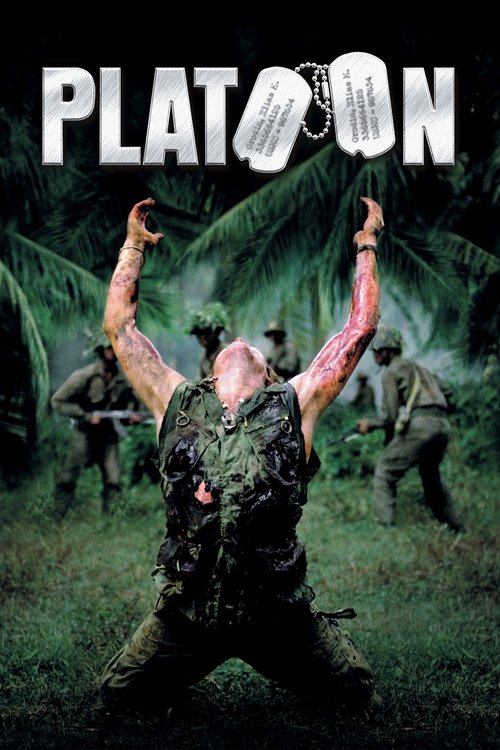
Platoon
1986 · Directed by Oliver Stone
Woke Score
CriticCritic Score
Audience
Ultra Based
Critics rated this 84 points above its woke score. Among Ultra Based films, this critic score ranks #98 of 1469.
Representation Casting
Score: 12/100
Forest Whitaker and Keith David appear in the ensemble, but their characters exist without specific attention to racial positioning. Representation is present but not thematized.
LGBTQ+ Themes
Score: 0/100
No LGBTQ+ themes or characters present in the film.
Feminist Agenda
Score: 5/100
Women appear primarily as background figures and romantic/sexual interests. No feminist agenda or critique of gender dynamics in the military.
Racial Consciousness
Score: 8/100
Black soldiers are present in the platoon but treated as individuals rather than subject to systemic racial analysis. The Vietnam War's specific dimensions regarding race and empire are not interrogated.
Climate Crusade
Score: 0/100
No climate themes or environmental consciousness present.
Eat the Rich
Score: 15/100
The film critiques military violence and institutional brutality, which carries anti-war sentiment, but lacks explicit critique of capitalism or economic systems driving conflict.
Body Positivity
Score: 0/100
No body positivity themes or discourse about body diversity present.
Neurodivergence
Score: 0/100
No representation of or engagement with neurodivergence.
Revisionist History
Score: 25/100
The film does revise the American narrative around Vietnam by presenting the war as morally corrosive and American soldiers as perpetrators of atrocities, but this is not revisionist in the sense of recovering suppressed perspectives from marginalized groups.
Lecture Energy
Score: 5/100
Stone's moral vision is embedded in narrative and character rather than delivered through preachy exposition, though some monologues carry thematic weight.


Synopsis
As a young and naive recruit in Vietnam, Chris Taylor faces a moral crisis when confronted with the horrors of war and the duality of man.
Consciousness Assessment
Platoon stands as a masterwork of 1980s cinema in its willingness to interrogate American military violence without pretense or propaganda, yet it remains fundamentally a product of its era in its approach to social consciousness. Oliver Stone's autobiographical account of Vietnam presents the war as a crucible of moral degradation rather than a vehicle for exploring systemic injustice or the specific experiences of marginalized communities. The film's moral framework is humanistic and universal: good men become corrupted by violence, innocence is shattered, the machinery of war grinds everyone into the same moral mud. This is important cinema, but it is not animated by the particular sensibilities that define contemporary progressive discourse.
The ensemble cast includes Black actors of considerable talent, most notably Forest Whitaker, but they are integrated into the narrative as soldiers without particular attention to their distinct historical positioning or the specific dimensions of racial experience in the military apparatus. The film's engagement with morality operates at the level of individual conscience rather than structural critique. We watch Chris Taylor develop moral awareness through witnessing atrocities and wrestling with competing father figures (the gentle Sergeant Elias and the brutal Sergeant Barnes), but this awakening does not extend to examining how the war's brutality was inflected by race, empire, or the economic machinery that sustained American intervention.
Platoon's power derives from its refusal to offer easy answers and its unflinching commitment to depicting the chaos and horror of combat. It remains a serious artistic achievement that helped American culture process trauma and moral failure. Yet it lacks the specific markers of modern progressive sensibility: no interrogation of gender dynamics, no attention to the particular vulnerabilities of marginalized soldiers, no systemic critique, no sense that representation itself requires deliberate revision. It is a great film about the moral weight of war, not a film concerned with the cultural preoccupations that would come to define the 2020s.
Analysis generated by our Consciousness Algorithm
Critic Reviews
“It was Francois Truffaut who said that it's not possible to make an anti-war movie, because all war movies, with their energy and sense of adventure, end up making combat look like fun. If Truffaut had lived to see Platoon, the best film of 1986, he might have wanted to modify his opinion. Here is a movie that regards combat from ground level, from the infantryman's point of view, and it does not make war look like fun.”
“Possibly the best work of any kind about the Vietnam War since Michael Herr's vigorous and hallucinatory book "Dispatches."”
“Platoon is a triumph for Oliver Stone, a film in which a visceral approach to violence, which has always set him apart, is balanced by classical symmetries and a kind of elegiac distance. This is not the Vietnam of op-ed writers, rabble-rousers or esthetic visionaries, not Vietnam-as-metaphor or Vietnam-the-way-it-should-have-been. It is a movie about Vietnam as it was, alive with authenticity, seen through the eyes of a master filmmaker who lost his innocence there. ”
“He makes a good job of it, though the wider aspirations to contemporary relevance seem dubious. Stone seeks large lessons in the experiences of ordinary men in battle, but it isn't clear Vietnam has anything new to offer: war is hell and somebody inevitably gets shafted, but the uniqueness of this conflict lies away from the military arena: in politics, psychology, and history. For all the purported naturalism, the film seems resolutely schematic, and the attitudes shaping the drama are far from open-ended. ”
Consciousness Markers
Forest Whitaker and Keith David appear in the ensemble, but their characters exist without specific attention to racial positioning. Representation is present but not thematized.
No LGBTQ+ themes or characters present in the film.
Women appear primarily as background figures and romantic/sexual interests. No feminist agenda or critique of gender dynamics in the military.
Black soldiers are present in the platoon but treated as individuals rather than subject to systemic racial analysis. The Vietnam War's specific dimensions regarding race and empire are not interrogated.
No climate themes or environmental consciousness present.
The film critiques military violence and institutional brutality, which carries anti-war sentiment, but lacks explicit critique of capitalism or economic systems driving conflict.
No body positivity themes or discourse about body diversity present.
No representation of or engagement with neurodivergence.
The film does revise the American narrative around Vietnam by presenting the war as morally corrosive and American soldiers as perpetrators of atrocities, but this is not revisionist in the sense of recovering suppressed perspectives from marginalized groups.
Stone's moral vision is embedded in narrative and character rather than delivered through preachy exposition, though some monologues carry thematic weight.