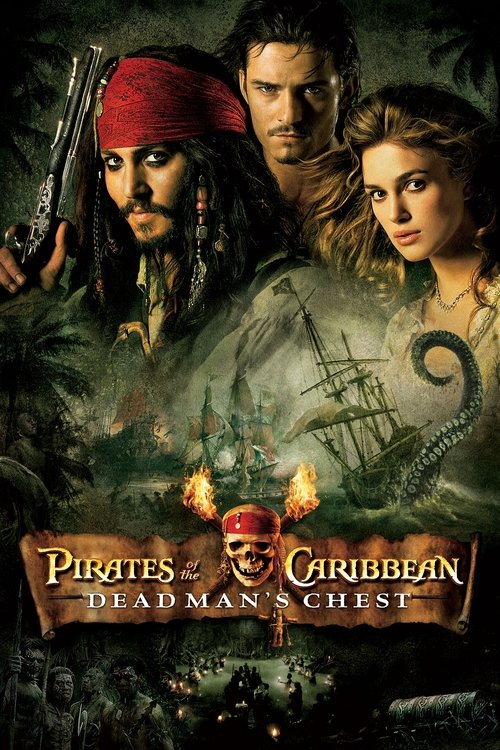
Pirates of the Caribbean: Dead Man's Chest
2006 · Directed by Gore Verbinski
Woke Score
CriticCritic Score
Audience
Ultra Based
Critics rated this 49 points above its woke score. Among Ultra Based films, this critic score ranks #1091 of 1469.
Representation Casting
Score: 25/100
The cast includes Keira Knightley in a significant role and some ethnic diversity among supporting players, but this reflects basic Hollywood casting practices of the era rather than deliberate representation consciousness. No substantive effort is made to center marginalized perspectives.
LGBTQ+ Themes
Score: 0/100
There are no LGBTQ+ themes, subtext, or characters of note in the film. The romantic dynamics are entirely heterosexual and conventionally structured.
Feminist Agenda
Score: 15/100
Elizabeth Swann displays agency within the narrative, but this agency operates within a fairly traditional love-triangle framework. She is written as a love interest first and character second, with her motivations tied to romantic concerns rather than independent goals.
Racial Consciousness
Score: 5/100
The film contains no meaningful engagement with racial themes or consciousness. Non-white characters appear in supporting roles without commentary or thematic weight regarding their identity.
Climate Crusade
Score: 0/100
Climate consciousness is entirely absent from this adventure film. Environmental concerns are not present in the narrative, themes, or visual language.
Eat the Rich
Score: 0/100
The film presents no critique of capitalism or wealth accumulation. The plot concerns itself with treasure and debt in purely fantastical terms without systemic interrogation.
Body Positivity
Score: 0/100
Body positivity is not a concern of the film. Characters are presented according to conventional action-film aesthetics, and no effort is made toward inclusivity in physical representation.
Neurodivergence
Score: 5/100
Captain Jack Sparrow's erratic behavior and unsteady demeanor could be read as neurodivergent coding, but this appears to be incidental comic characterization rather than deliberate representation or exploration of neurodiversity.
Revisionist History
Score: 0/100
The film operates in a fantasy register where historical accuracy is irrelevant. There is no attempt to revise or reframe actual historical events or narratives.
Lecture Energy
Score: 0/100
The film contains no preachy impulse to educate audiences about social issues. It proceeds purely as entertainment spectacle without moral instruction.


Synopsis
Jack's got a blood debt to pay: he owes his soul to the legendary Davy Jones, ghastly Ruler of the Ocean Depths. But ever-crafty Jack isn't about to go down without a fight.
Consciousness Assessment
Dead Man's Chest arrives from an era before the current vocabulary of social consciousness had calcified into Hollywood orthodoxy. This is a film concerned primarily with spectacle, humor, and the logistics of keeping Johnny Depp's Captain Jack Sparrow adequately intoxicated and off-balance. The narrative centers on masculine conquest, financial obligation, and the pursuit of romantic interests through largely conventional means. Keira Knightley's Elizabeth Swann occupies the screen with agency, but within the framework of a love triangle orchestrated by the plot rather than by any particular investment in her interiority. The film makes no serious attempt to interrogate its own premises about power, desire, or colonial adventure. Gore Verbinski's direction prioritizes momentum and visual excess over any deeper engagement with the material.
The supporting cast, while diverse in appearance, exists primarily as comic relief or plot mechanics. Bill Nighy's Davy Jones is rendered grotesque through practical effects rather than explored as a character with substantive depth. The film traffics in broad strokes and adventure-serial tropes that predate our current moment's anxieties about representation. There is no discernible effort toward climate consciousness, body positivity, or interrogation of capitalist systems. The class dynamics are purely ornamental, window dressing for a pirate fantasy. What we have instead is a straightforward commercial entertainment product, technically accomplished and mildly diverting, that simply does not concern itself with the markers of contemporary progressive cinema.
This is not a failure on the film's part, merely an absence. Dead Man's Chest exists in a different cultural moment, one where such concerns had not yet become the baseline expectation for major studio releases. It is a film of its time in the most literal sense.
Analysis generated by our Consciousness Algorithm
Critic Reviews
“Lively is an odd word for something called Dead Man's Chest, but lively it is. You won't find hotter action, wilder thrills or loopier laughs this summer.”
“It's too long, unnecessarily complicated and often silly, but Gore Verbinski's Pirates of the Caribbean: Dead Man's Chest is still the purest popcorn entertainment of the summer.”
“The slow, uneven beginning is more than compensated for by the rousing climax.”
“More than the usual bad or even numbingly horrible movie. It's an amalgam of many of the modern cinema's worst tendencies and modern filmmaking's most unfortunate misconceptions.”
Consciousness Markers
The cast includes Keira Knightley in a significant role and some ethnic diversity among supporting players, but this reflects basic Hollywood casting practices of the era rather than deliberate representation consciousness. No substantive effort is made to center marginalized perspectives.
There are no LGBTQ+ themes, subtext, or characters of note in the film. The romantic dynamics are entirely heterosexual and conventionally structured.
Elizabeth Swann displays agency within the narrative, but this agency operates within a fairly traditional love-triangle framework. She is written as a love interest first and character second, with her motivations tied to romantic concerns rather than independent goals.
The film contains no meaningful engagement with racial themes or consciousness. Non-white characters appear in supporting roles without commentary or thematic weight regarding their identity.
Climate consciousness is entirely absent from this adventure film. Environmental concerns are not present in the narrative, themes, or visual language.
The film presents no critique of capitalism or wealth accumulation. The plot concerns itself with treasure and debt in purely fantastical terms without systemic interrogation.
Body positivity is not a concern of the film. Characters are presented according to conventional action-film aesthetics, and no effort is made toward inclusivity in physical representation.
Captain Jack Sparrow's erratic behavior and unsteady demeanor could be read as neurodivergent coding, but this appears to be incidental comic characterization rather than deliberate representation or exploration of neurodiversity.
The film operates in a fantasy register where historical accuracy is irrelevant. There is no attempt to revise or reframe actual historical events or narratives.
The film contains no preachy impulse to educate audiences about social issues. It proceeds purely as entertainment spectacle without moral instruction.