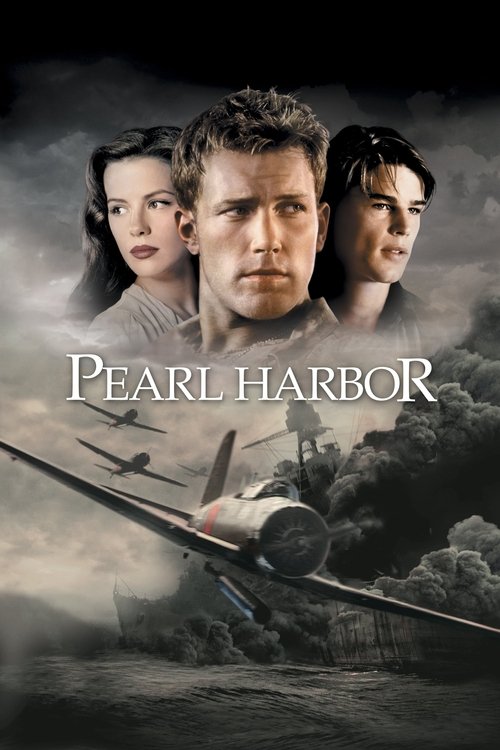
Pearl Harbor
2001 · Directed by Michael Bay
Woke Score
CriticCritic Score
Audience
Ultra Based
Critics rated this 40 points above its woke score. Among Ultra Based films, this critic score ranks #1287 of 1469.
Representation Casting
Score: 15/100
Token casting of Cuba Gooding Jr. in a supporting role without conscious engagement with representation. Predominantly white cast reflects 2001 Hollywood norms rather than any progressive intent.
LGBTQ+ Themes
Score: 0/100
No LGBTQ+ characters, themes, or representation of any kind. Entirely heteronormative narrative structure.
Feminist Agenda
Score: 10/100
Kate Beckinsale's character functions as romantic prize between two male leads. She has conventional agency within traditional Hollywood structure but no feminist consciousness or subversion.
Racial Consciousness
Score: 5/100
No awareness of race as a social construct or historical factor. White-centered narrative that ignores racial dimensions of WWII and the attack itself.
Climate Crusade
Score: 0/100
Not applicable. 2001 war film with no environmental themes or climate consciousness.
Eat the Rich
Score: 0/100
No anti-capitalist themes, critique of wealth inequality, or systemic economic analysis. Military industrial complex is not examined.
Body Positivity
Score: 0/100
Standard Hollywood casting practices with no engagement with body diversity or challenge to conventional beauty standards.
Neurodivergence
Score: 0/100
No representation of neurodivergence or engagement with disability and mental health as social categories.
Revisionist History
Score: 5/100
Significant historical liberties taken for dramatic effect, but not in service of progressive historical revisionism or marginalized perspective centering.
Lecture Energy
Score: 0/100
No preachy exposition about social issues or systems of oppression. Film remains purely narrative-driven action spectacle.


Synopsis
The lifelong friendship between Rafe McCawley and Danny Walker is put to the ultimate test when the two ace fighter pilots become entangled in a love triangle with beautiful Naval nurse Evelyn Johnson. But the rivalry between the friends-turned-foes is immediately put on hold when they find themselves at the center of Japan's devastating attack on Pearl Harbor on Dec. 7, 1941.
Consciousness Assessment
Pearl Harbor stands as a monument to pre-consciousness cinema, a Michael Bay spectacle from 2001 when the cultural vocabulary we now use to analyze representation and social themes had not yet calcified into its modern form. The film operates in a register entirely innocent of contemporary progressive sensibilities. Its narrative priorities are love triangle, explosions, and historical pageantry in that order. Kate Beckinsale's Evelyn Johnson exists as a romantic object rather than a character with agency rooted in her own interiority. Cuba Gooding Jr. appears in a supporting capacity that makes no particular statement about racial representation or historical erasure, simply present without comment or consciousness.
The film's approach to history is driven by Hollywood convention rather than revisionist intent. It bends facts toward dramatic effect, but not in service of any particular ideological project. There are no lectures about systemic injustice, no efforts to center marginalized voices in the retelling of Pearl Harbor, no interrogation of American military adventurism or imperial ambition. This is simply a 2001 action film that happens to be set during a historical event. It does not attempt to grapple with the Japanese-American internment that followed the attack, nor does it engage with the war's racial dimensions in any meaningful way.
The film is so thoroughly unconcerned with the markers of modern social consciousness that scoring it feels almost absurd, like applying contemporary wine terminology to a bottle of soda. Pearl Harbor is not offensive by modern standards so much as it is simply indifferent to the entire framework through which we now evaluate cultural products. It is a relic of a different era, when such indifference was the default.
Analysis generated by our Consciousness Algorithm
Critic Reviews
“The film's immense cast and crew, headed by director Michael Bay, writer Randall Wallace and stars Ben Affleck, Josh Hartnett and Kate Beckinsale, blend artistry and technology to create a blockbuster entertainment that has passion, valor and tremendous action.”
“It expertly capitalizes on the emotional associations Americans have with Pearl Harbor and renders the battle scenes with an excellence that goes beyond proficiency and into the realm of art.”
“The cast is engaging, the overall visual effects are tremendous and I found myself fairly swept away for most of the fast-moving, three-hour running time.”
“Littered with low points -- lame comedy, dubious history, fumbling drama and a love story so inept as to make a pacifist long for war.”
Consciousness Markers
Token casting of Cuba Gooding Jr. in a supporting role without conscious engagement with representation. Predominantly white cast reflects 2001 Hollywood norms rather than any progressive intent.
No LGBTQ+ characters, themes, or representation of any kind. Entirely heteronormative narrative structure.
Kate Beckinsale's character functions as romantic prize between two male leads. She has conventional agency within traditional Hollywood structure but no feminist consciousness or subversion.
No awareness of race as a social construct or historical factor. White-centered narrative that ignores racial dimensions of WWII and the attack itself.
Not applicable. 2001 war film with no environmental themes or climate consciousness.
No anti-capitalist themes, critique of wealth inequality, or systemic economic analysis. Military industrial complex is not examined.
Standard Hollywood casting practices with no engagement with body diversity or challenge to conventional beauty standards.
No representation of neurodivergence or engagement with disability and mental health as social categories.
Significant historical liberties taken for dramatic effect, but not in service of progressive historical revisionism or marginalized perspective centering.
No preachy exposition about social issues or systems of oppression. Film remains purely narrative-driven action spectacle.