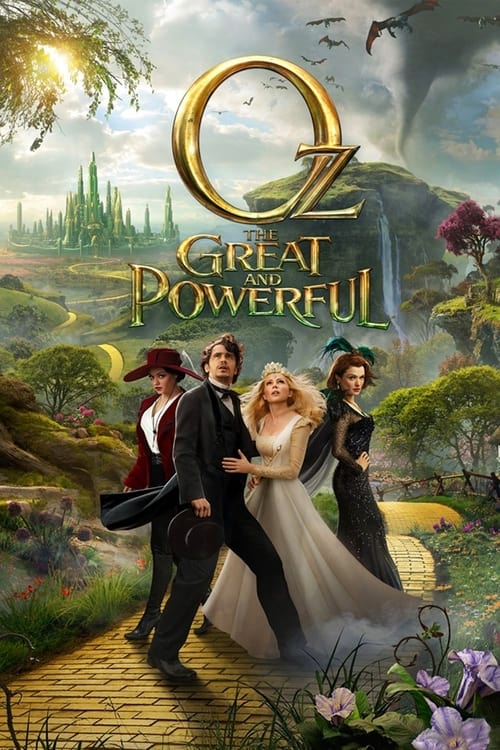
Oz the Great and Powerful
2013 · Directed by Sam Raimi
Woke Score
Critic Score
Audience
Ultra Based
Critics rated this 55 points above its woke score. Among Ultra Based films, this critic score ranks #608 of 833.
Representation Casting
Score: 35/100
The cast includes women and performers of color in secondary roles, but the narrative centers exclusively on a white male protagonist, and female characters are confined to supporting positions without meaningful agency.
LGBTQ+ Themes
Score: 0/100
There is no evidence of LGBTQ+ themes or representation in the film. The romantic plot centers on heterosexual relationships only.
Feminist Agenda
Score: 5/100
The film was explicitly criticized by critics for having regressive ideas about female characters and eroding the feminist elements of the original 1939 film. Female characters are portrayed as manipulative or wicked rather than complex or sympathetic.
Racial Consciousness
Score: 0/100
There is no evidence of racial consciousness or engagement with systemic racial issues. The film is a straightforward fantasy adventure with no thematic engagement with race.
Climate Crusade
Score: 0/100
Climate change or environmental consciousness plays no role in the film's narrative or thematic concerns.
Eat the Rich
Score: 0/100
The film contains no anti-capitalist messaging or critique of economic systems. The plot involves a con-artist protagonist but does not interrogate capitalism itself.
Body Positivity
Score: 0/100
There is no evidence of body positivity messaging or celebration of diverse body types. The film presents conventional beauty standards without commentary or challenge.
Neurodivergence
Score: 0/100
The film contains no representation of or engagement with neurodivergence or neurodivergent characters.
Revisionist History
Score: 0/100
While the film is a prequel to an existing work, it does not engage in revisionist history or reframe historical events. It is a straightforward fictional expansion of a fantasy universe.
Lecture Energy
Score: 0/100
The film contains no didactic messaging about social issues or progressive values. It is conventional narrative entertainment without explicit social commentary.


Synopsis
Oscar Diggs, a small-time circus illusionist and con-artist, is whisked from Kansas to the Land of Oz where the inhabitants assume he's the great wizard of prophecy, there to save Oz from the clutches of evil.
Consciousness Assessment
Sam Raimi's 2013 prequel arrives as a curious artifact of Hollywood's relationship with its own feminist legacy, a film that manages to take one of cinema's most progressive works and systematically drain it of any progressive sensibility. Where the 1939 original offered Dorothy as a resourceful young woman who solved her own problems, this film subordinates its female characters to a male protagonist's journey, rendering them either objects of desire or obstacles to overcome. The three witches, particularly Mila Kunis and Rachel Weisz, embody a tired dynamic in which female power is inherently suspect, their ambitions read as wickedness and their agency as manipulation. One might charitably note that this was 2013, not 2023, yet the film still managed to be retrograde even by the standards of its own moment.
The film's casting offers surface-level diversity through its ensemble, yet the narrative structure itself functions as a corrective to any notion that women might deserve central agency in their own story. The female characters exist primarily to validate or challenge the male lead's arc, their motivations consistently subordinated to his education in humility and authenticity. There is no meaningful engagement with identity politics, no consideration of the institutional systems that might oppress these characters, no examination of anything beyond the romantic and political machinations of the witch trio. The film is, in essence, a perfectly conventional piece of mainstream entertainment that happened to arrive in a cultural moment when such conventionality was increasingly difficult to defend.
Where the film does operate is in its unexamined assumption that maleness equals universality and that a male protagonist's perspective requires no justification or interrogation. This is not progressive cinema, nor was it particularly progressive for 2013. It is the sound of Hollywood choosing not to hear the conversations happening around it, a choice that registers not as boldness but as a kind of determined indifference.
Analysis generated by our Consciousness Algorithm
Critic Reviews
“If there are post-Harry Potter children who don't know or care about The Wizard of Oz, they might be at sea with this story about a not-very-nice grownup in a magic land, but long-term Oz watchers will be enchanted and enthralled. There's even a musical number, albeit an abbreviated one. Mila Kunis gets a gold star for excellence in bewitchery and Sam Raimi can settle securely behind the curtain as a mature master of illusion.”
“Raimi manages to keep things engaging, which is a very real act of wizardry in and of itself.”
“The cast, plainly packed with second or third choices, lets it down. Is there anything in James Franco's past that suggests larger-than-life, a fast-talking, womanizing con-man? And the three witches – Theodora, Evanora and Glinda – are Bland, Blander and Blond Bland.”
“Nothing in it comes close to the magic, the originality or the everlasting entertainment value of the original, which only cost $2.777 million and didn't use a single computer-generated graphic. This says more about how much better movies were in 1939 than they are today. Still, I had enough fun to predict that history (or at least a tiny piece of it) seems destined to repeat itself.”
“Most of the time, though, it's a confusing mishmash featuring a fine actor too willfully operating outside his comfort zone.”
“That's why the more you like the Judy Garland film, the more you might appreciate Oz the Great and Powerful. Appreciate. Enjoy. Admire. Be glad to see. Have fun with ... But as for love - well, love will be harder to come by.”
Consciousness Markers
The cast includes women and performers of color in secondary roles, but the narrative centers exclusively on a white male protagonist, and female characters are confined to supporting positions without meaningful agency.
There is no evidence of LGBTQ+ themes or representation in the film. The romantic plot centers on heterosexual relationships only.
The film was explicitly criticized by critics for having regressive ideas about female characters and eroding the feminist elements of the original 1939 film. Female characters are portrayed as manipulative or wicked rather than complex or sympathetic.
There is no evidence of racial consciousness or engagement with systemic racial issues. The film is a straightforward fantasy adventure with no thematic engagement with race.
Climate change or environmental consciousness plays no role in the film's narrative or thematic concerns.
The film contains no anti-capitalist messaging or critique of economic systems. The plot involves a con-artist protagonist but does not interrogate capitalism itself.
There is no evidence of body positivity messaging or celebration of diverse body types. The film presents conventional beauty standards without commentary or challenge.
The film contains no representation of or engagement with neurodivergence or neurodivergent characters.
While the film is a prequel to an existing work, it does not engage in revisionist history or reframe historical events. It is a straightforward fictional expansion of a fantasy universe.
The film contains no didactic messaging about social issues or progressive values. It is conventional narrative entertainment without explicit social commentary.