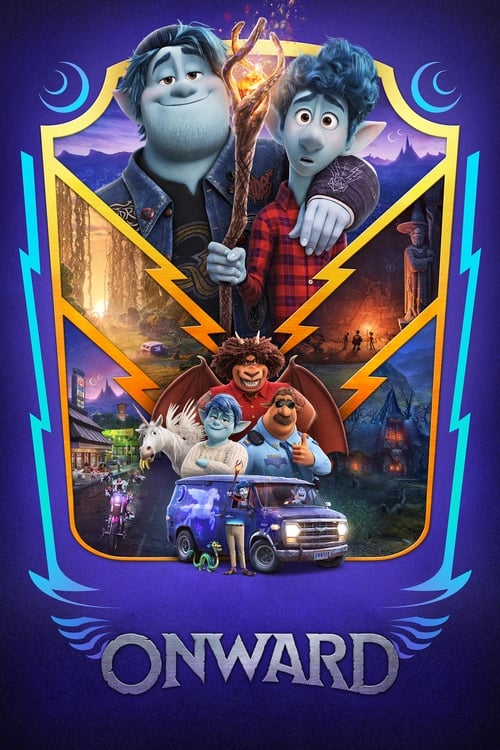
Onward
2020 · Directed by Dan Scanlon
Woke Score
CriticCritic Score
Audience
Woke-Adjacent
Critics rated this 19 points above its woke score. Among Woke-Adjacent films, this critic score ranks #112 of 151.
Representation Casting
Score: 65/100
The cast includes Octavia Spencer, Lena Waithe, and Ali Wong in voice roles, with a reasonably diverse ensemble. However, the main characters are voiced by white male actors (Holland, Pratt), limiting the impact of overall diversity.
LGBTQ+ Themes
Score: 45/100
Officer Specter is presented as an openly lesbian character, a significant historical first for Disney animation. However, she appears only briefly and her sexuality is mentioned casually rather than being central to her characterization or the narrative.
Feminist Agenda
Score: 35/100
The film features Julia Louis-Dreyfus as the mother and a centaur love interest, but the narrative centers on the male brothers' journey. Female characters are largely supportive rather than driving the central quest or themes.
Racial Consciousness
Score: 25/100
While the cast includes actors of color, the film does not engage with racial themes or consciousness. The suburban fantasy world does not address or explore racial dynamics in any meaningful way.
Climate Crusade
Score: 0/100
No meaningful climate consciousness or environmental themes appear in the film. The suburban fantasy setting does not incorporate climate activism or ecological awareness.
Eat the Rich
Score: 20/100
The film portrays a working-class family struggling after the father's death, but it does not critique capitalism or systemic inequality. The narrative focuses on personal relationships rather than economic critique.
Body Positivity
Score: 15/100
The film features diverse body types among the fantasy creatures, but this reflects the magical world's variety rather than any deliberate body positivity messaging. No commentary on body standards is present.
Neurodivergence
Score: 10/100
The characters do not explicitly display neurodivergent traits or engage with disability representation. The film does not address neurodivergence as a thematic element.
Revisionist History
Score: 30/100
The film presents a fantasy world where magic has faded, offering a nostalgic rather than revisionist view of history. There is no reframing of actual historical events through a progressive lens.
Lecture Energy
Score: 25/100
The film maintains a light, adventurous tone without heavy-handed moralizing. While themes about family and loss are present, the film does not lecture audiences or pause to explain its values.


Synopsis
In a suburban fantasy world, two teenage elf brothers embark on an extraordinary quest to discover if there is still a little magic left out there.
Consciousness Assessment
Onward represents the peculiar moment when a major studio animation house attempts to acknowledge contemporary social consciousness without allowing it to disrupt the fundamental mechanics of family entertainment. Officer Specter's appearance as an openly lesbian character marked a threshold, a ceremonial first that satisfied a checkbox while occupying perhaps ninety seconds of screen time. One observes this with the detachment of a museum curator cataloging an artifact of cultural transition, a moment when representation became a matter of explicit record-keeping.
The film's actual thematic content concerns itself with loss, brotherhood, and the discovery that magic persists in human connection rather than supernatural forces. These are perfectly serviceable emotional cores for a children's film, but they exist in a register entirely separate from the cultural markers we have learned to recognize. The working-class suburban setting and the fractured family structure could have generated commentary on economic precarity or systemic disadvantage, yet the film chooses instead to treat these circumstances as mere backdrop, a staging ground for a personal journey. It is content to mourn what has been lost without questioning why or who bears responsibility.
The voice cast demonstrates a clear attempt at diversity, yet the architectural weight of the narrative rests entirely on the shoulders of Tom Holland and Chris Pratt, two white male leads whose brotherhood forms the emotional spine of the entire enterprise. The supporting characters, including Julia Louis-Dreyfus and Octavia Spencer, occupy orbits around this central gravitational pull. The film has absorbed the language of contemporary consciousness without fundamentally restructuring its worldview, a piece of entertainment that whispers acknowledgment while proceeding along well-established paths. It is, in short, a film for an audience that wants to feel progressive without requiring that anything particularly challenging occur.
Analysis generated by our Consciousness Algorithm
Critic Reviews
“Pixar returns with a great big power-chord of a movie — heart-pumping, resonant, and positively harmonious.”
“The style and tone of writer-director Dan Scanlon’s movie has elements of DreamWorks’ “Shrek” and “How To Train Your Dragon” mixed with the siblings-with-secrets aspects of Disney’s “Frozen.” But Onward is better for the change-up. That stylistic and narrative departure gives us Pixar’s most heartfelt story in years.”
“You expect excellence from Pixar, and excellence is what they deliver in Onward.”
“When the leads are drawn this terribly thin, and Onward is so hopelessly focused on the dad narrative that it can’t help but ignore its creativity in favor of mawkish afternoon special, the product stinks of a bad Amblin ripoff.”
Consciousness Markers
The cast includes Octavia Spencer, Lena Waithe, and Ali Wong in voice roles, with a reasonably diverse ensemble. However, the main characters are voiced by white male actors (Holland, Pratt), limiting the impact of overall diversity.
Officer Specter is presented as an openly lesbian character, a significant historical first for Disney animation. However, she appears only briefly and her sexuality is mentioned casually rather than being central to her characterization or the narrative.
The film features Julia Louis-Dreyfus as the mother and a centaur love interest, but the narrative centers on the male brothers' journey. Female characters are largely supportive rather than driving the central quest or themes.
While the cast includes actors of color, the film does not engage with racial themes or consciousness. The suburban fantasy world does not address or explore racial dynamics in any meaningful way.
No meaningful climate consciousness or environmental themes appear in the film. The suburban fantasy setting does not incorporate climate activism or ecological awareness.
The film portrays a working-class family struggling after the father's death, but it does not critique capitalism or systemic inequality. The narrative focuses on personal relationships rather than economic critique.
The film features diverse body types among the fantasy creatures, but this reflects the magical world's variety rather than any deliberate body positivity messaging. No commentary on body standards is present.
The characters do not explicitly display neurodivergent traits or engage with disability representation. The film does not address neurodivergence as a thematic element.
The film presents a fantasy world where magic has faded, offering a nostalgic rather than revisionist view of history. There is no reframing of actual historical events through a progressive lens.
The film maintains a light, adventurous tone without heavy-handed moralizing. While themes about family and loss are present, the film does not lecture audiences or pause to explain its values.