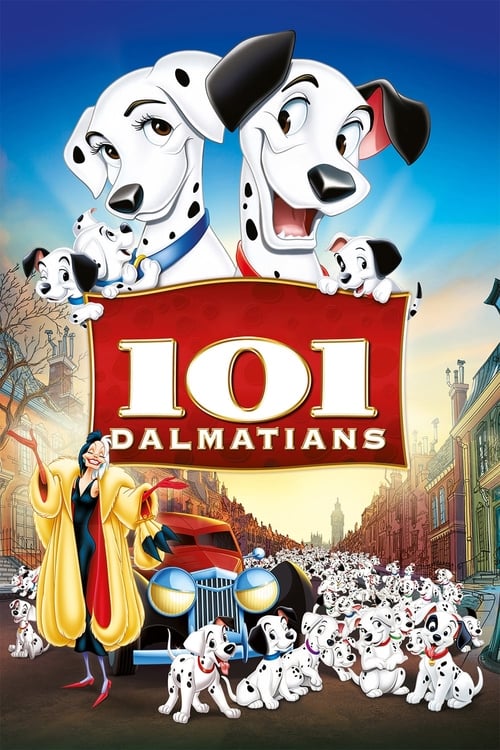
One Hundred and One Dalmatians
1961 · Directed by Wolfgang Reitherman
Woke Score
CriticCritic Score
Ultra Based
Critics rated this 85 points above its woke score. Among Ultra Based films, this critic score ranks #207 of 1469.
Representation Casting
Score: 0/100
The voice cast is entirely white and predominantly male. No characters of color appear in the film, and the human world depicted is racially homogeneous.
LGBTQ+ Themes
Score: 0/100
There are no LGBTQ+ themes, characters, or subtext in the film. The narrative centers on heterosexual marriage and family reproduction.
Feminist Agenda
Score: 5/100
While Cruella De Vil is a powerful female character, she is portrayed as a villain motivated by personal greed rather than as any commentary on gender dynamics or female agency. The female characters are largely passive within the narrative.
Racial Consciousness
Score: 0/100
The film contains no racial consciousness whatsoever. All characters are white, and the film makes no attempt to engage with race as a topic or to include diverse representation.
Climate Crusade
Score: 0/100
Climate change and environmental consciousness are entirely absent from the film. The fur coat plot point is motivated by fashion obsession, not environmental critique.
Eat the Rich
Score: 0/100
The wealthy protagonists are presented sympathetically without any critique of their class position. Cruella's villainy is personal greed, not systemic class commentary.
Body Positivity
Score: 0/100
Body positivity is not a consideration in the film. Character design reflects conventional aesthetic standards of the era with no commentary on body diversity.
Neurodivergence
Score: 0/100
Neurodivergence is entirely absent from the film. No characters are coded as neurodivergent, and the concept is not engaged with in any form.
Revisionist History
Score: 0/100
The film contains no historical revisionism as it is a fantasy adventure set in a contemporary (for 1961) London without historical pretensions.
Lecture Energy
Score: 0/100
The film contains no preachy messaging or lecture-like exposition about social issues. It is purely an entertainment narrative without pedagogical intent regarding cultural matters.


Synopsis
When a litter of dalmatian puppies are abducted by the minions of Cruella De Vil, the parents must find them before she uses them for a diabolical fashion statement.
Consciousness Assessment
One Hundred and One Dalmatians stands as a monument to pre-consciousness cinema, a film so thoroughly uninterested in progressive cultural awareness that it barely registers on our instruments of measurement. The voice cast is uniformly white and British, the human characters exist in a state of complete racial and ethnic homogeneity that would never pass unexamined in contemporary animation. The narrative concerns itself entirely with protecting property (dalmatian puppies) from a wealthy woman's fashion obsession, a setup that contains no interrogation of class dynamics, animal welfare beyond the sentimental, or any other marker of social consciousness. Cruella De Vil, despite being a memorable villain, is not presented as a commentary on anything beyond her individual villainy. She is motivated by personal greed and eccentricity, not systemic forces or ideological positions. The film presents marriage and traditional family structures as unambiguous goods, the wealthy Roger and Anita De Dear as sympathetic protagonists whose affluence is never questioned. There is no indication that the filmmakers considered, much less grappled with, any of the social dimensions that now preoccupy contemporary entertainment. This is not criticism. It is simply observation. The film operates entirely outside the framework of modern cultural self-consciousness. It is a children's adventure from an era when such considerations barely existed in commercial animation.
Analysis generated by our Consciousness Algorithm
Critic Reviews
“This is flat-out one of Disney's finest achievements, because puppies.”
“However much the film breaks with Disney tradition, it's still a winning effort that mixes cuteness with dry wit in the service of a fast-paced, emotionally charged adventure tale.”
“This loveable romp evokes a gloomy, starlit London of Georgian streets and quietly grand parks.”
“Among the many contributions of Disney and his team to the cinema, this is perhaps the strangest: they have made us watch with heart in mouth the adventures of beings who exist only as the projection of photographs and colored drawings.”
Consciousness Markers
The voice cast is entirely white and predominantly male. No characters of color appear in the film, and the human world depicted is racially homogeneous.
There are no LGBTQ+ themes, characters, or subtext in the film. The narrative centers on heterosexual marriage and family reproduction.
While Cruella De Vil is a powerful female character, she is portrayed as a villain motivated by personal greed rather than as any commentary on gender dynamics or female agency. The female characters are largely passive within the narrative.
The film contains no racial consciousness whatsoever. All characters are white, and the film makes no attempt to engage with race as a topic or to include diverse representation.
Climate change and environmental consciousness are entirely absent from the film. The fur coat plot point is motivated by fashion obsession, not environmental critique.
The wealthy protagonists are presented sympathetically without any critique of their class position. Cruella's villainy is personal greed, not systemic class commentary.
Body positivity is not a consideration in the film. Character design reflects conventional aesthetic standards of the era with no commentary on body diversity.
Neurodivergence is entirely absent from the film. No characters are coded as neurodivergent, and the concept is not engaged with in any form.
The film contains no historical revisionism as it is a fantasy adventure set in a contemporary (for 1961) London without historical pretensions.
The film contains no preachy messaging or lecture-like exposition about social issues. It is purely an entertainment narrative without pedagogical intent regarding cultural matters.