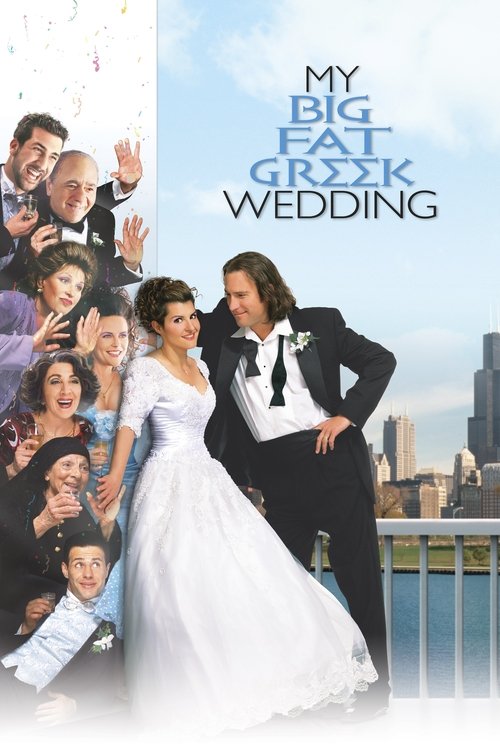
My Big Fat Greek Wedding
2002 · Directed by Joel Zwick
Woke Score
CriticCritic Score
Audience
Ultra Based
Critics rated this 44 points above its woke score. Among Ultra Based films, this critic score ranks #846 of 1469.
Representation Casting
Score: 45/100
Greek-American characters occupy leading and substantial supporting roles, with the film centered on an ethnic minority family. However, this is representation through inclusion rather than through progressive consciousness.
LGBTQ+ Themes
Score: 0/100
No LGBTQ representation or themes present in the film.
Feminist Agenda
Score: 25/100
Female protagonist drives the narrative, but the central arc involves winning male romantic approval and family acceptance through marriage, reinforcing traditional relationship hierarchies.
Racial Consciousness
Score: 20/100
While the film celebrates Greek cultural specificity, it does not interrogate racial dynamics, systemic inequality, or colonial histories. Cultural celebration without critical consciousness does not constitute racial consciousness.
Climate Crusade
Score: 0/100
No climate themes or environmental consciousness present.
Eat the Rich
Score: 0/100
No anti-capitalist themes or critique of wealth and class structures present.
Body Positivity
Score: 15/100
The protagonist is presented as unmarketable and undesirable before her transformation, suggesting that body acceptance remains conditional on male approval rather than intrinsic worth.
Neurodivergence
Score: 0/100
No representation of or engagement with neurodivergence.
Revisionist History
Score: 0/100
No revisionist historical claims or reinterpretation of history present.
Lecture Energy
Score: 5/100
The film is entertainment-focused with minimal preachy intent. Any progressive themes emerge organically from the story rather than being foregrounded as lessons.


Synopsis
A young Greek woman falls in love with a non-Greek and struggles to get her family to accept him while she comes to terms with her heritage and cultural identity.
Consciousness Assessment
My Big Fat Greek Wedding arrives from the early 2000s as a film that, by the standards of its era, had some interest in ethnic representation and female perspective, yet remains fundamentally untouched by the cultural anxieties that would define progressive cinema in subsequent decades. The film centers Greek-American family life with genuine specificity and affection, allowing extended Greek family members substantial screen time and comedic agency rather than relegating them to supporting roles. Nia Vardalos anchors the narrative as its female protagonist, giving her the central position and romantic authority typically reserved for male leads in comedies of this vintage. These elements, which were moderately progressive for 2002, do not constitute modern progressive sensibility so much as they constitute basic competent filmmaking that happened to include minority perspectives.
What the film conspicuously lacks is any engagement with the specific markers of 2020s cultural consciousness. There is no LGBTQ representation, no examination of systemic inequality, no climate themes, no body positivity discourse, no neurodivergent representation treated as such, and no preachy lecture energy. The narrative structure remains entirely conventional: a young woman gains self-worth primarily through securing romantic validation from a man, and her family crisis resolves through traditional marriage. The film traffics in charming ethnic stereotypes rather than interrogating them. Its feminism, if one can call it that, extends to allowing a woman to be the protagonist of her own romantic story, which is a low bar even for 2002.
This is essentially a well-crafted entertainment product that happened to include Greek-American characters in a leading capacity. To score it highly on measures of modern progressive sensibility would be to confuse basic representation with ideological commitment. The film exists in a pre-woke universe, and we must score it accordingly.
Analysis generated by our Consciousness Algorithm
Critic Reviews
“Like Vardalos and Corbett, who play their roles with vibrant charm, the film, directed by Joel Zwick, is heartfelt and hilarious in ways you can't fake. It's a keeper.”
“It's not art, this movie. But it's much more amusing than you'd expect.”
“The wedding, which turns the very concept of ''Greek'' into the sort of hideous, pandering clichés that look rejected from bad Jewish and Italian sitcoms.”
Consciousness Markers
Greek-American characters occupy leading and substantial supporting roles, with the film centered on an ethnic minority family. However, this is representation through inclusion rather than through progressive consciousness.
No LGBTQ representation or themes present in the film.
Female protagonist drives the narrative, but the central arc involves winning male romantic approval and family acceptance through marriage, reinforcing traditional relationship hierarchies.
While the film celebrates Greek cultural specificity, it does not interrogate racial dynamics, systemic inequality, or colonial histories. Cultural celebration without critical consciousness does not constitute racial consciousness.
No climate themes or environmental consciousness present.
No anti-capitalist themes or critique of wealth and class structures present.
The protagonist is presented as unmarketable and undesirable before her transformation, suggesting that body acceptance remains conditional on male approval rather than intrinsic worth.
No representation of or engagement with neurodivergence.
No revisionist historical claims or reinterpretation of history present.
The film is entertainment-focused with minimal preachy intent. Any progressive themes emerge organically from the story rather than being foregrounded as lessons.