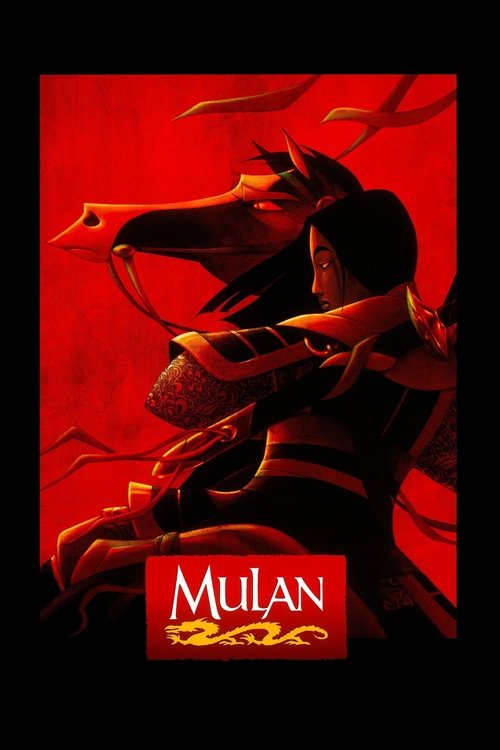
Mulan
1998 · Directed by Tony Bancroft
Woke Score
CriticCritic Score
Audience
Woke-Adjacent
Critics rated this 30 points above its woke score. Among Woke-Adjacent films, this critic score ranks #75 of 151.
Representation Casting
Score: 72/100
The film features predominantly Asian voice cast for Asian characters, which was notable for 1998. However, the lead character is voiced by Ming-Na Wen, a Chinese-American actress, and the comedic sidekick Mushu is voiced by Eddie Murphy, a Black American actor, representing a form of cultural cross-casting that was standard Disney practice.
LGBTQ+ Themes
Score: 0/100
No LGBTQ+ themes or representation present in the film. The romantic subplot follows heterosexual conventions without subtext or ambiguity.
Feminist Agenda
Score: 58/100
The film centers a female protagonist who defies gender expectations by disguising herself as a man to fight. However, this is framed as an individual exception rather than a systemic critique. The resolution ultimately affirms traditional feminine presentation and romantic fulfillment.
Racial Consciousness
Score: 35/100
While the film celebrates Chinese culture through its setting and mythology, it presents a somewhat sanitized and Americanized version of Imperial China. The Huns are depicted as mindless invaders with no cultural complexity, functioning primarily as generic villains rather than explored as a distinct people.
Climate Crusade
Score: 0/100
No climate or environmental themes appear in the film. The natural world serves as backdrop rather than subject of moral or political concern.
Eat the Rich
Score: 0/100
The film contains no critique of capitalism or class systems. It operates within a pre-modern imperial framework without interrogating economic structures or power distribution.
Body Positivity
Score: 0/100
The film does not engage with body positivity messaging. Characters conform to conventional animated beauty standards, and Mulan's physical transformation and beauty are presented as desirable aspects of her character arc.
Neurodivergence
Score: 0/100
No representation of neurodivergence or disability is present. Mulan's father is portrayed as physically weak and in need of protection, but his condition is not explored with nuance or as a form of neurodivergence.
Revisionist History
Score: 25/100
The film takes considerable liberties with the historical legend of Hua Mulan, adding fictional elements like the Huns invasion narrative. However, this is more fantastical adaptation than ideological revisionism of historical events to serve modern political narratives.
Lecture Energy
Score: 28/100
While the film contains some messages about self-discovery and breaking gender norms, these emerge organically through the narrative rather than as heavy-handed sermonizing. The tone remains light and entertainment-focused without preachy lectures on social issues.


Synopsis
When Imperial China calls one man from every family to defend the empire from invading Huns, a young woman disguises herself as a soldier to take her ailing father's place. Facing ruthless invaders, brutal training, and the risk of execution if discovered, she must decide who she truly is— and what she's willing to fight for.
Consciousness Assessment
Mulan occupies an interesting position in the genealogy of family entertainment: it is a film that traffics in progressive symbolism without fully committing to progressive analysis. The central conceit—a young woman must disguise herself as a man to participate in military service—presents gender as an obstacle to overcome through deception rather than a system to interrogate. We are meant to admire Mulan's courage and determination, which are genuine virtues, but the film resolves her journey by affirming that she can be both a warrior and conventionally feminine, a compromise that speaks more to 1990s Disney sensibilities than to any coherent political philosophy.
The film's treatment of Asian representation deserves acknowledgment and qualification in equal measure. The casting of Ming-Na Wen as the voice of Mulan, alongside veteran Asian American actors such as BD Wong, James Hong, and Pat Morita, represented a deliberate choice to center Asian voices in an Asian-inspired narrative. This stood in meaningful contrast to the whitewashing practices that had defined Hollywood for decades. Yet the script itself presents a somewhat sanitized version of Chinese culture, filtered through American comedy sensibilities. Eddie Murphy's Mushu, a comedic dragon sidekick, functions as a familiar Disney mechanism for reaching a mainstream audience, which is to say it functions as a concession to the assumption that Asian-centered storytelling cannot sustain box office success without American cultural mediation.
The film's broader ideological content remains modest. It does not interrogate power structures, economic systems, or the nature of military service. Its feminism, such as it is, amounts to the proposition that women can excel in traditionally male domains if they are sufficiently determined and possess the right spirit. This is individualism dressed in the costume of social progress. For a 1998 animated feature, Mulan was reasonably ambitious in its thematic scope, but measured against the standards of contemporary progressive cinema, it reads as a preliminary sketch rather than a fully realized work of cultural consciousness.
Analysis generated by our Consciousness Algorithm
Critic Reviews
“The payoff is a consistently rich piece with impressive visual vitality.”
“It's the characterization of Mulan, both in voice and visuals, that makes the film a keeper.”
“Gorgeously animated and stirringly told, Disney's Mulan is a timeless story that will delight kids and divert adults with its sweeping scope, emotional intimacy and screwball humor.”
“A film that not only breaks the cross-dressing barrier but also ratchets up the violence level for children's animation. ”
Consciousness Markers
The film features predominantly Asian voice cast for Asian characters, which was notable for 1998. However, the lead character is voiced by Ming-Na Wen, a Chinese-American actress, and the comedic sidekick Mushu is voiced by Eddie Murphy, a Black American actor, representing a form of cultural cross-casting that was standard Disney practice.
No LGBTQ+ themes or representation present in the film. The romantic subplot follows heterosexual conventions without subtext or ambiguity.
The film centers a female protagonist who defies gender expectations by disguising herself as a man to fight. However, this is framed as an individual exception rather than a systemic critique. The resolution ultimately affirms traditional feminine presentation and romantic fulfillment.
While the film celebrates Chinese culture through its setting and mythology, it presents a somewhat sanitized and Americanized version of Imperial China. The Huns are depicted as mindless invaders with no cultural complexity, functioning primarily as generic villains rather than explored as a distinct people.
No climate or environmental themes appear in the film. The natural world serves as backdrop rather than subject of moral or political concern.
The film contains no critique of capitalism or class systems. It operates within a pre-modern imperial framework without interrogating economic structures or power distribution.
The film does not engage with body positivity messaging. Characters conform to conventional animated beauty standards, and Mulan's physical transformation and beauty are presented as desirable aspects of her character arc.
No representation of neurodivergence or disability is present. Mulan's father is portrayed as physically weak and in need of protection, but his condition is not explored with nuance or as a form of neurodivergence.
The film takes considerable liberties with the historical legend of Hua Mulan, adding fictional elements like the Huns invasion narrative. However, this is more fantastical adaptation than ideological revisionism of historical events to serve modern political narratives.
While the film contains some messages about self-discovery and breaking gender norms, these emerge organically through the narrative rather than as heavy-handed sermonizing. The tone remains light and entertainment-focused without preachy lectures on social issues.