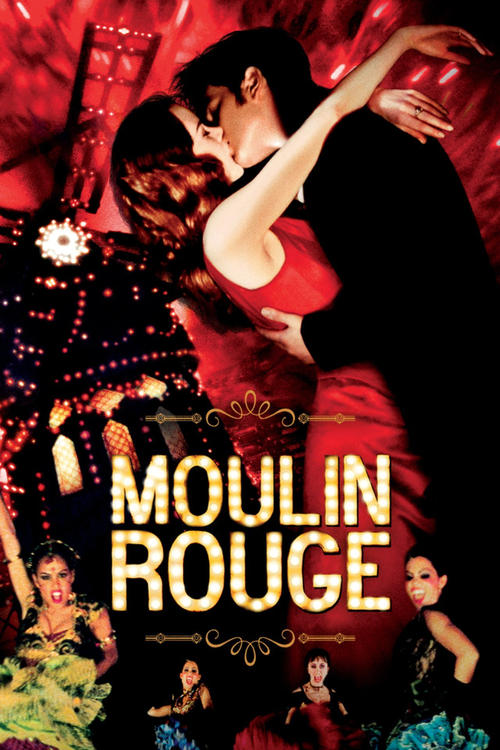
Moulin Rouge!
2001 · Directed by Baz Luhrmann
Based
Consciousness Score: 22%
Representation Casting
Score: 35/100
The cast includes John Leguizamo as Toulouse-Lautrec and a diverse ensemble, though roles are limited and stereotyped. The representation feels more like colorful window-dressing than substantive character work.
LGBTQ+ Themes
Score: 25/100
John Leguizamo's Toulouse-Lautrec is coded as queer but never explicitly addressed. The film treats homosexuality as aesthetic flourish rather than serious representation.
Feminist Agenda
Score: 15/100
While Satine is a complex, ambitious character, the film ultimately frames her primarily through her romantic relationship with Christian and her tragic sacrifice. Her agency is limited by the plot's demands.
Racial Consciousness
Score: 20/100
The film features performers of color in the Moulin Rouge ensemble but does not engage with racial themes or colonial contexts of the Belle Epoque setting.
Climate Crusade
Score: 0/100
No climate-related content or environmental consciousness appears in the film.
Eat the Rich
Score: 10/100
The film romanticizes bohemian poverty and artistic struggle but never critiques capitalist systems. The Duke represents wealth as corrupting but the film offers no systemic analysis.
Body Positivity
Score: 5/100
Nicole Kidman's Satine represents an idealized, conventionally attractive body type. The film celebrates the body primarily through aestheticized spectacle rather than inclusive representation.
Neurodivergence
Score: 0/100
No representation of neurodivergent characters or exploration of neurodivergent themes.
Revisionist History
Score: 10/100
The film takes considerable liberties with historical accuracy but does not engage in revisionist history in the modern social consciousness sense. It simply prioritizes spectacle over historical fidelity.
Lecture Energy
Score: 30/100
The film contains some preachy moments about love, art, and bohemian values, though it favors spectacle and emotion over explicit messaging.


Synopsis
A celebration of love and creative inspiration takes place in the infamous, gaudy and glamorous Parisian nightclub, at the cusp of the 20th century. A young poet, who is plunged into the heady world of Moulin Rouge, begins a passionate affair with the club's most notorious and beautiful star.
Consciousness Assessment
Moulin Rouge arrives as a carefully choreographed fever dream of fin-de-siecle excess, a film so committed to its own visual intoxication that it rarely pauses to consider the social implications of what it depicts. Baz Luhrmann's 2001 romance treats the world of Parisian cabaret not as a site of genuine economic desperation and sexual commodification, but as a glittering playground where bohemians waltz through poverty with theatrical flair. The film's central female character, Satine, possesses agency and ambition, yet the narrative ultimately subordinates her arc to the demands of romantic tragedy, a structure that predates modern progressive consciousness by more than a century and remains unexamined by the film itself.
What cultural consciousness the film does exhibit arrives almost accidentally, as atmospheric detail rather than deliberate engagement. John Leguizamo's Toulouse-Lautrec embodies a queer sensibility that the film aestheticizes without interrogating, treating his sexuality as part of the bohemian texture rather than as a subject worthy of genuine representation. The ensemble of the Moulin Rouge includes performers of color, yet they function primarily as visual elements in Luhrmann's maximalist composition, their presence decorative rather than meaningful. The film's romance with poverty and artistic struggle never extends to any actual critique of the systems that produce such conditions, preferring instead to celebrate the transcendent power of love and spectacle as escape routes from material reality.
The film remains a product of early 2000s sensibilities, concerned with emotional authenticity and visual innovation rather than social consciousness in the modern sense. It is not a bad film for failing to engage with contemporary progressive frameworks, nor is it notably reactionary. It is simply indifferent to such matters, operating in a register where beauty and passion supersede all other considerations. This indifference, paradoxically, may be the film's most honest quality.
Analysis generated by our Consciousness Algorithm
Consciousness Markers
The cast includes John Leguizamo as Toulouse-Lautrec and a diverse ensemble, though roles are limited and stereotyped. The representation feels more like colorful window-dressing than substantive character work.
John Leguizamo's Toulouse-Lautrec is coded as queer but never explicitly addressed. The film treats homosexuality as aesthetic flourish rather than serious representation.
While Satine is a complex, ambitious character, the film ultimately frames her primarily through her romantic relationship with Christian and her tragic sacrifice. Her agency is limited by the plot's demands.
The film features performers of color in the Moulin Rouge ensemble but does not engage with racial themes or colonial contexts of the Belle Epoque setting.
No climate-related content or environmental consciousness appears in the film.
The film romanticizes bohemian poverty and artistic struggle but never critiques capitalist systems. The Duke represents wealth as corrupting but the film offers no systemic analysis.
Nicole Kidman's Satine represents an idealized, conventionally attractive body type. The film celebrates the body primarily through aestheticized spectacle rather than inclusive representation.
No representation of neurodivergent characters or exploration of neurodivergent themes.
The film takes considerable liberties with historical accuracy but does not engage in revisionist history in the modern social consciousness sense. It simply prioritizes spectacle over historical fidelity.
The film contains some preachy moments about love, art, and bohemian values, though it favors spectacle and emotion over explicit messaging.